The new system is the first of its kind to offer 5G wireless measurements with the precision
Mobile devices such as cell phonesConsumer Wi-Fi devices and public safety radios currently operate primarily at electromagnetic frequencies below 3 gigahertz (GHz) with antennas that emit radiation equally in all directions. Experts predict that 5G technologies can boost data rates a thousandfold through the use of higher millimeter-wave frequencies above 24 GHz and highly directional, actively changing antenna patterns. Such active antenna arrays help overcome the loss of these high frequency signals during transmission. 5G systems also send signals simultaneously over multiple paths - called spatial channels - to increase speed and overcome interference.
Many instruments can measure someaspects of the characteristics of directional 5G devices and channels. But most of them are focused on collecting quick snapshots in a limited frequency range to provide an overall view of the channel. In turn SAMURAI provides a detailed "portrait". In addition, many instruments are so large that they can distort the transmission and reception of millimeter-wave signals.
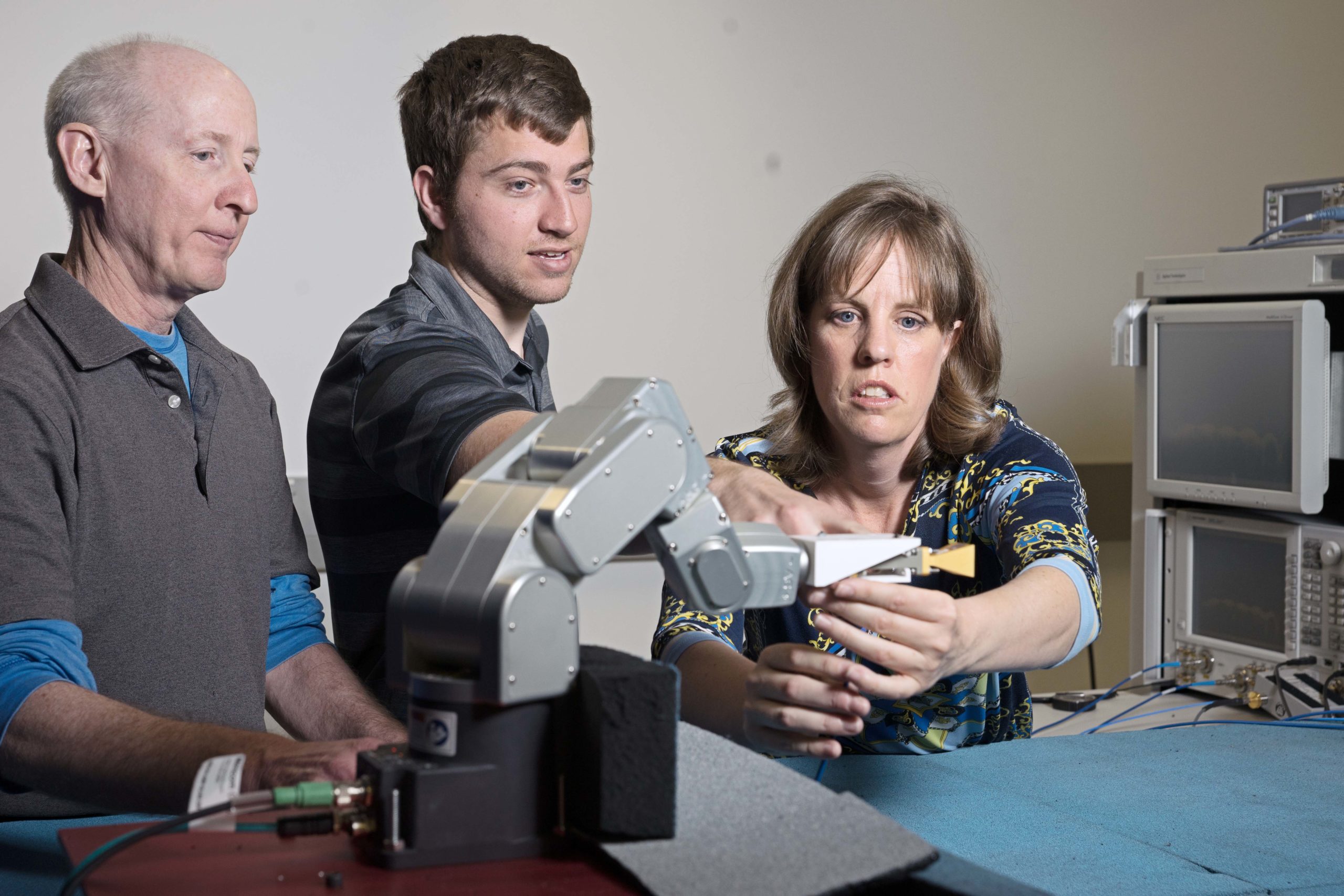 Engineers Rodney Leonhardt, Alec Weiss and JeanneNIST SAMURAI's Quimby, a portable measurement system to support the design and repeatable laboratory testing of 5G wireless devices with unprecedented precision.
Credit: M. Hammer / NIST
SAMURAI is expected, of which the developerstold at the conference on August 7, will help solve many unanswered questions related to the use of active 5G antennas. For example, what happens when high data rates are transmitted over multiple channels simultaneously? The new system will help improve theory, equipment and analysis techniques to provide accurate channel models and efficient networks.
SAMURAI measures signals over a wide rangefrequencies, currently up to 50 GHz, and next year - up to 75 GHz. The system gets its name because it measures received signals at many points on a grid, or virtual “synthetic aperture.”
SAMURAI can be used to solve manytasks ranging from testing the performance of wireless devices with active antennas to measuring reflective channels in environments where metal objects scatter signals.
The main components are two antennas forsignal transmission and reception, precision time-synchronized instrumentation for radio transmission generation and reception analysis, and a six-axis robotic arm that positions the receiving antenna at grid points that form a synthetic aperture. The robot provides accurate and repeatable antenna position and tracks various reception patterns in 3D space, such as cylindrical and hemispherical shapes.
The system is usually attached to an opticaltable measuring 1.5 meters by 4.3 meters. But the equipment is portable enough to be used in mobile field testing and moved to other laboratories.
Read also
The last ice shelf in Canada collapsed into the ocean. He lost 40% in two days
See what Hubble's successor can see in space. Webb telescope overview
Russia has opened flights with a number of countries. How safe is it to fly there?