A prototype device developed by a team from RMIT University in Melbourne, Australia, can electronically
Lead Researcher Professor Madhu Bhaskaransaid the pain sensor prototype was a significant step forward in biomedical technology and next-generation intelligent robotics.
Skin is our largest sensory organbodies with complex functions designed to send rapid alert signals when something hurts. We feel things through our skin all the time, but our response to pain only occurs at a specific moment, such as when we touch something too hot or too sharp. No amount of electronic technology has been able to realistically simulate this very human feeling of pain—until now. Our artificial skin reacts instantly when pressure, heat or cold reaches a painful threshold. This is an important step forward in the future development of the complex feedback systems we need to create truly intelligent prosthetics and intelligent robotics.
Lead researcher, Professor Madhu Bhaskaran
Functional sensor prototypes
In addition to the prototype pain sensor, the research team has also developed devices with stretchable electronics that can sense and respond to changes in temperature and pressure.
Bhaskaran, co-leader of the functional groupmaterials and microsystems at RMIT, said three functional prototypes were developed to electronically transfer key functions of skin sensitivity. With further development, extensible artificial skin may also be a future option for non-invasive skin grafts where the traditional approach is not viable or does not work.
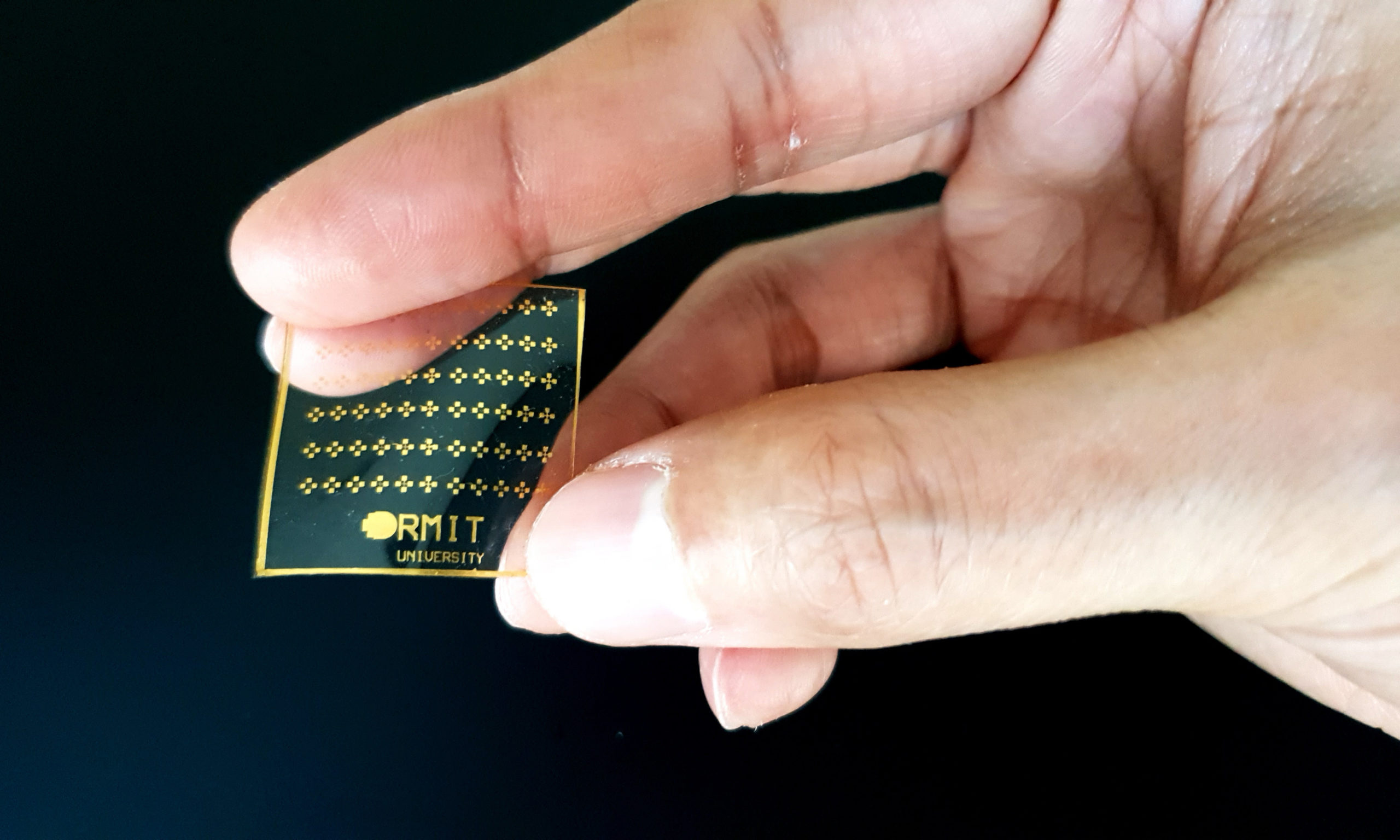 A prototype of a leather sensor device made with stretchable electronics.
Credit: RMIT University
“We need further development to integrate this technology into biomedical applications, but the basics - biocompatibility, skin-like extensibility - are already there,” the scientist said.
How to make e-skin?
The new study, filed as a provisional patent, combines three technologies previously developed and patented by the team:
- Resilient Electronics: Combining oxide materials with biocompatible silicone to create sticker-thick, transparent, shatter-proof and wearable electronics.
- Temperature-reactive coatings: Self-modifying coatings 1000 times thinner than human hair, based on a material that transforms when exposed to heat.
- Brain Mimic Memory: Electronic memory cells that mimic the way the brain uses long-term memory to recall and store previous information.
The prototype pressure sensor combinesexpandable electronics and long-term memory cells, heat sensor integrates thermosetting coatings and memory, and pain sensor integrates all three technologies.
Ataur Rahman, Ph.D., said that memory cells in each prototype are responsible for triggering a response when pressure, heat, or pain reaches a set threshold.
In fact, we created the first electronicsomatosensors that reproduce key features of the body's complex system of neurons, neural pathways, and receptors that govern our perception of sensory stimuli. While some existing technologies have used electrical signals to simulate different levels of pain, these new devices can respond to real mechanical pressure, temperature and pain and provide the correct electronic response. This means that our artificial leather knows the difference between lightly touching a pin with a finger or accidentally pricking it - an important distinction that has never been achieved electronically before.
Ph.D. Ataur Rahman
The study was supported byAustralian Research Council at RMIT's state-of-the-art micronano-nanotechnology research center for micro / nanotechnology and device prototyping.
Read also
The Andromeda halo is approaching our galaxy. We tell you why it is important
Symptoms of coronavirus in children. What you should pay attention to?
It turned out that made the Mayan civilization leave their cities