Why is thermonuclear energy needed?
To prevent global temperatures from rising by more than 1.5

What if there was one energy solution that could solve all of these pressing problems? While this sounds fantastic, it exists.
One of the most powerful forms of energy wewe use today is nuclear energy. Although modern nuclear power is extremely efficient and generates zero carbon emissions, it has many disadvantages, and they are serious: potential nuclear melts and radioactive waste that remain hazardous for thousands of years.
But there is a better way.
What is thermonuclear fusion and how can it be applied on Earth?
All current nuclear reactors operate withusing nuclear fission, the process of splitting atoms to produce energy. For years, scientists have wondered how we can use the reverse process - nuclear fusion, which “powers” the sun by attaching atoms together - to meet the growing energy needs on Earth. Thermonuclear fusion itself is a super-powerful process, several times more powerful than fission, and does not lead to the formation of nuclear waste, since its fuel is not uranium or plutonium, but hydrogen. In fact, if the development of a fusion reactor is successful, scientists will create a “mini-sun” on Earth.
"Achievement of controlled thermonuclear reactions,which consume more energy than is required to generate them and are seen commercially as a potential response to climate change, ”explains science correspondent Nathaniel Gronevold for Scientific American. “Fusion energy will eliminate the need for fossil fuels and solve the discontinuity and reliability issues inherent in renewables. The power will be generated without the dangerous amount of radiation that raises concerns about nuclear fission energy. ”
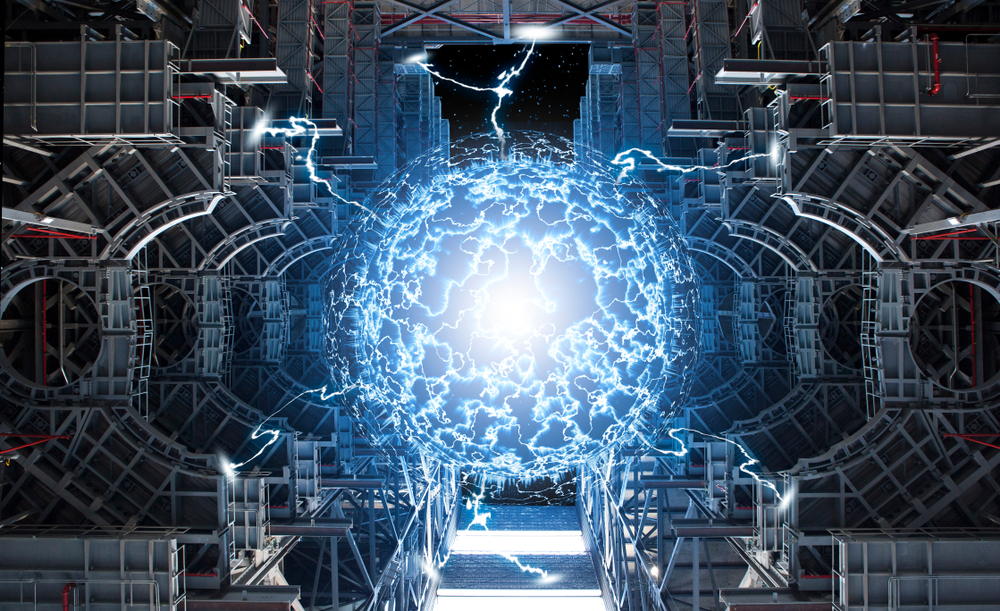
Officials of the International ThermonuclearExperimental Reactor (ITER), a multinational project based in the south of France, announced that they are now just 6.5 years from First Plasma, a historic milestone. The ITER project, supported by a consortium of 35 countries, is now 65% complete, according to a press release this week. The newly installed section - the base of the cryostat and the bottom cylinder - paves the way for the installation of the tokamak, the technological structure chosen to house the powerful magnetic field that would surround the fusion core of the super-hot plasma.
Nuclear fusion problems
Nuclear fusion is so difficult to accomplish due toextreme conditions - for example, in the core of the Sun - that need to be reproduced here on Earth. As explained in the US Department of Energy, "thermonuclear reactions are studied by scientists, but they are difficult to maintain over long periods of time due to the enormous pressure and temperature required to fuse nuclei."
Fusion energy requires the confinement of a very hot plasma under high pressure.For magnetic confinement, very hot – many times hotter than the centerSolar plasmas require strong magnetic fields, which must be 10 times the atmospheric pressure on the Earth's surface.The strength of the magnetic field is a critical parameter in achieving these conditions, as it providesBoth insulation to keep the plasma hot and external pressure to hold it stably – all without physical contact between the plasma and the surface of the material.
Although nuclear fusion producesincredible prospects for solving some of the most difficult problems of the modern world, time is ticking, and many experts say that even if fusion is just around the corner, time is not on our side. While it is hoped that ITER will be launched by 2025 and fully operational by around 2035, this may be too late. Back in 2019, climate experts argued that the 12-year deadline the Intergovernmental Panel gave the world to reverse the planet's changing situation might have to be cut to 18 months. Hans Joachim Schellnhuber of the Potsdam Climate Institute explained it this way a year ago: “The climate mathematics is crystal clear: although the world may not be healed in the next few years, it may be mortally wounded by negligence before 2020.”
However, this week the hopes for clean energy have rekindled.
SPARC project
Scientists developing a compact versionA nuclear fusion reactor has been shown in a series of research papers to work, reviving hopes that the long-elusive goal of imitating the sun's energy production can be achieved and ultimately contribute to the fight against climate change.
Center for Plasma Research and Thermonuclearsynthesis of the Massachusetts Institute of Technology in collaboration with privately-owned startup Commonwealth Fusion Systems (CFS) is developing a conceptual project SPARC. This is a compact high-voltage experiment with pure thermonuclear energy. The SPARC is expected to be the size of existing mid-range fusion devices, but with a much stronger magnetic field. Based on the laws of physics, scientists hope that the device will produce 50-100 MW of thermonuclear power. Such an experiment will be the first demonstration of the creation of clean energy and the possibility of creating a device built using new superconducting technology. SPARC is part of an overall strategy to accelerate fusion development through the use of new high-field, high-temperature superconducting (HTSC) magnets.
 The Sparc fusion power plant will be relatively small, as shown in this image of the reaction chamber.
T. Henderson / CFS / MIT-PSFC
Construction time
It is expected that the construction of the reactor underThe name SPARC, which is being developed by researchers at the Massachusetts Institute of Technology and a subsidiary of Commonwealth Fusion Systems, will begin next spring and will take three or four years, researchers and company officials said.
Although there are still many serious problems,the company said the construction would be followed by trials and, if successful, a power plant that could use fusion energy to generate electricity starting in the next decade.
This ambitious schedule is much faster thanthe world's largest fusion energy project, a multinational project in the south of France called ITER. This reactor has been under construction since 2013, and although it is not designed to generate electricity, it is expected to produce fusion reactions by 2035.
Bob Mumgaard, CEO of CommonwealthFusion, and one of the founders of the company, said the goal of the SPARC project is to develop fusion in time to play a role in mitigating the effects of global warming. “We are focused on getting thermonuclear power as quickly as possible,” he said.
Thermonuclear fusion, in which light atomscoming together at temperatures of tens of millions of degrees to release energy has become a way for the world to cope with the climate change impacts of electricity generation.
Like a conventional nuclear fission power plant, which splits atoms, a fusion plant will not burn fossil fuels and will not produce greenhouse gas emissions.
Project criticism
Despite the ambitions of the project, obstacles in the waythe creation of a machine capable of creating fusion plasma and manipulating a swirling super-hot cloud of atoms that damages or destroys everything it touches are enormous.
Some scientists who have worked on thermonuclear energy for decades say that while they are enthusiastic about Sparc's prospects, the timeline may simply be unrealistic.
“Reading these documents (research papers- approx. ed.) gives me the feeling that the developers will have the controlled thermonuclear thermonuclear plasma that we all dream of, "said Carey Forest, a physicist at the University of Wisconsin who is not involved in the project. However, he is not sure if the project timeline is realistic.
According to Dr. Mumgaard, SPARC will be muchsmaller than an ITER - the size of a tennis court compared to a football field - and much cheaper than an international project, which, according to official estimates, will cost about $ 22 billion, but this figure is not the limit. Commonwealth Fusion, founded in 2018 and with about 100 employees, has raised $ 200 million to date for its project.
Differences between Sparc and ITER
Since they began almost a century agofusion experiments, the prospect of creating a practical fusion device that can produce more energy than it uses has remained elusive.
But, according to the findings of scientists in The Journal of Plasma Physics, the SPARC project will succeed and will produce 10 times more energy than it consumes.
Research “confirms that the project isthe one we work for is likely to work, ”said Martin Greenwald, deputy director of the MIT Center for Plasma Research and Fusion and one of the project's lead scientists. Dr. Greenwald is the founder of Commonwealth Fusion but is not currently affiliated with the company.
SPARC uses the same device type asITER: A tokamak, or donut-shaped chamber within which a fusion reaction takes place. Because the plasma cloud is so hot — hotter than the Sun — it must be held back by magnetic forces.

ITER does this using huge electromagnetic coils containing superconducting wires that must be cooled with liquid helium.
 Model of the ITER fusion reactor (cross-section)
CC BY-SA 2.0 fr
According to Greenwald, SPARC usesthe benefits of a new electromagnetic technology that uses so-called high-temperature superconductors, which can create a much stronger magnetic field. As a result, the plasma is much smaller.
The documents show that “this path with highthe field still looks viable, ”said Dr. Greenwald. "If we can overcome the engineering challenges, this machine will perform as we predict."
Commonwealth Fusion said it will announce the SPARC whereabouts in a few months.
Who else is working on thermonuclear energy and is there any hope?
Commonwealth Fusion is just one of manycompanies working on the development and commercialization of fusion energy in partnership with research institutions, supported by hundreds of millions of dollars in investment.
For example, TAE Technologies, basedin Southern California is working on a design that uses a linear device that shoots two clouds of plasma at each other to produce nuclear fusion.
First Light Fusion, a subsidiary of the University of Oxford in England, uses energy to compress and compress thermonuclear fuel.
Dr Forest said:By using stronger magnetic fields, SPARC can be said to be more "conservative". “This completely sets it apart from all startups, which by definition are more risky,” he emphasizes.
William Dorland, physicist at the University of Maryland andthe editor of The Journal of Plasma Physics, said the journal had asked representatives of some of these fusion projects to "talk about their physical underpinnings." The MIT and Commonwealth Fusion group quickly agreed, he said.
“From my point of view, this is the first of these groups,which has private money, which is actually very clear about what they are doing, ”said Dr. Dorland. - Reasonable people disagree about whether it works. But I'm just happy that they have stepped up and tell us using normal science what is happening, ”he concludes.
In the end, what consequences to expect fromdeveloping a fusion reactor? If technological processes are debugged and controlled, it will save humanity. Clean energy from fusion of atoms instead of fission will at least protect the planet from nuclear waste.
What's the bottom line?
Despite all the danger and complexity of projects ondevelopment of thermonuclear fusion, it does not seem that humanity has any alternatives. The planet's capabilities are limited, unlike human needs. Whether SPARC, ITER or any startup will fulfill their promises, time will tell.
Read also
Scientist has created a paint that can replace expensive solar panels
The CHEOPS mission has found a planet with the harshest conditions in the universe. the main thing
Astronomers have discovered a lunar accelerator from the 60s. He's heading towards Earth