Who is involved in the idea of launching a nuclear reactor into space?
Ideas for developing a nuclear reactor will be
Idaho National Laboratory (INL) is the leading US center for the development of advanced nuclear reactors, including micro reactors and reactors that can operate without water cooling.
Which reactor to launch into space though?
Idaho National Laboratory (INL) is the leading US center for the development of advanced nuclear reactors, including micro reactors and reactors that can operate without water cooling.
Water cooled nuclear reactors make up the vast majority of reactors on Earth.
Small nuclear reactors can provide the power needed for space exploration missions of interest to the federal government.
message from the US Department of Energy.
What is a microreactor?
According to the principle of operation, it similar to hisstandard analogues: the core is cooled due to the circulation of ordinary fresh water. However, in addition to this, it uses gravity and buoyancy to naturally circulate fluid. The new reactor also features increased efficiency and a modern design.
Microreactors have many advantages overcompared to conventional reactors, including significant improvements in energy efficiency, response and yield, safety, reliability, scalability, on-site / on-demand production, and much more accurate process control.
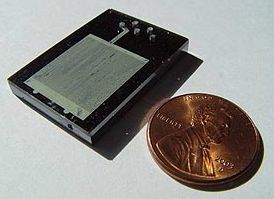 Microreactor technologies developed at Lawrence Livermore National Laboratory (LLNL) use micromachining techniques to reduce reactor design.
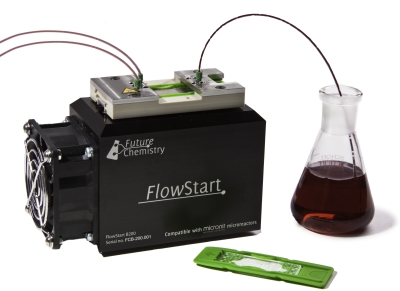 An example of a flow reactor system.
How will the launch preparations go?
The first meeting on it should take place inAugust. The plan, as reported by the Associated Press, consists of two stages. First, the reactor itself will be developed, and then a prototype will be created.
Then it is planned to develop a flight system andlander that could transport a reactor to the Moon. The Energy Department has said multiple linked reactors will likely be needed to meet energy needs on the Moon or Mars. Accordingly, in addition to the reactor itself, it is also planned to create special spacecraft and landers to deliver the reactor to the Earth’s satellite.
The reactor must be able to generateuninterrupted electricity of at least 10 kilowatts. According to the US Energy Information Administration, the average US home uses about 11,000 kilowatt-hours per year.
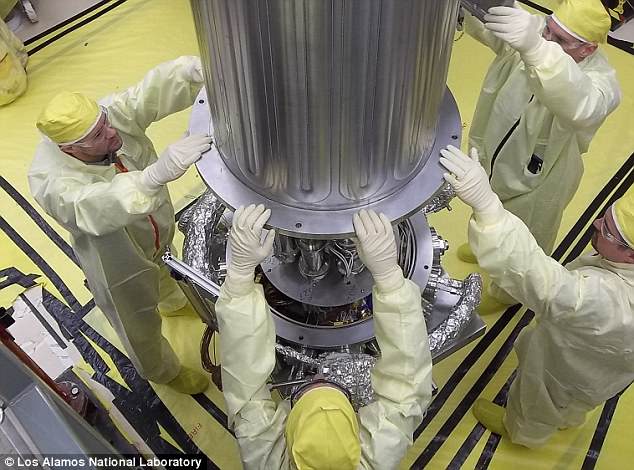 Kilopower Reactor Prototype
 Kilopower uranium-235 kilowatt prototype that was successfully tested in 2017-2018
In addition, the reactor cannot weigh more than 3500 kg, must operate in space, and mostly autonomously and for at least 10 years.
According to ministry representativesenergy, The reactor is designed to support research into the lunar south pole. The specific region on the surface of Mars for exploration has not yet been determined. Officials say operating a nuclear reactor on the Moon would be the first step toward creating a modified version to operate in Martian conditions.
Idaho National Laboratory playsa central role in strengthening the United States' global leadership in nuclear innovation, with the expected demonstration of advanced reactors at the INL site. The prospect of deploying a modern reactor on the lunar surface is as exciting as it is challenging.
John Wagner, Deputy Laboratory Director, INL Center for Nuclear Science and Technology
 Four nuclear reactors on Mars. Source: NASA
The reaction of the scientific community:
But at the same time, in scientificThe community is concerned that such a rapid implementation timeline and technical specifications for the project may indicate that the reactor will use highly enriched uranium, used in nuclear weapons.
Edwin Lyman, director of nuclear safety atThe nonprofit Union of Concerned Scientists says his organization is concerned about the design parameters and timing of the most likely reactors using highly enriched uranium.
This could trigger or start an international space race to create and deploy new types of reactors that require highly enriched uranium.
Edwin Lyman, director of nuclear safety at the nonprofit Union of Concerned Scientists
When is the launch planned?
After a company has been found that will implement the project, it will be given time until 2026. The start is planned for this period.
Nuclear reactor developers interested in entering the competition can contact Aaron Weston for more information at[email protected]... Applications are accepted until September 8, 2020.
Read also:
See what Hubble's successor telescope can see in space
The history of the origin of "strange" meteorites is revealed: they fell to Earth in the 60s
Three asteroids are flying towards Earth, and one of them is potentially dangerous. Is there a threat?