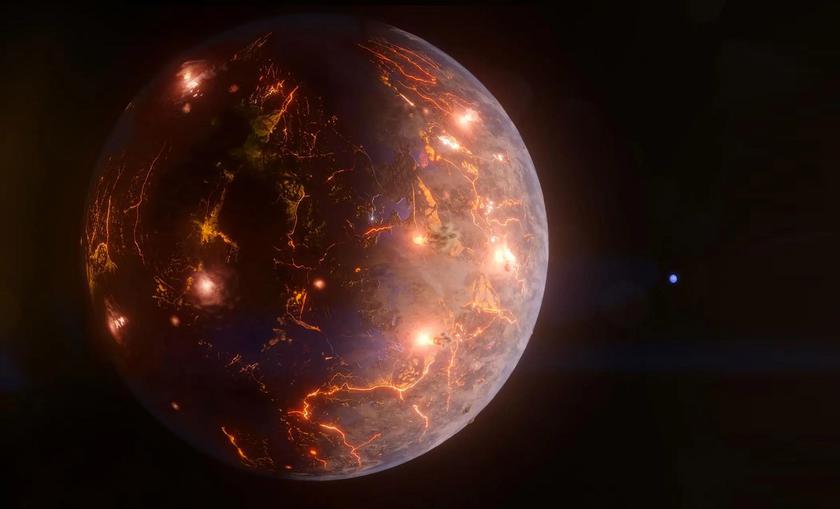
The Transiting Exoplanet Survey Satellite (TESS) and Spitzer space telescopes helped scientists discover a planet on which
What is known
The planet resembles the Earth and is located ona distance of 90 light years from us. It revolves around a red dwarf in the constellation Crater, constantly deforms and is characterized by high volcanic activity.
The deformation and volcanic activity are due to the fact that the more massive planet LP 791-18c is nearby. The same story happens with Io, one of the moons of Jupiter. We have a separate article on this.
LP 791-18d is permanently turned to one sideto your star. In this regard, it is very hot on the "sunny" side of the planet. At the same time, scientists believe that a large volcanic activity can provoke the formation of the atmosphere and the existence of water on the dark side.
The planet under study is on the inner edgehabitation zones. The temperature in this region allows water to exist in a liquid state on the surface. Scientists hope to get more information about LP 791-18d through the James Webb Space Telescope. Permission to use the observatory to study the planet has already been received.