Researchers from Cardiff University borrowed ideas from popular dating apps.
“The human eye is extremely sensitive tosubtle differences in size, shape, color and appearance can be useful in research, explains Dr. Judith Harrison of the Center for Brain Imaging at Cardiff University - Cubric. “Knowing that the majority of people view different images from day to day, for example, when using dating apps, we wondered if the same principle could be applied to filtering brain scans.”
For brain research, scientists make dozensthousands of scans - and not all of them are of high quality. In everyday life, we often take bad photos - when our finger hits the lens or our hands are shaking. The same happens when the patient moves around in the scanning machine. In this case, the picture is also bad, it cannot be used for research. It can take several hours for examiners to review each scanned image and decide if it is of sufficient quality for use in the study.
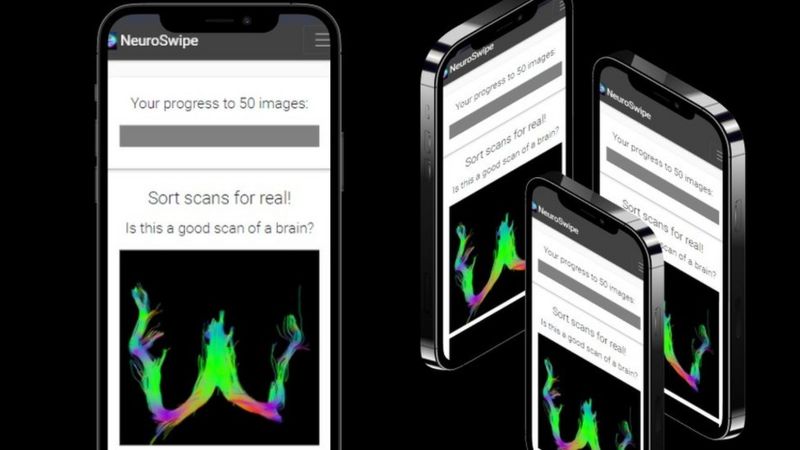
Here the application can come to the rescue,developed by Cardiff University and the National Academy of Software Engineering. Using real-life images of the brains of Alzheimer's patients, the app trains volunteers to recognize the correct shape of the fornix in the scanned image.
 CARDIFF UNIVERSITY
The app is called Neuroswipe and is still under development. So far, the project is only available as a web application.
“In recent years, the process of filtering imagesMostly automated, but teaching an AI-based program to find low-quality scans is difficult, explains Dr. Harrison. "We want to see if volunteers can help us weed out low-quality images and become scientists of their own kind."
Perhaps in the future the application will be used in large-scale studies involving thousands of patients. This way, scientists can quickly analyze large amounts of data.
Read also
On the threatening Earth asteroid Apophis noticed a dangerous phenomenon. What's happening?
Scientists have found out why children are the most dangerous carriers of COVID-19
What the Parker Solar Probe discovered when it flew as close to the Sun as possible