Engineers from the Max Planck Institute for Medical Research and the University of Heidelberg showed how
Traditional 3D printing creates objects layer by layer.layer. This approach requires a relatively large amount of time and is not suitable for all objects and materials. In a study published in the journal Science Advances, engineers used ultrasound to assemble complex 3D objects from components in a single "punch".
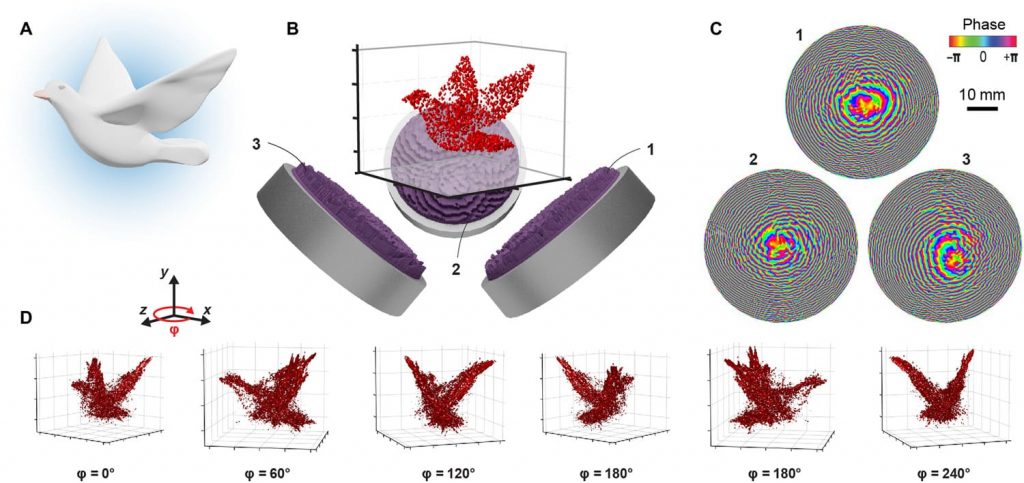 The principle of the technology. Image: Kai Melde et al., Science Advances
The researchers manipulated the ultrasound withacoustic holograms - 3D printed plates that are designed to encode a specific sound field. By adjusting several fields in a given way, they captured particles and cells floating freely in the water and assembled them into the desired shape.
In a test demo, the researchersthree transducers with a frequency of 3.5 MHz and a diameter of 50 mm were used. Arranged in a predetermined order, they acted on the materials from different sides in order to give the finished object a predetermined shape. Engineers have demonstrated that the proposed method works effectively with a variety of materials, including glass or hydrogel beads and biological cells.
Demonstration of the technology. Image: Kai Melde et al., Science Advances
Scientists believe that technology isa promising platform for 3D printing of cell cultures and tissues. The advantage of ultrasound is that it has a gentle effect on biological cells, does not damage them, and can penetrate deep into tissues.
Read more:
Two photos of the Earth with a difference of 50 years were compared at NASA: what scientists found
Mysterious green rays were noticed in the sky over the USA: where did they come from
Scientists transplanted human “brain” into rats and told what happened in the end
On the cover: an artistic illustration of printing with acoustic holograms.