What happened?
On May 21, 2019, gravitational-wave detectors on Earth registered a signal
The ratio of the #GW190412 #blackholes masses is "roughly equal to the ratio of filling in a regular Oreo to in a Mega Stuf Oreo," notes @LIGO & @NorthwesternU's @cplberry "Investigations of connections between Oreos and black hole formation are ongoing." https://t.co/HvSVOUMeLv pic.twitter.com/raRKbpQXP7
— LIGO (@LIGO) April 20, 2020
Usually this event is accompanied by gravitationalwaves. However, this may have been one of those rare occasions when a collision caused an outburst of light. The team using the data from the laser interferometer, the LIGO gravitational-wave observatory and the European detector Virgo confirmed that it was a “flash of light”, which was most likely due to the merging of black holes.
What usually happens in a collision?
Many galaxies have supermassive black holes.at its center, their giant gas disk can attract and combine small black holes. In the past, astronomers could only by indirect signs understand that there was a collision of such massive objects, including the gravitational waves or gas reaction seen by the instruments.
If black holes do not emit light, then why is this happening now?
According to the main working hypothesis put forward by Stern and his colleagues, in 2019 there was a collision inside the accretion disk surrounding the supermassive black hole lying at the center of the quasar — a distant galaxy with a very bright active nucleus. As soon as the smaller black holes collide, the large black hole receivesa pulse that pushes it in a random direction, causing it to collide with the gas in the disk and create aa flash of light.
However, scientists can not yet prove what exactlythe merger led to an outbreak. Astronomer Matthew Graham, who participated in the researchers, warned that they still could not "completely exclude some other versions." But if they can, then this will confirm existing theories and add data on black holes and their behavior.
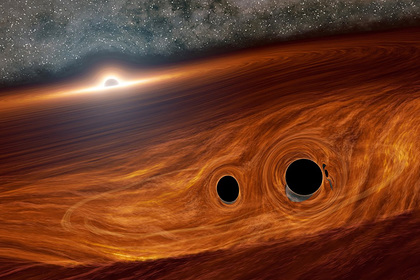 Image: Caltech
Researchers have put forward other theories.as to what could cause a flash of light. However, they consistently ruled out such versions as “eating” a star, a supernova burst, or a supermassive black hole explosion.
The impact and further merging of the two black holes led to the formation of a new celestial body. Its mass is about 100 times higher than the sun.
Will such an event ever happen again?
Astronomers believe that the outbreak will recur in a few years. This will happen because a new object on the way back will cut through the hot gas in the vicinity of the supermassive black hole.
Now scientists continue to analyze the event.
Read also
Look at the sunset in other worlds: how the Sun sets on Mars, Titan and Uranus
Two super-lands were discovered near us: they can find life there
On day 3 of illness, most COVID-19 patients lose their sense of smell and often suffer from a runny nose