Latest tidal disruption of a star by a black hole is the closest ever recorded
It happens when a star passes tooclose to a black hole, and its excessive gravitational pull tears the star into thin streams of material. This process is also called "spaghettification". During it, some of the material falls into the black hole, releasing a bright burst of energy that astronomers can detect.
Tidal disruption is rare and not always easylend themselves to study. The fact is that they are usually hidden by a curtain of dust and debris. An international team of scientists led by the University of Birmingham was able to study this event in unprecedented detail, because it was discovered shortly after the star tore apart.
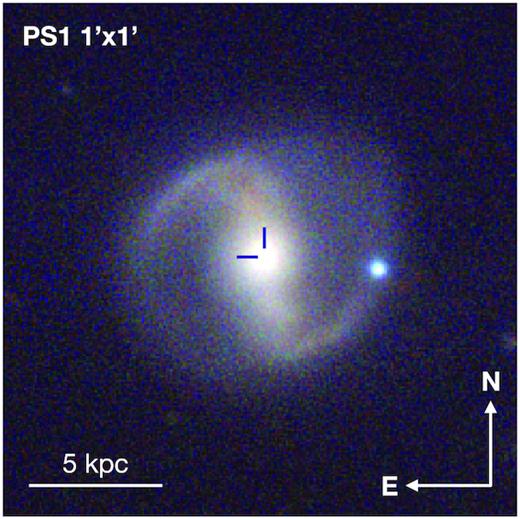 Color image before host destruction AT2019qiz.
Using the very large telescope SouthObservatory (Very Large Telescope) and the New Technology telescope, the global network of telescopes of the Las Cumbres observatory and the Swift satellite of Neil Gerel, the team of scientists was able to observe the flash, dubbed AT2019qiz, for six months, when it became brighter and then disappeared.
"The idea of a black hole" sucking in "the neareststar, sounds like science fiction. But that's exactly what happens during tidal destruction, ”says lead author Dr. Matt Nicholl, a lecturer and fellow at the Royal Astronomical Society at the University of Birmingham. "We were able to study in detail what happens when such a monster eats a star."
“When a black hole engulfs a star, it canlaunch a massive ejection of material outward that obscures our view, ”explains Samantha Oates of the University of Birmingham. "This is because the energy released by the black hole eating stellar material pushes the debris outward."
In the case of AT2019qiz, astronomers were able to identify the phenomenon early enough to observe the entire process.
Fast and extensive observations in ultraviolet,optical, X-ray and radio-light ranges for the first time have revealed a direct connection between matter escaping from a star and a bright flash emitted when it is absorbed by a black hole.
Research helps astronomers understand bettersupermassive black holes and how matter behaves under extreme gravity around them. Scientists argue that AT2019qiz may even become a "Rosetta stone" for interpreting future observations of tidal destruction events. ESO's Extremely Large Telescope (ELT), slated to launch this decade, will allow researchers to unravel new mysteries in the physics of black holes.
Read also
There may be universes in black holes. We tell you about the new discovery
On day 3 of illness, most COVID-19 patients lose their sense of smell and often suffer from a runny nose
Graphene microbubbles made perfect lenses