The mini fertilizer plant is easy to set up and very efficient.Scientists have already conducted tests in
To feed the growing world population - hugeproblem. According to forecasts, in 2030 the planet will be home to 8.6 billion people, and in 2050 - almost 10 billion. Artificial fertilizers, in particular - nitrogen, play a key role in solving this problem.
Nitrogen is one of the three mainmacronutrients used by plants for growth (along with phosphorus and potassium). In 2015, approximately one in two people received food grown using nitrogen fertilizers.
Although artificial fertilizers are widely available inin the developed world, in developing countries they are not so common. In Africa, where 60% of all farmers have less than one hectare of land at their disposal, there is often not enough money for fertilizers to buy these products. In addition, fertilizers are often produced by large multinationals that only ship in bulk.
Leap-Agri Fertilizer Mini-Plantwill come in handy just in this case. Its design includes a small reactor to produce liquid nitrogen fertilizers that any farmer with access to sunlight and water can use.
While the technology behind this is quite state-of-the-art, the application is very low-tech. The system is small, simple, and very fast. Once switched on, it will start producing fertilizer in a matter of seconds. The mini-factory uses plasma technology. Plasma is the fourth state of matter and is made up of ionized atoms and molecules.
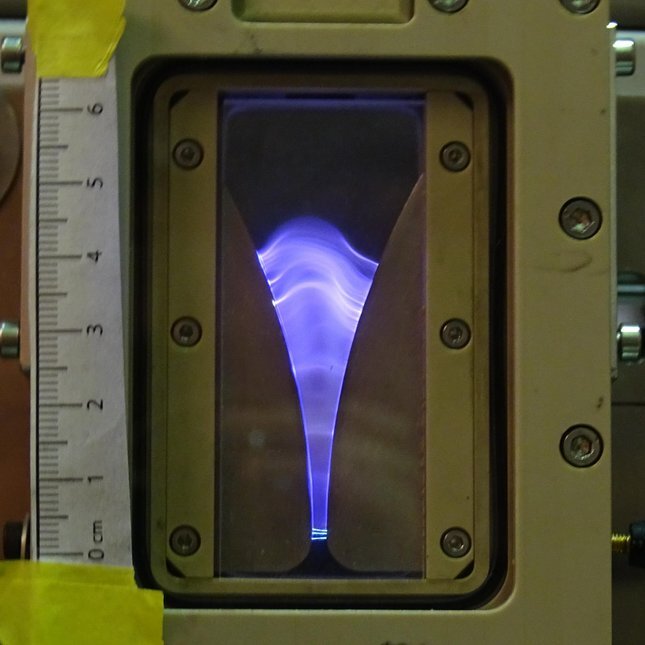 Plasma reactor tested in Uganda. Credit: Eindhoven University of Technology.
Plasma used in a manufacturing plantfertilizer is non-thermal: while the electrons driving the reaction reach extremely high temperatures, the surrounding gas can remain relatively cold. This saves energy.
This makes plasma technology attractivean alternative to the traditional nitrogen production process, the so-called Haber-Bosch process, which requires both high pressure and high temperatures. The Haber-Bosch process is estimated to consume between 1% and 2% of the world's energy, releasing about 300 million tons of carbon dioxide into the air annually.
In the production of nitrogen fertilizers in a plasmaThe reactor uses a process known as nitrogen fixation. Although 78% of the air is N2, this gas does not react with other elements (it is chemically inert). This makes it difficult to use plants. Nitrogen fixation solves this problem. It converts nitrogen (N2) from air to NOx, which in turn reacts with oxygen and water to form nitrate (NO3). It can then be used as an ingredient for liquid fertilizers.
In the case of the Leap Agri mini-plant, the electricity for generating the plasma comes from solar power, a cheap and sustainable source widely available in developing countries.
This process is very efficient:it produces a liquid fertilizer with a high level of nitrates that is easily absorbed by plants. In Uganda, NARO researcher Stella Kabiri conducted an analysis that compared the fertilizer to other fertilizers in the local market. The result showed that the nitrate content was around 20 percent, which is 14, 42 and 51 percentage points higher than solid fertilizers, ammonium nitrate, NPK and urea, respectively.
Liquid fertilizers can be produced locally and on demand, so each farmer can choose exactly the amount of fertilizer and nitrate content they need for their crop and plot of land.
Currently, the cost of the mini-plant is still quite high (around 70,000 euros), but scientists expect the price to drop significantly when it is produced on a large scale.
Read more
The first accurate map of the world was created. What's wrong with everyone else?
What drones are there and when will passenger air taxis appear?
Check out the most beautiful pictures of Hubble. What has the telescope seen in 30 years?