The mystery of the neutron's life
The neutron is one of the building blocks of matter.
But how long it takes for a neutron to "fall apart " remains a mystery. why.
One method measures the measurement gives the resultat 887.7 seconds, give or take 2.2 seconds.
Another method shows 878.5 seconds, plus or minus 0.8 seconds.
Here they are, those same nine seconds that confuse scientists.
At first it seemed that this difference was due tomeasurement sensitivity. A perfectly valid theory. However, scientists continue to conduct a series of increasingly accurate experiments, and the insidious discrepancy still remains.
Such constancy in the difference in data clearly indicates some unknown type of physics, the scientists are sure.This may indicate a hitherto unknown process of neutron decay.Or such a fundamental discrepancy may point to science beyond the standard model currently usedAfter all, there are a number of phenomena that the Standard Model does not explainfully.
In fact, it is not a theory of everything, since it does not describedark matter, dark energy, and does not include gravity.However, experimental confirmation of the existence of intermediate vector bosons in the mid-1980s completed the construction of the Standard Model and its acceptance as the main model.
And yet, the need to expand the modelarose in 2002 after the discovery of neutrino oscillations. By the way, it was the confirmation of the existence of the Higgs boson in 2012 that completed the experimental detection of elementary particles predicted by the Standard Model.
To unravel the strange discrepancy in neutron lifetime, the U.S. Department of Energy's Office of Science (DOE) is workingwith other federal agencies, national laboratories, and universities.
Why study the neutron?
Nuclear physicists were the first to study timethe life of the neutron because of its important role in physics. “There are some fundamental quantities in nature that are always important,” explains Jeff Green, a University of Tennessee professor and physicist at Oak Ridge National Laboratory under the Department of Energy. He studied the neutron lifetime for most of his life - about 40 years. "Theories come and go, but the neutron lifetime remains central to many processes."
In fact, the neutron is a useful guide to understanding other particles.It is the simplest radioactive particle, so it regularly decays into other particles.Thus, it is the neutron that gives scientists a good idea of the weak interaction. The very force that determines whether neutrons turn into protons or not. Often, this process releases energy and causesWeak interaction processes also play an important role in nuclear fusion, where two protons combine.
The neutron's lifetime can also give scientists an idea of what happened immediately after the Big Bang. Tempting, isn't it?
 Neutron star explosion illustration
Just seconds after educationprotons and neutrons, but before they combined into elements, time began. The universe was rapidly cooling down. At some point, it cooled down so much that protons and neutrons combined almost instantly to form helium and hydrogen. If neutrons decayed into protons a little faster or slower, this would have a huge impact on the entire process of the universe. The universe would have a very different balance of elements; it is likely that life itself would not exist at all.
Scientists hope to get a single-digit number fordetermination of the neutron lifetime so that it could be included in various equations describing the Universe. The uncertainty of the neutron lifetime is acceptable, but when it is less than a second. However, getting certainty on just one number proved to be more difficult than physicists expected.
The neutron lifetime is one of the least known fundamental parameters of the Standard Model.
Zhaouen Tang is a physicist at the U.S. Department of Energy's Los Alamos National Laboratory (LANL).
Yes, of course, various individualexperiments were able to achieve the required level of accuracy. But the inconsistency between different types of experiments prevents scientists from determining a specific neutron life number.
How the data inconsistency was discovered
Finding out that there is anythe difference in data arose due to the desire of physicists to give answers to all questions about the universe. Using two or more methods to measure the same amount is the best way to ensure accurate measurement. But scientists cannot set timers on neutrons to see how quickly they decay. Instead, they find ways to measure neutrons before and after they decay to calculate their lifetime.
And this is the main problem.
When physicists rip neutrons from atomic nuclei,they put them in a bottle and calculate how many neutrons will remain in it after some time, they assume that neutrons undergo radioactive decay on average after 14 minutes 39 seconds. But when other physicists create beams of neutrons and count the number of protons that appear - particles that are decay products of free neutrons - they get an average life time of about 14 minutes 48 seconds.
 The discrepancy between the measurements of the "bottle" and "beam" still persists.
Discrepancies between measurements in the "bottle" andThe "ray" has been around since the days when methods for calculating the neutron lifetime began to yield results in the 1990s. At first, all measurements were so inaccurate that no one was worried about it. But gradually both methods improved, and still differed in estimates.
In beam experiments, machines are usedwhich create fluxes of neutrons. Scientists measure the number of neutrons in a specific volume of the beam. They then direct the flow through the magnetic field into a particle trap formed by the electric and magnetic fields. The neutrons decay in a trap where physicists measure the amount of protons that are left behind.
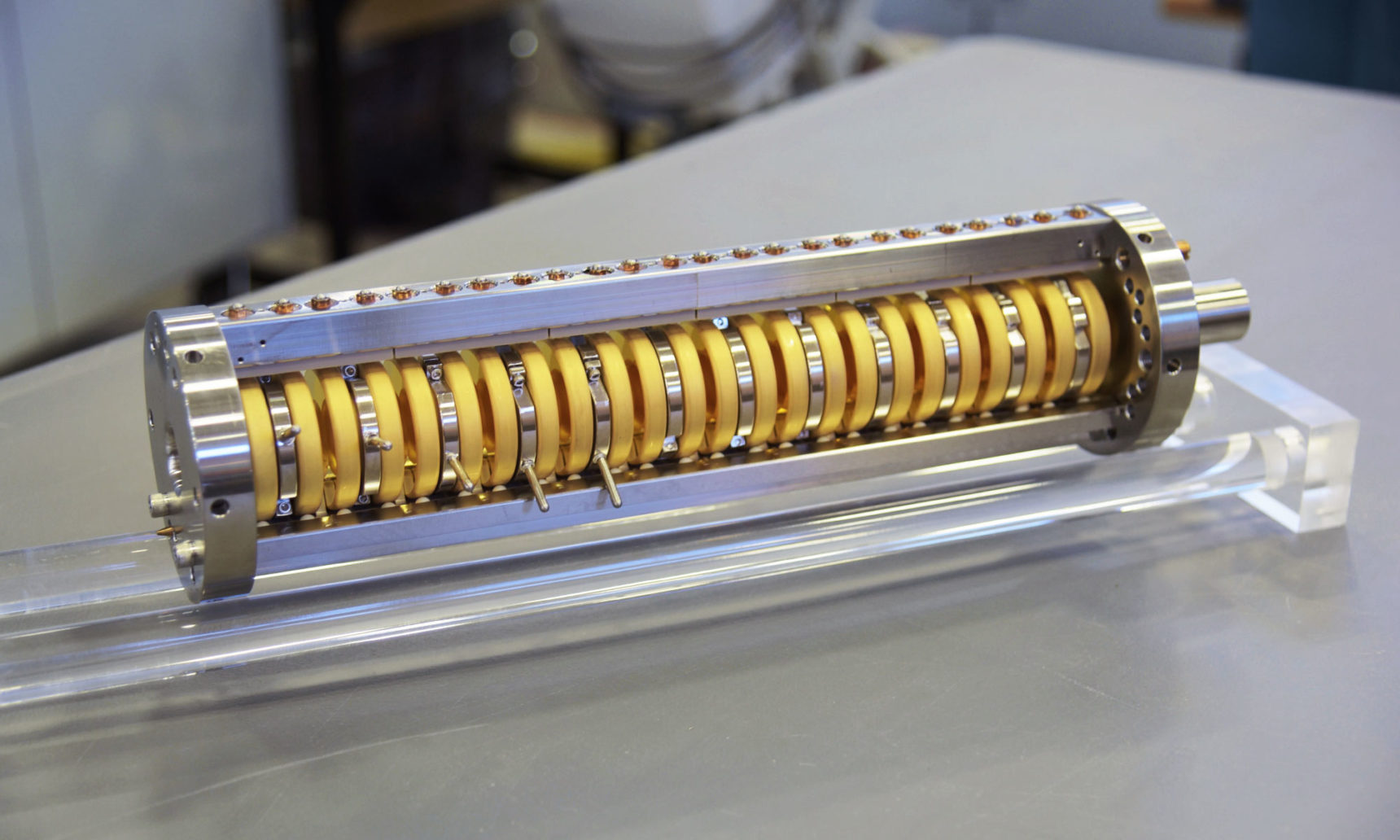 A proton detector at the National Institute of Standards and Technology used in the beam method.
On the contrary, bottle experiments catchultracold neutrons in a container. Ultracold neutrons travel much slower than normal neutrons - a few meters per second, compared to 10 million meters per second from fission reactions. Scientists measure how many neutrons are in the container first, and then again after a certain period of time. By studying the difference, they can calculate how quickly the neutrons decayed.
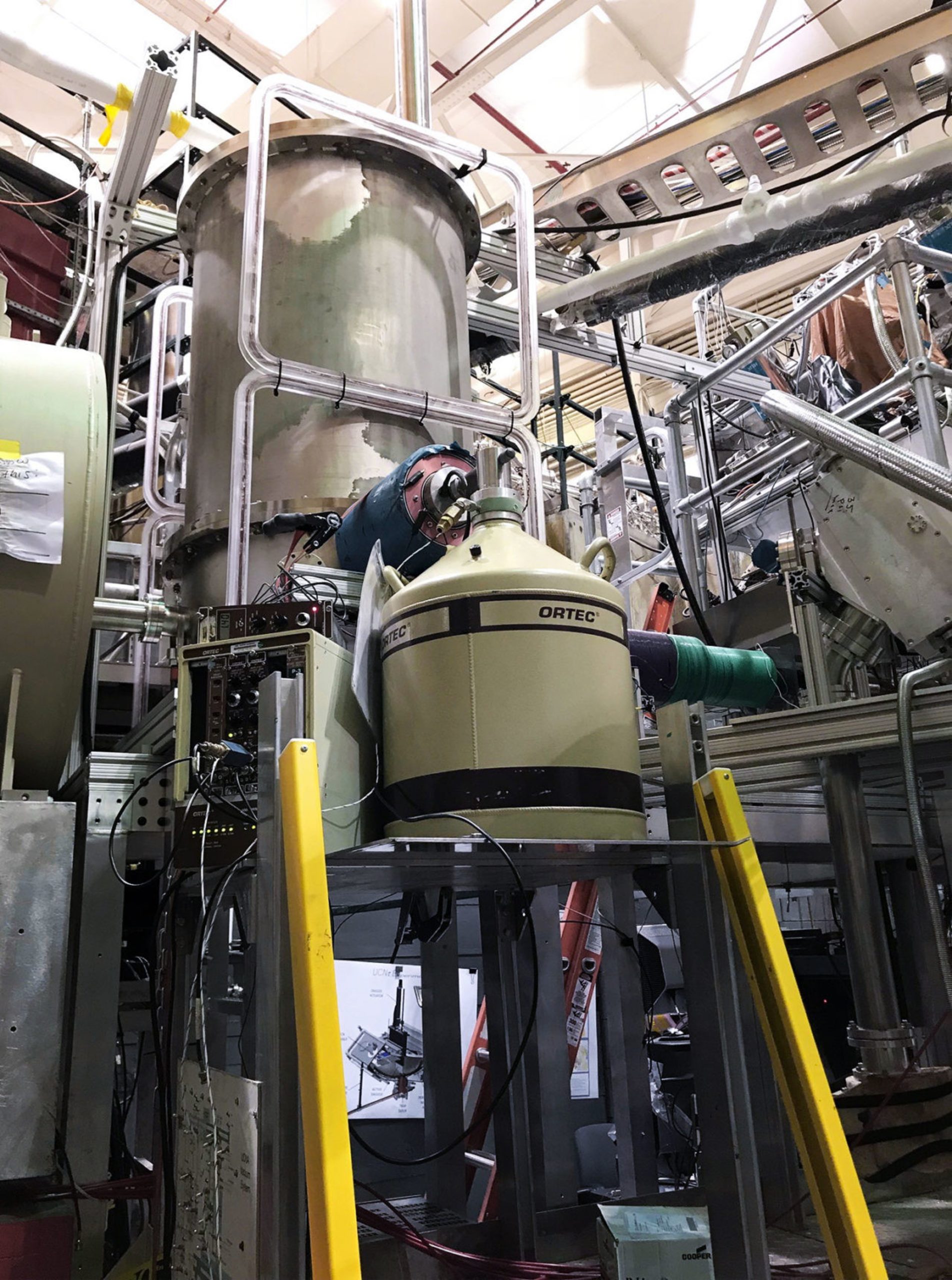 Experiment at UNCtau at Los Alamos using the bottle method to measure the neutron lifetime
"In the bottle experiment, the 'survivors' are measured, in the radiation experiment , the 'dead' ," Green explains. Experimentwith a bottle sounds easy, but is actually very difficult. It sounds difficult with rays, and in practice it is also difficult to carry it out."
Green and his collaborators conducted new measurements in 2013 at NIST that helped them recalculate the experiment even more accuratelybeam that they conducted in the same lab in 2005.By this point, the scientists had completed five experiments with the bottle and two with the beams.Green was convinced that previous experiments with the beam had overlooked one of the biggest sources of uncertainty.Physicists have improved their measurements of this variable to make them five times more accurate.But eight years of hard work left them with nothing.More precisely, with the same gap in results.
Scientists working on experiments withbottles, faced their own difficulties. One of the biggest measurement challenges was to prevent the loss of neutrons when interacting with the material from which the container is made. The leak changes the number of neutrons at the end of the decay and interferes with calculations.
To solve this problem, the latest bottle experiment at LANL, which was supported by the U.S. Department of Science, eliminated physical walls.Instead, nuclear physicists used magnetic fields and gravity to hold the neutrons in place.
“I was convinced that if we did this, wewe can make the neutron live longer and agree with the neutron lifetime as a result of the beam experiments, ”said Chen-Yu Liu, a female professor at Indiana University who led the experiment. "That was my personal bias."
But the difference remains. “It was a big shock for me,” she later admitted, referring to the results, published in 2018. The probability that the difference will be due to coincidence is less than one in 10,000. But this could still be due to experimental error.
Why does the error occur?
Scientists face two typesuncertainties or errors in experiments: statistical or systematic. Statistical errors arise from insufficient data. This prevents us from drawing firm conclusions. Getting big data reduces errors.
Systematic errors are fundamentaluncertainty of the experiment. By the way, they are often not obvious. The two types of neutron lifetime experiments have completely different potential systematic errors. If the results were the same, the experiments would be an excellent test of each other. But that doesn't happen.
"The most difficult thing in measuring the neutron lifetime- it is that it is both too short and too long, ”says Hoogheide. "It turns out that 15 minutes is a really inconvenient time to measure in physics."
Therefore, nuclear scientists continue to work to collect additional data and minimize systematic errors.
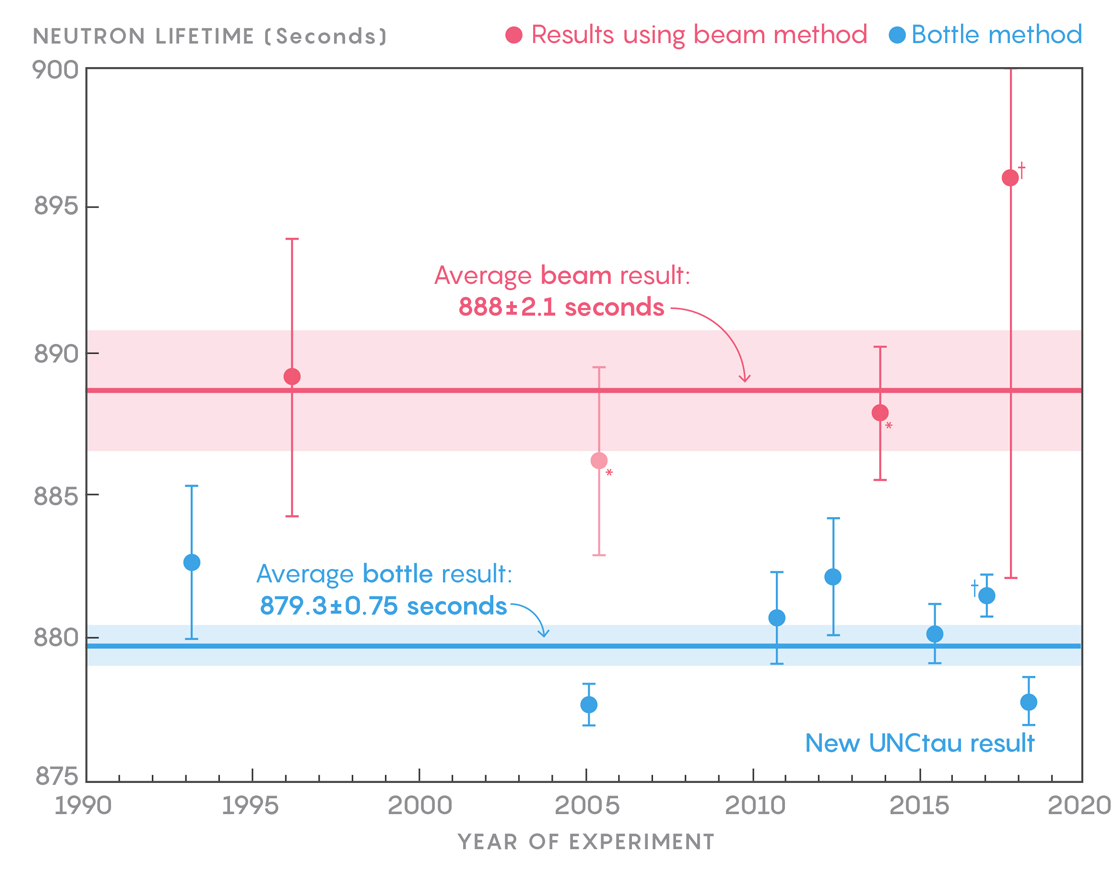 Vertical - neutron lifetime in seconds. Red marks the results of experiments with rays, blue - with bottles.
“One of the things that I like the mostin my field, it’s extraordinary attention to detail and how deeply you have to understand every aspect of your experiment to make a reliable measurement, ”said Leah Broussard, nuclear physicist at ORNL.
At NIST, Hoogerheide, Green, and other scientists are conducting a new beam experiment that investigatesUnfortunately , every setting for every experiment has an impacton the next results, so this work is based on the "two steps forward , one step back" system.
Other work is aimed at finding new ways to measure the lifetime of a neutron.
Researchers from Johns Hopkins University andDurham University, UK, with the support of the US Department of Energy, figured out how to use NASA data to measure the neutron lifetime. Based on neutrons emanating from Venus and Mercury, they calculated a lifetime of 780 seconds with an error of 130 seconds. But since data collection is not intended for this purpose, the uncertainty is too high to determine a difference in particle life. Zhaouen Tang, a physicist at Los Alamos National Laboratory, sets up an experiment that is a cross between bottle and beam experiments. Instead of measuring protons at the end, it will measure electrons.
A completely new approach. But it looks like all other options have exhausted themselves?
Or not?
New theories. From Radical Ideas to Science Fiction
Of course, there is always the possibility that the difference in measurements directly indicates a gap in our knowledge about this fundamental particle - the neutron.
Tang admits that he has no intention of giving up his experiments. There are so many examples of people who observed something extraordinary and then just referred to a mistake, didn't work hard enough... and someone else worked hard and won the Nobel Prize."
One theory for the mystery of the life of the neutron isis that it is destroyed in ways that scientists simply do not know. It can decay into particles different from the familiar combination of proton, electron and antineutrino. If so, then this explains why neutronsdisappear in experiments with bottles,but the corresponding amountprotons are not detected in beam experiments.
Other ideas are even more radical.
Some theorists suggest that neutronsdecay into gamma rays and mysterious dark matter. Dark matter makes up 75% of the matter in the universe, but as far as scientists know, it interacts with ordinary matter only through gravity. To test this theory, a group of scientists at LANL ran a version of the bottle experiment in which they measured neutrons and gamma rays. But the proposed gamma rays did not materialize, and scientists have no evidence of the appearance of dark matter from neutrons.
Mirror matter is another possiblea concept that sounds like science fiction. Theoretically, the “missing” neutrons can turn into mirror neutrons, namely, exact copies that exist in the opposite Universe. Developing differently than our Universe, this mirror Universe would be much colder and helium would predominate in it. While some nuclear scientists like Green think it's "implausible," others are interested in testing the theory, just "just in case."
“This is relatively uncharted territory.That sounds very attractive to me because I have a great neutron source in my backyard,” said Leah Broussard, referring to the Spallation Neutron Source and High Flux Isotope Reactor, both owned by the Department of Energy's Office of Science. ORNL.
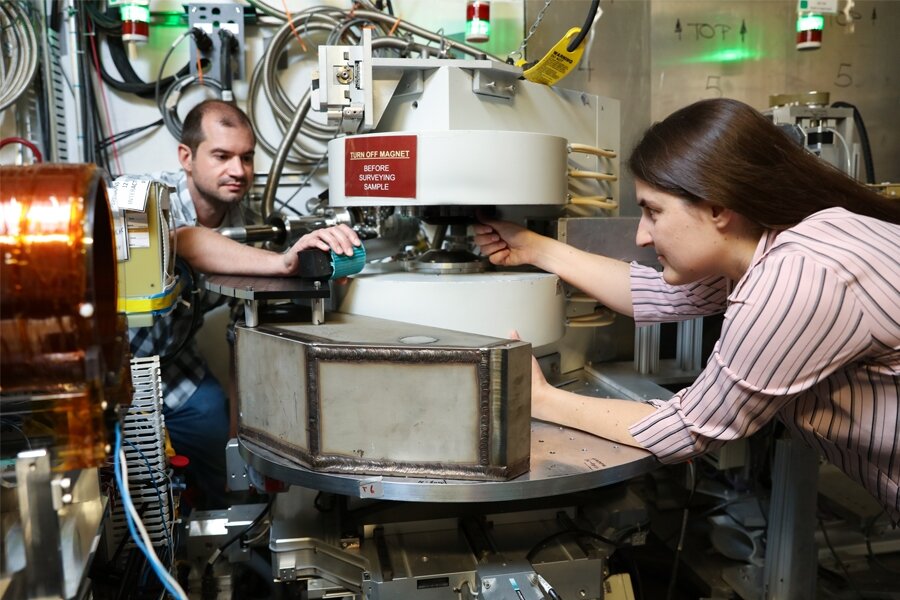 From left to right: ORNL collaborators Matthew Frost and Leah Broussard are working on a magnetism reflectometer in a fission neutron source that is used to search for specular neutrons. Credit: Genevieve Martin / Oak Ridge National Laboratory, US Department of Energy.
To test this theory, Broussard analyzesdata from a process that mimics a beam lifetime experiment, but is tuned to capture the signature of a potential invisible neutron partner. By launching a beam of neutrons through a specific magnetic field and then stopping it with a material that stops normal neutrons, she and her colleagues may be able to determine if mirror neutrons exist.
Whatever results brought thisexperiment, work to determine the neutron lifetime will continue. “It is very significant that there are so many attempts to accurately measure the lifetime of a neutron. This speaks to the highly emotional reaction of scientists to the inconsistency in this field—'I want to finally find out!'" Broussard concludes. “Every scientist is motivated by the desire to learn, the desire to understand.”
Read also
On the threatening Earth asteroid Apophis noticed a dangerous phenomenon. What's happening?
Scientists have found out why children are the most dangerous carriers of COVID-19
What the Parker Solar Probe discovered when it flew as close to the Sun as possible