The European Space Agency has released a new image from the James Webb Space Telescope.
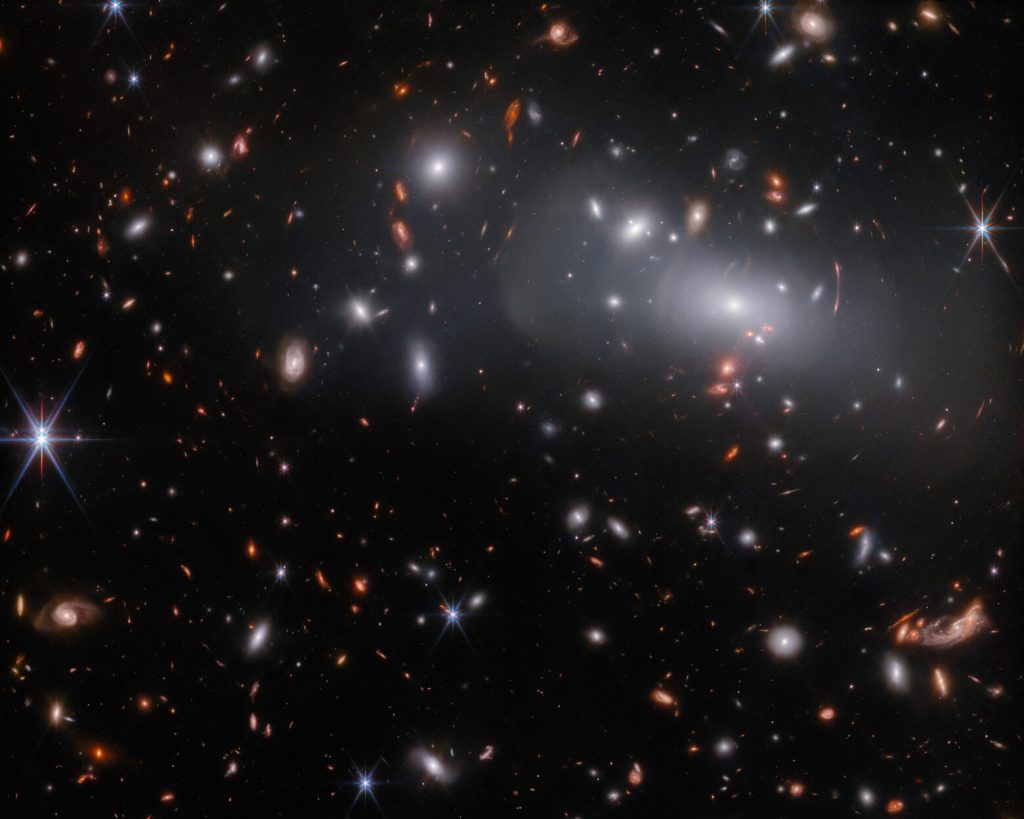 Galaxy cluster RX J2129 as seen by the James Webb Telescope. Image: ESA/Webb, NASA & C.S.A., P. Kelly
Gravitational lensing is an effectassociated with the curvature of space-time by a massive space object. Light that passes by or through such an object is slightly deflected, just as in an ordinary optical lens. In this image, such a gravitational lens (more precisely, several lenses) are the objects of the RX J2129 galaxy cluster, located about 3.2 billion light-years from Earth in the constellation of Aquarius.
Astronomers have noticed that due to gravitational lenseslight from a distant background galaxy was captured by the James Webb telescope three times in a single image. This galaxy contains a supernova, which the researchers believe is of the la type. It was discovered earlier with the help of the Hubble telescope, but has not been studied in detail.
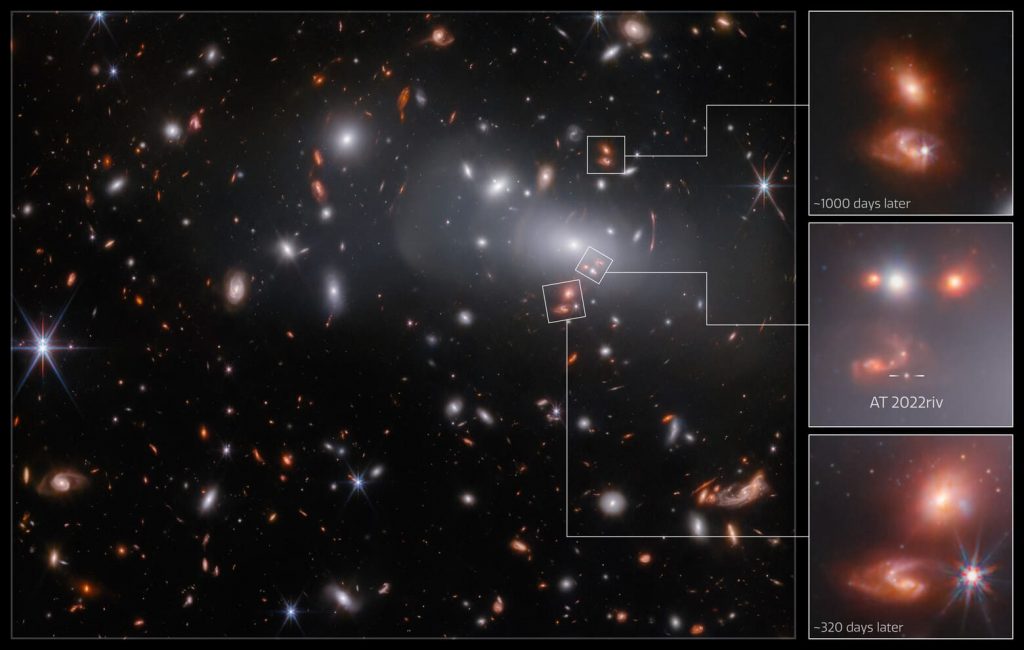 Three images of the same galaxy with a supernova in the galaxy cluster RX J2129. Image: ESA/Webb, NASA & C.S.A., P. Kelly
La-type supernovae always give a constant brightness- at the same distance, different supernovae of this type look equally bright. This means that their observed brightness is proportional to their distance from Earth. Scientists use this feature of supernovae to determine astronomical distances.
Almost uniform luminosity of a Type Ia supernovawill help astronomers understand how much the RX J2129 galaxy cluster magnifies background objects and, therefore, how massive this galaxy cluster is. Not only do gravitational lenses distort images of background objects, but they can also make distant objects much brighter. Analyzing how light from a supernova changes as it passes through the "lens" will help determine the properties of the latter.
Read more:
The mystery of the red stripes on the satellite of Jupiter is revealed
Found "impossible" planet. She defies modern science
Mysterious hexagonal "honeycombs" in salt deserts found an explanation