The James Webb Telescope captured this image of a breeding ground for young stars. Thanks to the work of infrared devices
 Two views of the Tarantula Nebula. NIRCam and MIRI images
The Tarantula Nebula, also known as 30Doradus is a star-forming region about 160,000 light-years away in the Large Magellanic Cloud galaxy. This one is relatively close to Earth. The presence in the nebula of the hottest and most massive stars known to science makes it of particular interest to astronomers who study star formation.
Previous observations of this area were carried outother telescopes. They detected shorter wavelengths of light that were obscured by the nebula's dust. Because of this, many of the nebula's young stars and its other "inhabitants" remained out of sight.
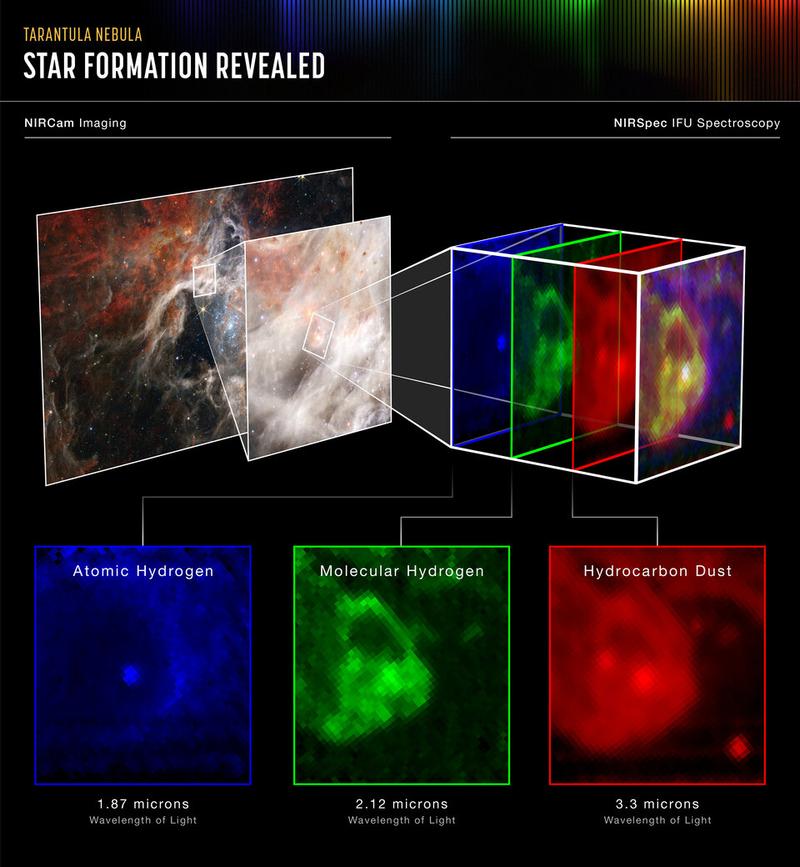 Webb's NIRSpec spectrograph shows star formation in the Tarantula Nebula.
Photo: NASA, ESA, CSA and STScI
New image obtained by the spectrographWebb's near-infrared image (NIRSpec), shows a star in the process of "hatching" from the "cocoon" - the protective dust cloud from which it was formed. These clouds, which look like bright “pillars,” indicate the center of the nebula. Powerful stellar winds “blew up” the cavities in Tarantula.
New images of "Webb" in full resolution are available here.
Read more:
The ancient Vikings suffered from a dangerous disease. It is caused by a parasite from Africa
Plant on Mars produces oxygen at the rate of an average tree
Physicists have cooled atoms to record temperatures. They are a billion times colder than outer space.