Researchers are using the Hubble Space Telescope to study the protoplanetary disk surrounding the
Back in 2017, astronomers reported findinga shadow sliding across the surface of a huge disk of gas and dust surrounding a red dwarf star. The shadow does not come from the planet, but from the inner disk, which is slightly tilted relative to the much larger outer one. In a new study, scientists announced the discovery of a second shadow, formed by another inner disk located at a different angle.
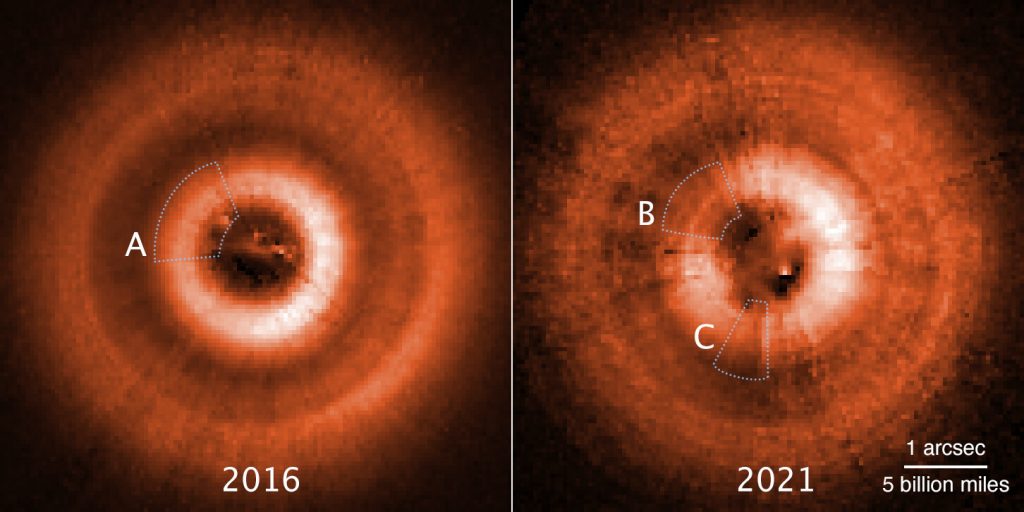 Two shots of the protoplanetary disk surroundingstar TW Hydra. The 2016 image shows one shadow cast by the inside of the disk on the outside, but the 2021 Hubble image splits it into two distinct shadows. Image: NASA, ESA, J. Debes (STScI)
By simulating different scenarios, the researchers concluded that the observations best describeA system in which two other discs are located inside the outer gas and dust disk.They are so close to each other in the first observation that they were not noticed.Now they have shifted and split into two separate shadows.
Researchers believe that the disks are a sign of the formation of an invisible planet star.They attract material and deform a structure that would otherwise be a perfectly flat disc.The suspected planets are located at about the same distance as Jupitermoves around the Sun.
The shadows orbit the star about every 15 years.The two inner discs are inclined approximately 5° to 7° relative to the plane of the outer disc.This is comparable to the inclination range of the orbits of planets within the solar system.
The outer disk on which the shadows fall is severaltimes the radius of the Kuiper belt in the solar system. The researchers also found that it has a small gap that is twice the average distance from Pluto to the Sun. This may be evidence of the existence of a third planet.
The protoplanetary disk of TW Hydra is located almostperpendicular for observation from Earth. This opens up the possibility of studying in detail the changes that occur in the system. The researchers believe that further analysis will help to better understand how the planets of the solar system formed.
Read more:
Scientists first saw how a star devours the planet: this, in the end, is waiting for the Earth
Two super-Earths found on the edge of the habitable zone: one of them has a comfortable temperature
Scientists examined the dying brain and told what they found
On the cover: An artistic illustration of several nested disks associated with the forming planets surrounding the star. Image: NASA. ESA, L. Hustak (STScI)