What should happen on August 22?
According to the Global Footprint Network, the so-called "Excess Day"
A group of scientists calculated that the point"non-renewability" will be reached on August 22, compared to July 29 in 2019, marking a rare change in the situation. This was caused by a quarantine aimed at slowing the spread of the new coronavirus. It is mass isolation and caused a temporary reduction in emissions and reduced timber harvests.
According to their experts, this has reduced the ecological footprint of mankind by 9.3% compared to last year.
Why is this not cause for joy?
Mathis Wackernagel, president of the Global Footprint Network, said during an online presentation on Thursday that this is "not cause for joy." "This was not done on purpose, it was done by disaster," he added.
According to Wackernagel, researchers are countingthe date humanity exceeds its planetary budget by considering “all human needs” for food, energy, space for homes and roads, and what it takes to absorb global CO2 emissions.
Comparing this with what is available sustainably, they estimate that humanity uses 60% more than can be renewed, equivalent to 1.6 planets, reports Agence France-Presse.
How is the date of “World Environmental Debt Day” calculated?
"Day of exceeding the permissible level of resourcesEarth" marks the date when humanity's demand for environmental resources and services in a given year exceeds what the Earth can replace in that year.
To determine the date when the permissible limit was exceededEarth's resource levels for each year, the Global Footprint Network calculates the number of days in that year that the Earth's biocapacity is sufficient to support humanity's ecological footprint. The rest of the year is consistent with global emissions. World Green Debt Day is calculated by dividing the planet's biocapacity (the amount of environmental resources the Earth is capable of creating this year) by Humanity's Ecological Footprint (humanity's need this year) and multiplying by 365, the number of days in a year:
(Earth Biocapacity / Human Ecological Footprint) x 365 = World Environmental Debt Day
The methodology is based on the latest revision of the national footprint and biocapacity accounts, which inevitably represents a “time gap” with the present due to UN reporting procedures.
To fill this “gap” and defineOn World Green Debt Day this year, the Global Footprint Network sets trend lines based on national footprint and biocapacity account data and extends these lines to the current year. Whenever possible, more recent data from reputable sources is used. For example, the Global Carbon Project is an organization that seeks to quantify global greenhouse gas emissions and their causes.
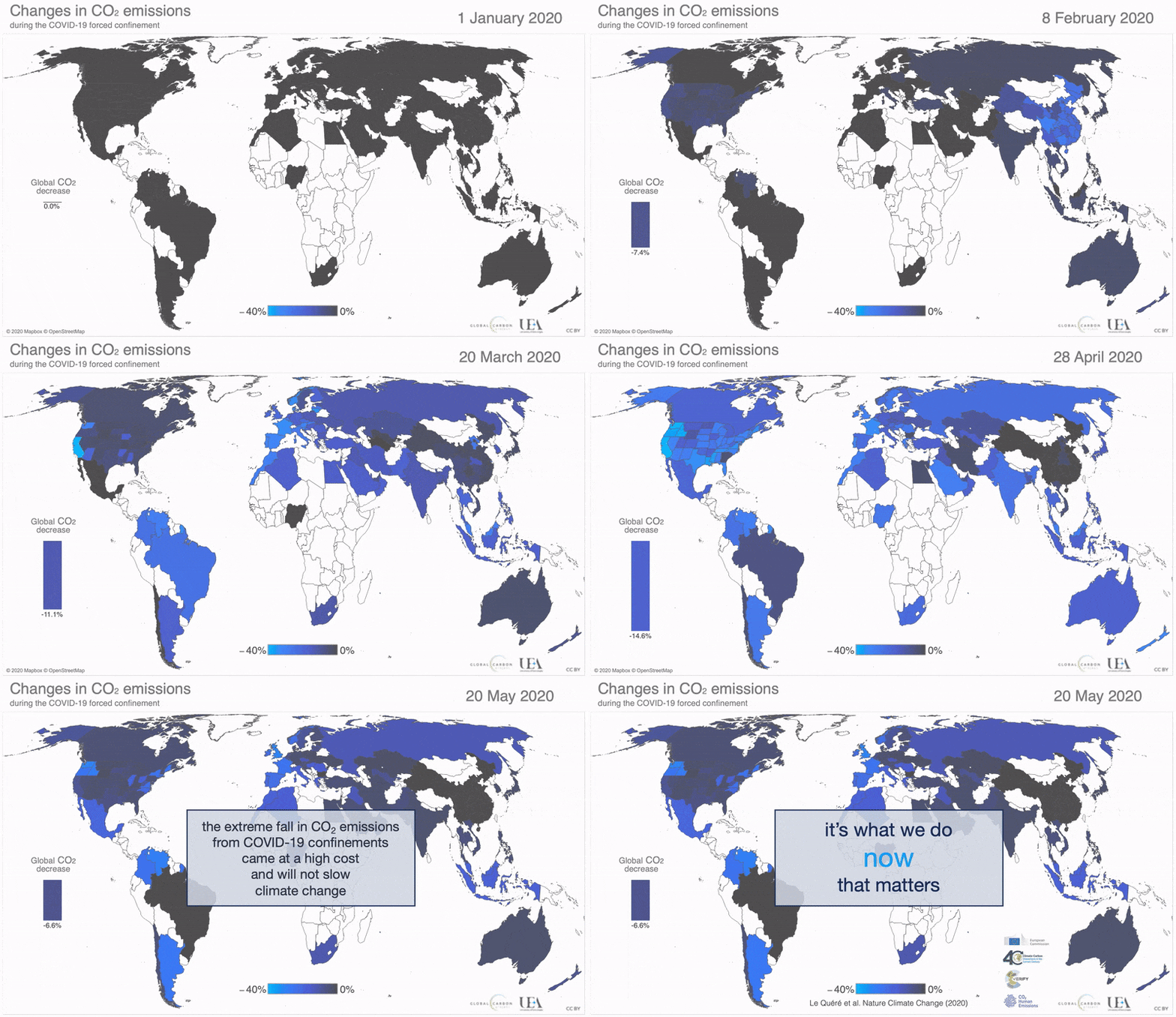 How emissions changed during blocking.
How was the date calculated in 2020?
To address the impact of the coronavirus pandemic this year, the Global Footprint Network pooled data and formed assumptions to assess the current situation of humanity's resources.
Were evaluated:
- changes in carbon emissions,
- changes in forest harvesting,
- total demand for food,
- as well as other factors that could affect global biocapacity or ecological footprint.
What are biocapacity and ecological footprint? How are they calculated?
Just like on a bank statementtracking income and expenditures, the Global Footprint Network measures population demand and supply of resources and services by ecosystems. These calculations then serve as the basis for calculating World Environmental Debt Day.
- Biocapacityof a city, region or country is represented by its biologically productive land and sea, including forest land, pasture land, arable land, fishing grounds and built-up land.
- Ecological footprintmeasures the population's need for productsfood and plant fibres, livestock and fisheries products, timber and other forest products, space for urban infrastructure and forests to absorb carbon dioxide emissions from fossil fuels.
Both are expressed in global hectares - globally comparable standardized hectares with a global average production. A hectare is equal to 10,000 sq. m, or 2.47 acres.
The ecological footprint of every city, region orcountries can be compared to its biocapacity. If the population's demand for environmental assets exceeds supply, the region experiences an environmental deficit. An ecologically scarce region meets demand through imports, disposing of its own environmental assets (such as overfishing) and / or carbon dioxide emissions.
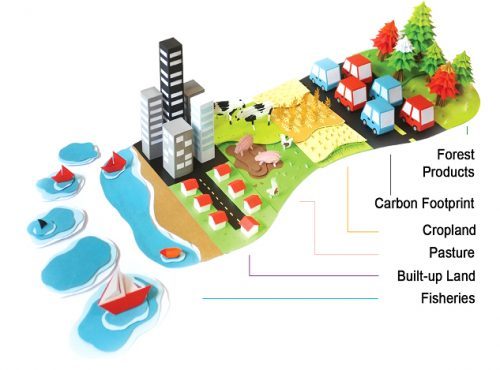 Source: WWF Japan and Global Footprint Network; Ecological footprint for sustainable living in Japan
Globally, environmental scarcity and overspending are one and the same since there is no net import of resources to the planet.
What has changed in 2020?
The research team found a 9.3% reduction in the global ecological footprint over the same period last year.
In the downloadable research reportThe main driving forces are indicated as being the carbon footprint (down 14.5% from 2019) and the ecological footprint of forest products (down 8.4% from 2019). The result of all the extrapolations of the data and the factors analyzed was the conclusion that Earth Day 2020 will come on August 22.
The study estimates that the pandemic has led toa 14.5% decrease in the carbon footprint of humankind compared to 2019, while the volume of forest products decreased by 8.4%, mainly due to a smaller harvest, which anticipated low demand.
Researchers said the pandemic causedhuge damage to global agricultural systems and markets, but concluded that ultimately the scale of humanity's food footprint has changed little.
“It's like money. We can spend more than we earned, but not forever, ”Wackernagel emphasized.
What does the future hold for the planet?
The Global Footprint Network said: efforts to combat the pandemic show that changing consumer habits in a short time frame is possible, adding that the shifted date of environmental debt is "an unprecedented opportunity to reflect on the future we want."
Speaking at the presentation, Head of the World FoundationWildlife Management (WWF International) Marco Lambertini said the pandemic has drawn the most attention to "our erratic, wasteful, downright destructive relationship with nature."
He called for "decoupling" economic development from environmental degradation.
We can develop, but not at the expense of the planet, because we know that the planet in crisis is a society in crisis, and therefore the economy is in crisis.
Marco Lambertini, head of the World Wildlife Fund (WWF International)
What is needed to save the planet?
Earlier this month, an international groupThe researchers said that global emissions from the burning of coal, oil and gas could be cut by up to 8% in 2020 due to unprecedented measures to combat the pandemic.
However, the scientists emphasized that without systemic changes in how we handle the planet, the emissions saved would be essentially meaningless.
Under the Paris Climate Agreementin 2015, countries pledged to limit temperature increases to “well below” 2 ° C above pre-industrial levels by drastically reducing emissions.
A safer target was also set - a limit of 1.5 °C.
The United Nations says that for this to be possible, global emissions must be reduced by 7.6% annually this decade.
Read also
Why are scientists so interested in Ceres? Everything about the planet on which they are actively looking for life
An "indestructible" drone has been designed in Russia
Supernova explosion could cause mass extinction on Earth