What are stellar flares?
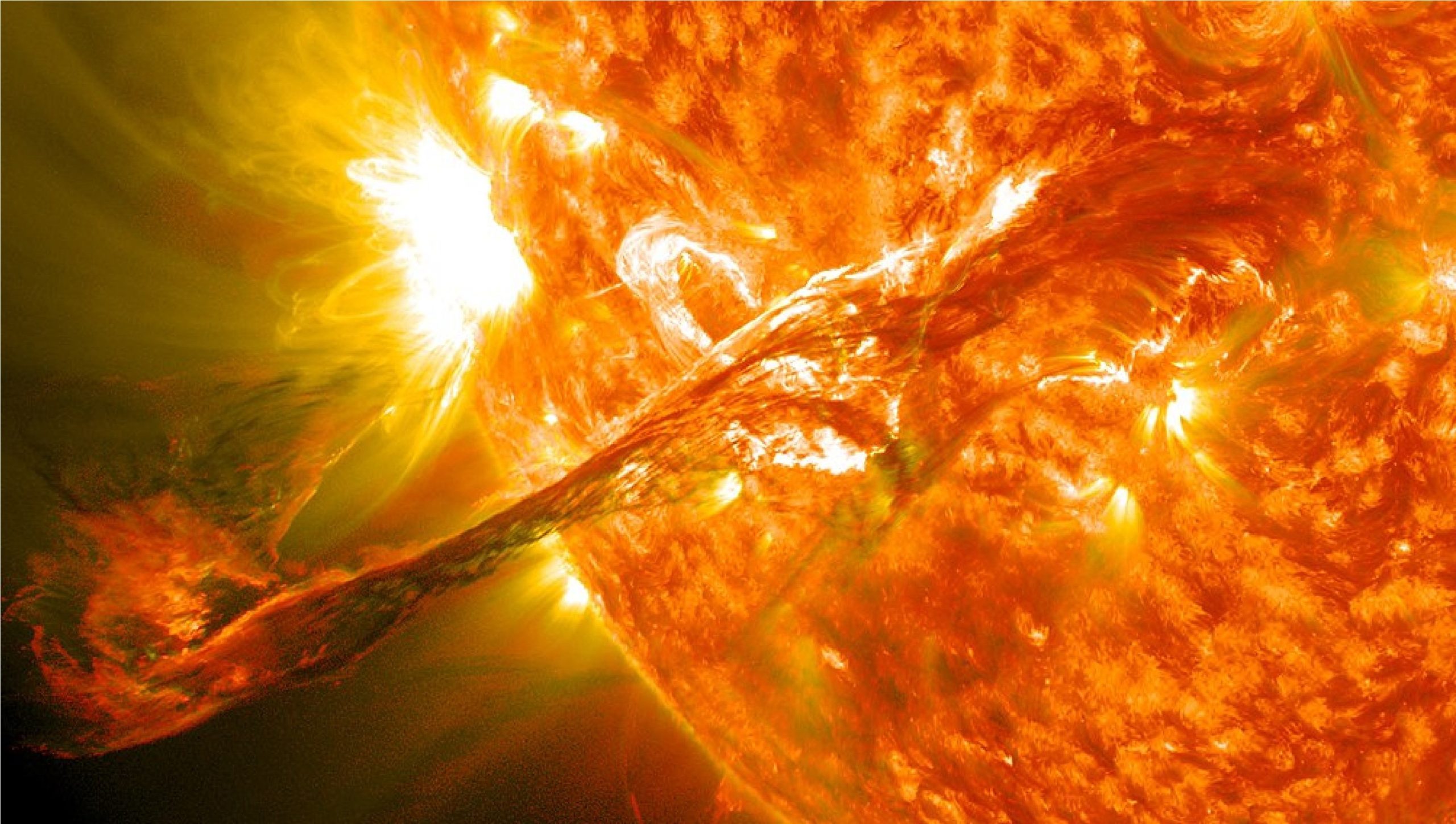
Stellar flares occur on UV Ceti type stars - these are variable stars.
Flare stars are faint red dwarfs.with a small mass, although flares are also observed on brown dwarfs. Many of the stars closest to the Sun, including Proxima Centauri, DX Cancri and Wolf 359, belong to the class of flare stars.
Outbreaks can last from minutes to severalhours, the average interval between them is from an hour to tens of days. The onset of an outburst occurs much faster than extinction; a star can double its brightness in just a few seconds. During this process, the spectrum of the star changes dramatically.
Scientists believe solar flares haveabout the same nature, although they are much weaker. Moreover, they are weaker not only in relative magnitude (the sun is much brighter than red dwarfs showing flares like UV Ceti), but also in the amount of energy released.
The phenomenon of stellar flares is explained by an increase in the energy of infrared photons during collisions with fast electrons during the inverse Compton effect or the “fast electron hypothesis”.
How are stellar flares studied and why is it important?
Determining the frequency of young eruptionsstars helps scientists understand where to look for habitable planets. But until now, the search for these flares involved studying by eye more than a thousand changes in the brightness of stars - light curves.
An international group of scientists decided to simplify thisprocess using machine learning. This will make the search for these phenomena faster and more efficient. To do this, astronomers taught a neural network to detect the characteristic light patterns of a stellar flash.
“With the help of a neural network, we were able to find more23,000 flares on thousands of young stars, ”explains Dr. Montet, professor at the University of New South Wales in Australia and co-author of the study.
 Artistic concept HD 209458 b,exoplanets whose atmosphere is bursting at speeds over 35,000 km / h by radiation from the nearest parent star. Credit: NASA / European Space Agency / Alfred Vidal-Majar (Institute of Astrophysics of Paris, CNRS).
"Detecting stellar flares that can be fatal to the developing atmospheres of nearby planets will help focus on finding habitable planets."
The results published in Astronomical Journal, demonstrate the promising uses of AI in astronomy, as well as a better understanding of the evolution of young stars and their planets.
“Of course, when we talk about “young”stars, we mean an age from a million to 800 million years,” emphasizes Adina Fainstein, a graduate student at the University of Chicago and the first author of the article. “Any planets around the star are still forming at this point.” This is a particularly important time, and a flare from the star could easily evaporate any water or atmosphere."
- Neural network creation
NASA's TESS telescope on boardThe satellite, which has been orbiting the Earth since 2018, is specially designed to search for exoplanets. Flares from distant stars appear in TESS images, but traditional algorithms are difficult to determine their shape.
However, neural networks are especially goodin searching for patterns such as Google's artificial intelligence, which selects, for example, cars from all the images on the Internet, and astronomers are increasingly turning to them to classify astronomical data.
Feinstein and Montet worked with the groupscientists from NASA, the Flatiron Institute, Fermi National Accelerator Laboratory, MIT, and the University of Texas at Austin to assemble a set of identified and non-flares to train a neural network.
- Experiment Results
And the neural network has proven to be really useful for detecting small flares. They are really hard to find with other methods, the researchers explain.
After making sure the performance of the neural network,the researchers applied it to a complete dataset that provided over 3,200 stars. Scientists have found that stars like our Sun had only a few flares, and they seem to have disappeared 50 million years after the star was born. This is good news for humanity.
"A calmer stellar environment means that the planet's atmosphere has a better chance of survival," Feinstein stresses.
In contrast, cooler stars, called red dwarfs, flare up much more frequently. Small rocky planets that orbit such stars have little chance of creating life.
By the way, scientists want to adapt the neural network to find planets hiding around young stars.
In search of habitable planets
In another study published in the journalMonthly Notices of Royal Astronomical Society: Letters,confirmed the theory that stellar flaresdo not particularly contribute to the emergence of life on young planets. In addition, scientists have discovered a pattern between the intensity of stellar flares and their effect on the atmosphere of planets.
An international team of scientists figured out which stars are most likely to contain habitable exoplanets, based on the calculated rates of erosion of planetary atmospheres.
 Credit: University of New South Wales.
Researchers have proven that frequent outbreaks withlow energy have a greater impact on the exoplanet's atmosphere than less frequent but high-energy flares. Planets with faint and rare flares are more likely to have life on their parent stars. Such stars include, for example, our Sun. Good news for earthlings! The researchers also figured out how different types of stars produce extreme ultraviolet radiation (XUV) from stellar flares and how this affects nearby planets.
It is important to understand that the ability to maintainatmosphere is one of the most important requirements for the habitability of the planet. Since the effects of stellar activity have not been well understood, the study by scientists from the Space Science Center at New York University Abu Dhabi (NYUAD) will make it easier to study exoplanets for habitability. The study also highlights the need for better numerical modeling of atmospheric escape—how planets release atmospheric gases into space—as this can lead to atmospheric erosion and a decrease in the planet's habitability.
Given the close proximity of exoplanetsto stars, it is important to understand how “space weather” on them can affect the habitability of exoplanets. The scientists' next step will be to expand the data set to analyze stellar flares from more stars. The goal is to see the long-term effects of stellar activity on the atmosphere of exoplanets and to find potentially habitable ones.
Read also
Research: some people have antibodies to coronavirus, although they did not have them
The largest iceberg in the world could collide with an inhabited island
The Doomsday glacier turned out to be more dangerous than scientists thought. We tell the main thing