When did synthetic biology appear?
The term “synthetic biology” was first used in 1980
Twenty years later, in 2000, the term againproposed by Eric Call, along with colleagues and other speakers, to describe the synthesis of artificial organic molecules that play a specific role in living systems.
Thus, back in 2002, the first completely artificial virus was born, and 8 years later, Cynthia, the first viable bacterium with a completely artificial genome.
How does a new direction in science work?
The idea itselfsynthetic biologyis developing “around” genome engineering.In recent years, new, extremely convenient molecular tools have appeared that can be used to change the genome of almost any organism in any way.
Synthetic biology applies engineeringapproach for the formation of living organisms - from enzymes to microbes. In the future, scientists will be able to shape the human genome, work in this direction is already underway.
The very essence of the new direction liesthe ability to actually program the code of living beings. This, of course, will affect their development. There are already tools that allow you to edit DNA and create new combinations of genes.
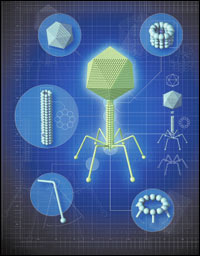 MIT scientists disassemble the T-7 virus into pieces
Why is this direction interesting?
In order to change the code of living beings, you need to understand the laws of life. Gradually studying synthetic biology can shed light on some biological patterns.
Nevertheless, the practical value of syntheticbiology is no less important than scientific. Since the industrial revolution, man has exhausted the forces of nature - now he can control the development of living organisms.
Synthetic biology can also create more environmentally friendly products, such as artificially grown meat or biofuel. This way you can cause minimal harm to the planet.
Examples of work:
DNA in living cells can be described, understood and studied using programming terms. Indeed, let's look at DNA through the eyes of a programmer.
- DNA language is digital, uses four meanings: A, T, C and G; "DNA byte" consists of three characters and encodes one amino acid;
- eukaryotes have a part of the "code" - sequencesintrons, - in fact, nothing encodes and is subsequently cut out. However, they serve a vital function: this DNA helps code execute correctly, just like comments in programs.
- the versatility of the genetic code makes genetic programs compatible with the vast majority of living organisms.
The revolutionary breakthrough occurred on May 20, 2010.This day will forever go down in history as the day on which the creation of the first living cell capable of reproduction based on a synthesized genome was announced. An artificial living organism was created at the Craig Venter Institute under the leadership of Craig Venter himself.
In total, the research leading tothe creation of the first synthetic organism capable of reproduction took more than 15 years, but this event carries a revolutionary potential for science and, possibly, will allow mankind to solve the most ambitious tasks, such as new sources of food raw materials, drugs and vaccines, victory over environmental pollution, synthesis of pure water, etc.
Scientists are aiming to create a vast genetica bank that allows you to create any desired organism (by analogy with the creation of an electronic circuit from industrial transistors and diodes). The bank is made up of biobricks (BioBrick) — DNA fragments whose function is strictly defined and which can be inserted into the cell genome to synthesize a previously known protein. All selected biobricks are designed to interact well with all others on two levels:
- mechanical — so that they can be easily produced, stored and included in the genetic chain;
- software - so that each brick sends out certain chemical signals and interacts with other pieces of code.
 Some biological molecular machines
What's next?
At the same time, synthetic biology usesvarious technologies, including machine learning. The Nature Communications article talks about algorithms that can predict how changes in a cell's DNA will affect its behavior. Algorithms can also provide recommendations for future developments by bioengineers.
At the same time, there are concerns that working withthe human genome can lead to irreversible consequences. It is also believed that some groups of organisms may be changed forever in this way.
For example, a recent Pew Research poll showed that most of the population considers genetically modified foods unsafe for consumption.
Read also:
The annual mission in the Arctic has ended and the data are disappointing. What awaits humanity?
On day 3 of illness, most COVID-19 patients lose their sense of smell and often suffer from a runny nose
Scientists have found out why children are the most dangerous carriers of COVID-19