Scientists have found stellar nursery L483, also known as the Boca globule, about 650 light-years from Earth.
Strange inconsistency
When dense clouds of gas and dust collapse,when forming stars, they launch streams of stellar matter at hypersonic speeds. The magnetic field surrounding a star-forming cloud is usually parallel to them. Initial observations of cloud L483 showed just such a standard picture. The magnetic field followed a typical profile.
But when astrophysicists used the StratosphericSOFIA Observatory for Infrared Astronomy, they saw a different picture. It turned out that the magnetic field was not parallel to the flows from the newborn star. It was twisted at an angle of 45 degrees relative to them.
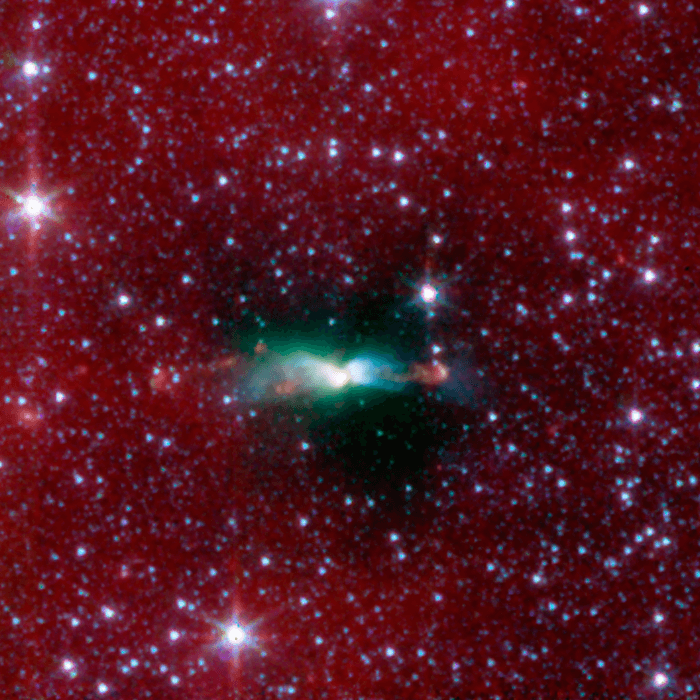 In this infrared image from NASA's Spitzer Space Telescope, the young protostar L483 and its signature stream peek out from beneath a shroud of dust. Photo: NASA
This came as a big surprise to scientists becauseThere is a close physical connection between the emissions of a young star and its magnetic field. “Theory may predict one thing, but observations may predict another,” the scientists note in a press release.
New questions
Scientists have tried to explain this discrepancyand used an array of telescopes in the Chilean desert to observe the globule. While studying a newborn star in a cloud, they noticed a star hidden behind it. The data showed that a second young star lives in the cloud, which, like the first one, recently came into being and is just gaining mass. She “hid” behind the first one, so she wasn’t noticed right away.
According to the modern picture of star formation,systems consisting of two (or more) stars form when the stellar envelope is particularly large. They can also appear when a cluster of material orbiting one young star collapses, forming a secondary cloud that itself becomes a second star. None of these processes can explain how the second star changed the direction of emissions from the Bok globule so that it did not coincide with its magnetic field. New data has changed scientists' understanding of the Universe and the star formation processes in it. Therefore, astrophysicists have put forward a new theory.
A theory that can explain everything
Scientists believe that two stars mayform far apart from each other, and then one of them approaches the other, forming a binary system. They suggest that this is exactly what happened in the Bok globule. Although the researchers' work is far from complete, the mathematics behind the new interpretation appears to explain the findings.
However, why does one star suddenly begingetting close to another remains a mystery. Scientists hope to learn more about the mysterious stellar nursery with the advent of new, even more powerful instruments such as the James Webb Space Telescope.
Read more
The Japanese dumped a giant turbine into the ocean to get endless energy from the current.
Astronomers from Japan have found an unknown structure in the galaxy
Researchers filmed a 'hidden' ecosystem in an Antarctic river