Editorial every yeargganalyzes the events of the past year in order to try to highlight
Predictions for 2020: 8 out of 10 came true
- Buying flagship smartphones for the sake of your own image, not technology.This year is truly senior flagshipApple and Samsung models, with Ultra or Pro Max prefixes in their names, were not about technology, but about image. Yes, they have more powerful processors, larger diagonal sizes, better digital zoom and more memory, but all this is not about new technologies, but about meeting other needs (first of all - I can afford it). In terms of user experience, there is no fundamental difference between this year's flagship and the previous year's. Separately, there are Samsung (and Huawei) flagships with a folding screen, but they (yet) do not make a difference on the market, and due to their high prices, their purchase scenario is most likely the same image - for the sake of technology, people will buy them only a couple of years later, when prices will drop to the psychological level of a thousand dollars.
- High growth rates of legal streaming video services. Of course, the pandemic played its role as a trigger, as the key event of 2020, but even without quarantine the growth would have been significant; take a look at the graph of Megogo traffic growth this year:
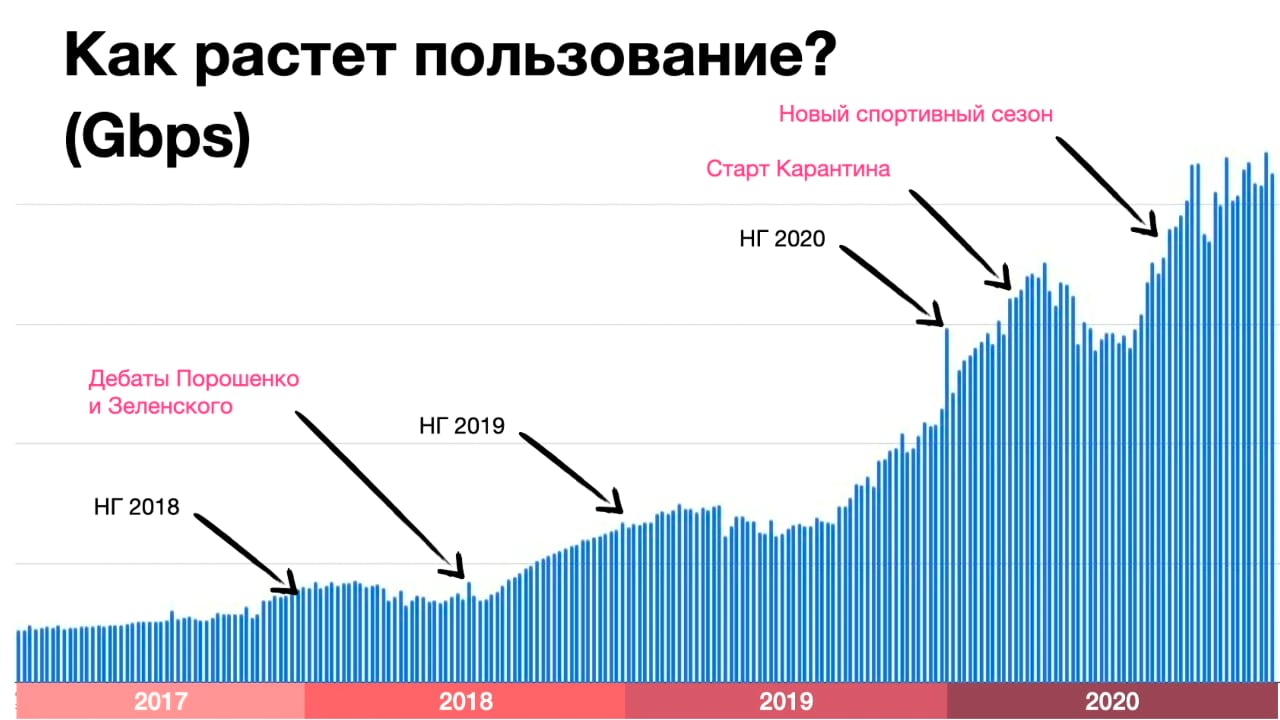
</ img>Separately (even if we are not talking about a video service)You can remember about the official entry of Spotify into our market. This also suggests that the time for legal streaming services has come. And it was in 2020 that we passed a certain barrier, after which everything will develop more intensively.
- 4G networks will continue to grow rapidly, but users will still be dissatisfied with the quality... 4G networks were still developing this yearhigh rates: thanks to licenses for frequencies in the 900 MHz range, high-speed mobile Internet began to appear in rural areas: all operators were actively building their networks, starting from the western regions of Ukraine and moving to the east. In total, hundreds of new settlements were added to the 4G coverage. And they also launched 4G in the Kiev metro - an event that is more significant than significant for the entire market. As for users who are dissatisfied with the quality of the mobile Internet, I suppose, no one has any doubts about this? Although this sarcasm was understandable initially and a year ago.
- The boom of TWS headphones.Everything is easy and simple to check here:a year ago, there were 211 models of TWS headphones in the outlet marketplace, today there are 2,000. Interestingly, the forecast came true at the optimistic border, directly indicated in the text a year ago (500 and 2000). If tenfold growth in a year is not a headphone boom, then what is the boom?
- The return of wristwatches: fitness bracelets and smartwatches. Although smart watches and fitness bracelets have long beenare on the market, as in the case of TWS headphones, their sales have increased significantly in 2020. Apple, Samsung and Huawei showed interesting watch models this year. Xiaomi has no equal in bracelets on the market (this year we received a version with the possibility of secure NFC payments). Not counting the market leaders (in addition to Xiaomi, Samsung and Huawei/Honor have good bracelets), you can find models on sale for up to 300 hryvnia (there are even cheaper ones, but we wouldn’t recommend buying them). That is, in recent years, wristbands have gone from a $200 device for enthusiasts to a mass product with prices ranging from $10 to $40. And, perhaps, this year was decisive.
- Tens of thousands of Ukrainian families will buy their first robot vacuum cleaner. The market for robotic vacuum cleaners has been growing at an accelerated pace throughout the year. It's nice that the editorsggalso had a hand in this: our article with recommendations for the best robot vacuum cleaners was read more than 100,000 times in 2020 alone.
- Paying with a smartphone will forever change the habits of Ukrainians. Paying with the touch of a smartphone has not just becomeubiquitous. In 2020, we were surprised to discover that it is seriously addictive. So serious that this, for example, became the reason for some buyers to refuse to purchase Huawei smartphones that lack Google services (the possibility of contactless payment in these smartphones was announced, but it was not implemented until the end of 2020, although the process, albeit slowly, but moving and there is no doubt that it will appear in 2021).
- Smart home devices will have a single standard. Although we did not expect much activity fromProject Connected Home over IP alliance this year, yet the complete lack of news on this topic throughout the past year suggests that the forecast (and the expectations associated with it) was most likely premature.
- Aliexpress will become a popular place to buy new unusual gadgets... The popularity of Aliexpress can hardly be overestimated inthe quarantine era, when the demand for such "gadgets" as protective masks (including FP3 protection) or pulse oximeters naturally increased. But it is really difficult to assess at the end of this year to what extent this forecast can be considered come true (or not). Although thinking about it, perhaps, was worth a year ago.
- We will see the first signs of "state in the smartphone". Everything is simple here:More than a million installations of the “Diya” application in the Android application store speak for themselves. Of course, a complete “state in a smartphone”, including, for example, voting, is still a long way off, but the application is working, developing and is already capable of at least partially replacing documents (driver’s license, compulsory motor liability insurance, passport and identification code). That is, the first signs on the faces, a start has been made.
Forecast for 2021
What awaits us in the technology sector in 2021, according to the editorsgg.This year's smartphone innovators included OPPO, Samsung, ZTE and Apple. There is no doubt that other companies will begin to adopt their successful experience. Already next year.
1. Massive transition of smartphones to displays with a frequency of 90 hertz and higher
This is a technological transition that causesso addictive that it will be impossible for smartphone manufacturers to ignore. Already now there are smartphones on sale with a price tag of 6,000 hryvnia, equipped with such a display; next year there will be many of them, and this will not only be the prerogative of flagships. In terms of its significance, this is as important a technological transition as the transition to monitors and televisions with a scanning frequency of 90-100 hertz instead of 60. The difference (and this is an important advantage in a world where it is difficult to assess what exactly technology gives to the user) is visible to the naked eye.
2. The appearance on the market of smartphones with an under-screen front camera
We literally got used to scanners in a couple of yearsfingerprints located under the screen (even if they don’t work as well, and not as conveniently, as scanners located on the side of the case, but they perform their task effectively, such techno-magic), but now we will have a new technological toy - a front camera , which is not just placed in a cutout (“T-shirt” or unibrow, or in a teardrop-shaped cutout, or even in a round hole), but is literally located under the display, hidden from view. ZTE was the first to announce such a smartphone - we are talking about the Axon 20 5G model, which we hope to introduce you to next year. But this will not be the only smartphone with this capability.
3. Using ultra-fast charging technology
Everyone knows that the biggest problem of modernsmartphones - their battery life, the solution of which requires fundamentally new battery production technologies. Until this problem is solved, we will have to be content with the emergence of ultra-fast chargers (such as, for example, the OPPO Reno 4 Pro, which is fully charged in one hour. Such things can provide a simple and clear competitive advantage, so we can expect the appearance of such chargers at the most different smartphone manufacturers.
4. realme will be among the top 3 smartphone sales on the Ukrainian market
In the summer of 2020, I wrote why exitingthe Ukrainian market will be successful for the manufacturer. The company's strategy fits perfectly into the market of our country, where the price factor is important. realme aims directly at the mass segment - with a price tag from 3 to 8 thousand hryvnia, giving the best technical characteristics for less money and supporting sales with an aggressive level of advertising. All this will allow the company to take a place right behind Xiaomi and Samsung.
5. Huawei will release the first smartphone on the Harmony operating system, it will be budget
Thanks to US sanctions, Huawei has noThere is no other choice but to create your own operating system so as not to depend on Google. Developing your own operating system for smartphones is not a trivial task, just ask smartphone developers on Sailfish or Firefox. Moreover, today it is no longer enough to create an operating system; you need an ecosystem of applications and thousands of developers ready to work with it. But here Huawei has already achieved some success with its AppGallery application store, which gives reason to say that the company is capable of achieving success in this area. But users are already accustomed to the fact that the operating system should have a lot of features, so we should expect that the first model on Harmony will be budget, where buyers are not so critical of the functionality of the smartphone. It is worth adding that the point of no return has already been passed, and even if the sanctions are lifted by the Biden administration, Huawei will not stop the development of its operating system.
6. Samsung will release a smartphone with a foldable screen with a price tag of $1000-1200
Like any other new technology, it bendsIt will take several years for smartphone screens to reach production capacity where we'll see the price tag we're used to. But this market segment will inevitably grow, and with growth, prices will gradually decrease. Therefore, you can count on the appearance of some kind of analogue of the Z Flip smartphone in the same form factor, which will cost not $1500, but $1200.
7. Manufacturers will begin to massively abandon chargers in the box with a new smartphone
The instigator of a new trend, like many times beforethis, has become Apple. She was the first to ditch floppy drives (does everyone remember what I'm talking about?) In her desktops. She was the first to give up CD drives in her laptops. The first to rid its users of the 3.5 mm headphone jack. Now the mains charger for smartphones has been abbreviated. In all honesty, there are too many chargers. They had value and meaning at the time when the smartphone was bought for the first time. Today (if we do not take into account very poor countries with low penetration of smartphones), a smartphone is bought most often to replace the previous one. And in every family there are already more chargers than smartphones. In addition, the smartphone can be charged from the USB port of a computer or laptop. Not to mention the fact that USB sockets with USB charging outputs began to appear in homes. As a result, the charger can really no longer be put in the box - all this can be served under the guise of taking care of the environment, although in fact, for the company, any reduction in the size of the box is a reduction in logistics costs in terms of the number of boxes that fit in one freight container. Although, of course, it would be great if, instead of a mains plug with USB, manufacturers put a wireless charger in the box (albeit without a plug). But you can't count on it.
8. The race of smartphone diagonals will end
Four years ago I published the text “WhyWe need smartphones with a diagonal larger than 6 inches.” Over the past few years, smartphone display sizes have been constantly growing. At the same time, the frames around the screen were reduced, which made it possible to maintain ease of use. The transition to “elongated” displays with aspect ratios up to 20:9 (and even 21:9 in the case of Sony) certainly played a role. But the time for increasing the size of smartphones is over. There are almost no reserves left in the form of unused frame space. We have folding smartphones with bendable screens on the horizon, so the increase in diagonals will end at 6.9 inches; larger diagonals will be either smartphones with a form factor like the Galaxy Fold, or some niche smartphones created to attract attention.
9. Using algorithms for automated management of smartphone settings
Bixby Scripts Introduced to Samsung Smartphones2020 and allowing you to automatically change smartphone settings depending on time, place and a bunch of other conditions (you can read more about this here), represent a new stage in smartphone customization. This is (so far) a very underrated by the market opportunity that sooner or later will develop (like any other technology related to machine learning) into predicting user actions based on a huge amount of data. But so far this data has yet to be collected, and here we cannot do without technology pioneers who will create their own scenarios from the proposed constructor based on "if, then" algorithms. Provided that this designer will be given to them by smartphone manufacturers (or Google itself in the next Android update). It will happen sooner or later anyway, so why not start in 2021?
10. We will see Windows laptops with ARM processors, but something will go wrong again
Apparently, the release of MacBook on ARM processorturned out to be a good move, radically changing the understanding of laptop battery life. If you don't know what this is about and why it's important, we have an editorial column about it. Microsoft, which has been unsuccessfully storming this direction since 2012 and already released then (insanely beautiful and magnificent in hardware, but completely disastrous in software), God forgive me, Surface RT, will not be able to stand aside and will begin to invite its partners - laptop manufacturers to release these devices on a special version of Windows for ARM. I don’t know what exactly Microsoft is screwing up this time, but there is a persistent feeling, nurtured over years of similar experiments, that everything will go as always, and the result will, to put it mildly, not be the same as Apple’s. In any case, reviews of the Microsoft Surface Pro X for ARM are convincing of this.
P.S. Bonus point for those in the know: in 2021 we won't see touchscreen MacBooks again, and that's good and right.
See you exactly one year later, when we find out how much these forecasts will correspond to reality.