1. The stars we see in the sky are long dead.
Light does not move instantly, but at a fixed speed
In fact, most of the approximately 6,000 visiblestars that can be seen with the naked eye are within a thousand light-years of Earth. From the point of view of stars that live for billions of years, this is almost an instant. Therefore, although we do not know for sure, it is unlikely that all these stars, or even many of them, completed their evolution at the same time.
2. A black hole is a powerful funnel that sucks everything around
Black holes are not "cosmic vacuum cleaners"sucking everything around them. In fact, they behave almost exactly like any other massive object in the universe. The speed required to escape the gravitational pull of an object, be it a planet or a black hole, is known as escape velocity or escape velocity. For example, for the Sun, with a modest gravitational pull, an object needs to move at a speed of 618 km / s in order to “break away” from the surface of a star.
At the event horizon of a black hole, even objectsmoving at the speed of light will not be fast enough to leave the region of gravitational attraction. But, the greater the distance from the black hole, the lower the gravitational attraction and escape velocity. Therefore, at a distance, they act like ordinary stars and anything that moves far enough and fast enough will not be "sucked in" by a black hole.

3. The big bang was a bang
Modern cosmological theory is indeedsuggests that the existence of the universe began with the Big Bang, which occurred about 13.8 billion years ago. Despite the name, this event does not resemble a classic bomb explosion, in which particles fly away from one epicenter.
The big bang was a rapid expansionspace. It can be compared to the shell of a balloon. When it is inflated, all the “points” remain in their places, but the “space” between them expands. The expansion of the universe resembles this process, only in contrast to the two-dimensional surface of a balloon, three-dimensional space is expanding. This explains why there is no void at the center of our universe.
4. Space is a vacuum
Outer space is the closesttrue vacuum belongs in the universe, and it has far fewer particles than anything we can produce on earth. But there is so much hydrogen in the universe that you can still find a few atoms of this light gas in every cubic meter of space. Therefore, the cosmos cannot in the full sense be considered an ideal vacuum, however, in the strict sense of the word, an ideal vacuum simply cannot exist.
5. You can't hear screams in space
For sound waves to propagate, they needsubstance. Not surprisingly, the notion that a hypothetical scream in space is impossible to hear is popular. However, the NASA experiment showed that everything depends on the place. The researchers were able to detect acoustic waves that propagate from a gas-rich black hole located near the Perseus cluster. So, if you shout quite loudly in a region of space with dense gases, plasma or other particles, then sound (pressure propagation) may well exist, although it will be too quiet.
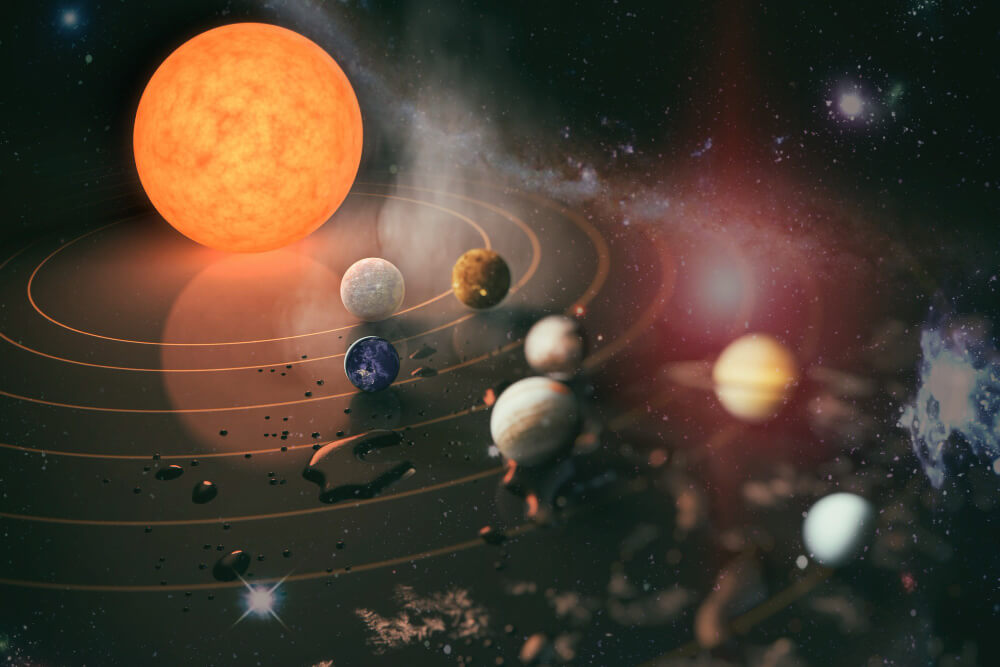
6. Mercury is the hottest planet in the solar system
Mercury is very close to the Sun, butVenus, located almost twice as far away, is hotter. The surface temperature of this planet is about 475°C. It's all about the atmosphere: on Venus, it is dense and consists mainly of carbon dioxide, which traps heat inside. In contrast, Mercury has a very thin atmosphere. When it turns away from the Sun at night, the surface temperature drops to -180°C.
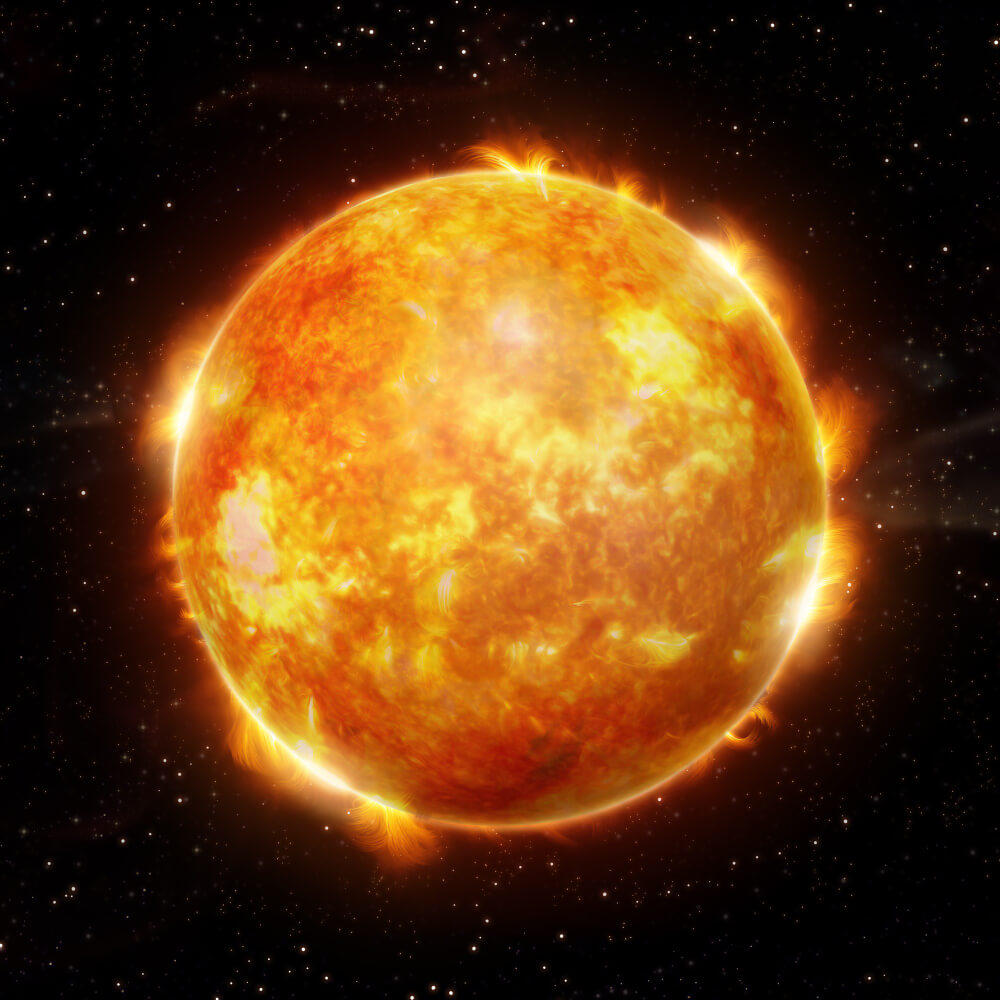
7. The sun is a yellow fireball
Fire is the result of combustion, and for thisA chemical process needs oxygen, heat, and fuel. If the latter two are in abundance on the Sun, then there is practically no oxygen on the Sun, since it consists mainly of hydrogen and gaseous helium. These two substances are used for nuclear fusion - every second inside the Sun, about 700 million tons of hydrogen fuse together, forming 650 million tons of helium and 50 million tons of energy in the form of gamma radiation. It is like an endless series of hydrogen bomb explosions.
In addition, the Sun is not yellow, it emits inall ranges of the visible spectrum and beyond. Therefore, in the visible spectrum, sunlight is white, and the earth’s atmosphere gives it a yellowish tint. The wavelengths of light in the blue part of the spectrum are much shorter than in the red part of the spectrum, making them more likely to collide with particles in the atmosphere. During the day, blue light is scattered high in the atmosphere, giving the sky a blue color and the sun appearing yellow.
In the morning and evening, the light that falls on the earth musttravel a greater distance, and this effect is enhanced. Most of the shorter wavelengths of blue dissipate before they hit the ground, giving sunrise and sunset its characteristic red-orange hue.
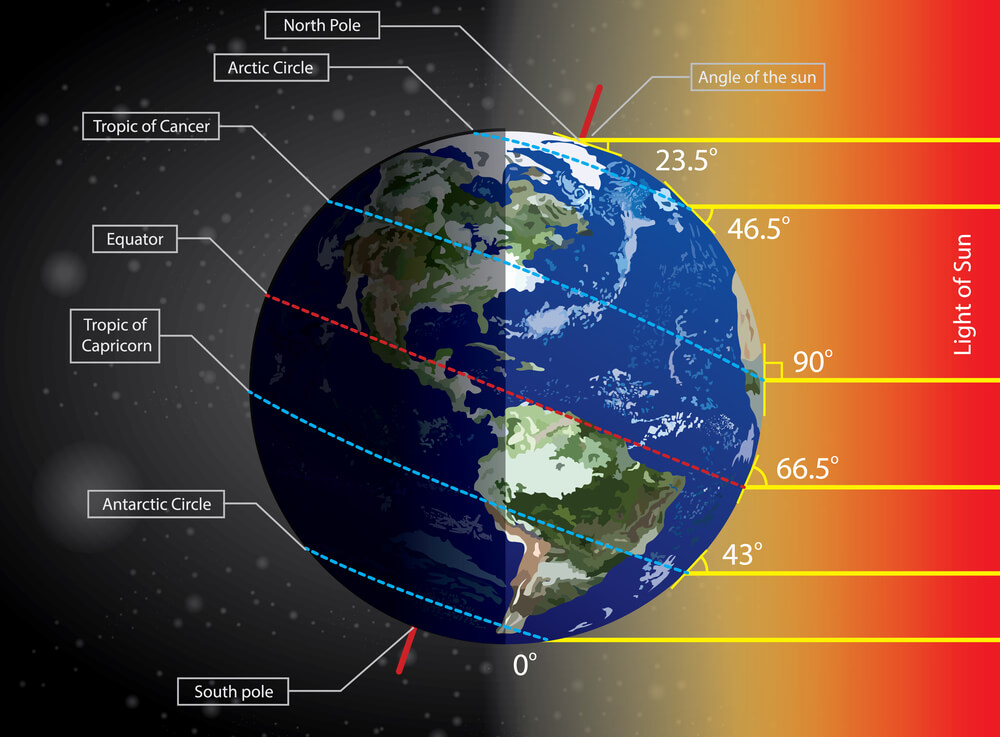
8. Earth is farther from the Sun in winter than in summer
The earth moves around the sun in an ellipticalorbit, but it's not quite what many people imagine. During the year, the distance between the Earth and the Sun changes by only 5 million km - this is about 3% of the total distance between them. Moreover, the inhabitants of the northern hemisphere are closer to the sun in winter than in summer.
The true reason for the change of seasons is the tiltearth's axis. Throughout the year, light strikes the northern and southern hemispheres at proportionally different angles and at different times each day. In winter, the days are short and light travels through the atmosphere at a gentle angle, colliding with gas molecules and scattering. In summer, the days are much longer, and sunlight hits Earth at a steep angle, heading more directly toward the surface and concentrating energy in a smaller area.
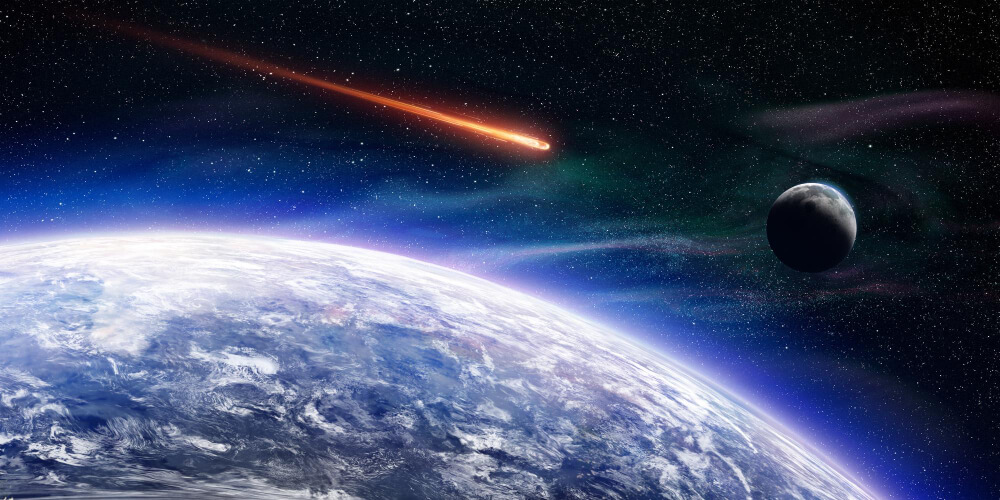
9. The tail follows the comet
Comets are essentially blocks of dirty ice.As they approach the Sun, they heat up, releasing gas and dust. On Earth, you would expect the resulting tail to point backwards, like the streak of a falling meteor, but in space there is no air. The main source of tail formation is solar wind pressure and radiation.
High energy ultraviolet lightcrashes into the comet's evaporating gas, stripping off electrons and forming charged ions. They are captured by magnetic field lines and shoot away from the Sun in the form of a blue ion tail. At the same time, the solar wind presses on dust particles, throwing them in the same direction. Therefore, the tail of a comet always points away from the Sun.
10. Spaceships heat up during landing due to atmospheric friction.
Vehicles intended fordescent are not streamlined, and friction is not the main cause of the incredible temperatures upon reentry. When a wide, blunt spaceship falls through the atmosphere, the gas molecules can't get out of the way fast enough and begin to accumulate, forming a cushion underneath the ship.
Heating is achieved by pressure.The closer the compressed molecules come together, the higher the temperature rises. Eventually the pressure becomes so strong that the molecules begin to rupture, creating a layer of charged plasma and a searing plasma corona.
Read more:
Scientists from the permafrost zone: how they develop smart clothes and a cancer vaccine
Scientists "cheated" time and sent a photon into the past: how this breakthrough will change physics
10 scientific facts that turned out to be fakes. Cards