For the second year in a row, the clock hands hover at 100 seconds until midnight, the hour of death.
Bulletin of the Atomic Scientists - Americana magazine that covers international security issues and threats posed by nuclear weapons - as well as other weapons of mass destruction, climate change and new technologies.
What is the Doomsday Clock?
The doomsday clock shows how peopleclose to destroying the world with dangerous technologies of their own production. They warn how many metaphorical minutes before midnight humanity has left. Every year, the staff of the Bulletin of the Atomic Scientists sets a new time and leaves the hands intact.
The clock appeared in 1947 to drawpeople's attention to the threat of proliferation and use of nuclear weapons. The scientists of the Bulletin considered it the greatest danger to humanity. In 2007, catastrophic disturbances caused by climate change began to be taken into account.
How does the Doomsday Clock work?
Until his death in 1973, editor of the BulletinEugene Rabinovich decided whether to move the clock hand. As a leader of the international disarmament movement, he actively communicated with policy experts and scientists around the world to set the clock and explained his opinion in the pages of the magazine.
Today the Council for Science andSecurity Bulletin is a group of 18 experts with diverse backgrounds ranging from politics and diplomacy to military history and nuclear science. Meetings are held twice a year to discuss events, policies and trends. The position of the clock is announced at the end of January.
The Bulletin now recognizes three main threatscivilizations: climate change, nuclear proliferation and dangerous technologies (experts include here the problem of bio- and cybersecurity). “Each of these threats can destroy civilization and make the Earth uninhabitable for people,” the scientists say.
The best and worst time for mankind
The quietest time, according to scientists,was in 1991. Then the time on the clock was set to 17 minutes to midnight: all because of the collapse of the USSR and the signing of the Treaty on the Reduction of Strategic Offensive Arms (its first version, START-I, was signed in July 1991) between Moscow and Washington.
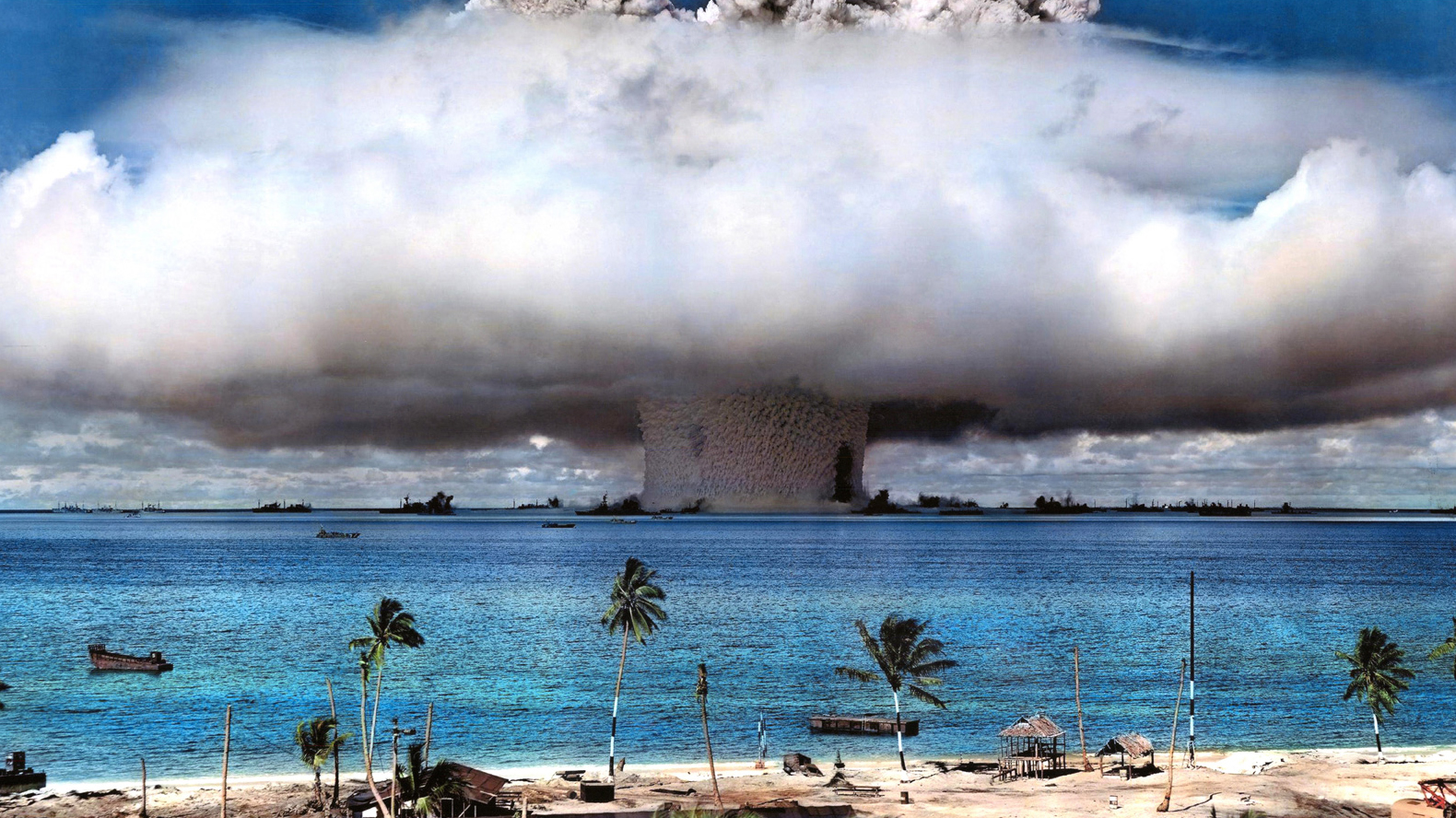 A mushroom cloud over an atoll in the Marshall Islands on July 25, 1946, when the United States detonated Baker's bomb underwater. Image courtesy of the US National Nuclear Security Administration
Until recently, the closest possible time (twominutes to midnight) was installed twice - first in 1953, when the US and the USSR tested thermonuclear weapons, and then in 2018. At the time, scientists accused world leaders of "failing to respond effectively to the threats of nuclear war and climate change." In 2019, the time has not changed, and in 2020, the hands moved as close as possible in history - 100 seconds before midnight. The reason is the COVID-19 pandemic, as well as climate change and instability in the world. The situation continued in 2021 and 2022.
It's been a tough year, but the clock hasn't moved. Why?
By annually setting the Doomsday Clock, expertsThe Bulletins answer two important questions: "Is humanity safer this year than last?" and “Is humanity safer this year than the previous 75 years?”.
Despite the pandemic and climate change, pastthe year will be remembered for progress in nuclear weapons control. As Scott Sagan, a member of the Bulletin's Science and Security Council, noted, the United States and Russia have resumed diplomatic dialogues on limiting arsenals and maintaining nuclear stability. This inspires hope.
However, relations between the two countries remaintense. In addition, China is testing new anti-satellite weapons, North Korea is producing new nuclear materials and developing short-range missiles for nuclear weapons, and nuclear stockpiles in India and Pakistan continue to be a cause for concern around the world. As a result, “the world is facing an uncontrolled arms race,” the scientist notes.
Why do we need the Doomsday Clock?
Initially, the project was launched to monitornuclear weapons, the use of which will affect humanity and the planet as a whole. Today, this threat remains, but the problem of climate change has become no less serious. “The clock metaphor is especially important in this case because there are tipping points for the climate when you can’t go back,” Bulletin director Rachel Bronson told the University of Chicago’s Big Brains podcast.
However, scientists constantly emphasize that the Clocknot meant to scare people. Their task is to push humanity to action. Professor Robert Rosner calls them "the canary in the coal mine" - a signal that encourages miners to take quick action to save their lives.
Read more
The fungus that infects covid patients with “black mold” has learned to bypass the immune system
Probably protons are much smaller than previously thought
Astronomers photographed the black hole at the center of a spiral galaxy