We have already introduced the most curious readers in the worldggwith Samsung's strategy for 2020 presented
TVs and their lines every major companythis market produces, to put it mildly, a lot. But every year the focus of consumer attention is on one thing, advanced and expensive - where the manufacturer can either gain a competitive advantage or earn more (ideally, both, but this rarely happens). For example, in 2009, the emphasis was on LED backlighting of panels (then, for example, the term LED TV appeared, although these were still the same LCD TVs as before). In 2010, the short-lived era of 3D TVs began. In 2011, the first SmartTVs appeared. Experiments with televisions also did not begin today - in 2011 there was an attempt to build television tuners into monitors, which did not take root. Curved TVs, which appeared in 2014, were initially a dead end (curved monitors, on the contrary, turned out to be very convenient to use), but they were necessary for the transition to the industrial production of bendable displays that we see now. Around the same time, TVs with 4K resolution began to be sold.
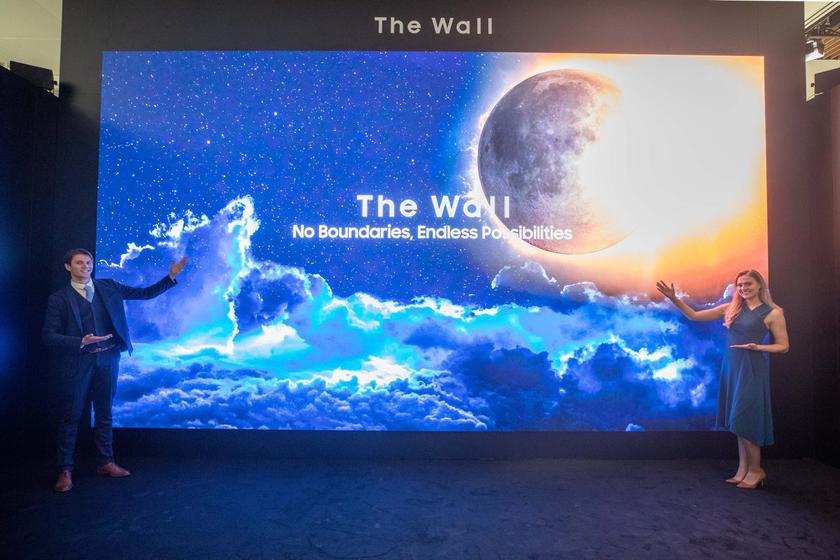
Samsung has several directions in 2020on TVs. Some of them are exotic, created for growing market segments (there is no one there yet, competition is low, but there are prospects for growth). These TVs include The Wall series of TVs with MicroLED technology. These are panels for huge interiors with diagonals from 146 to 292 inches with wide possibilities for customization (that is, individual ordering, here you need to understand that these are not TVs for the home, but rather for conference rooms and other business buildings, plus use for events and exhibitions). The aspect ratio can vary from 16:9 to 21:9, the resolution can be not only 8K, but also 4K.
The second direction is designer seriesTVs The Serif, The Frame and this year’s series The Sero (It appeared in South Korea last year; the native market is always used by Korean companies for experiments, the most successful of which receive carte blanche to expand to the global market).
Finally, the third direction, the most massive (andtherefore, the most interesting thing for us) - consumer QLED TVs with quantum dot technology. The emphasis in this series is on SmartTV functions and 8K resolution in older models. And also new technologies are used (as a rule, we are talking about intellectual processing of sound and images), which are worth mentioning.
Samsung The Wall TVs on MicroLED

</ img>
There is little information about these TVs - eachsold individually, this is a true B2B segment of the large projection panels that we see most often at concerts. MicroLED technology is interesting because each pixel lights up and is controlled separately; this technology also has fantastic brightness and contrast performance with low power consumption. And also pay attention to the truly frameless screen. Such a TV can actually take up the entire wall if the customer has the appropriate desire and money.
TVs Samsung The Frame

</ img>
The Frame series TVs are interesting becausesolve the problem of a huge black spot on the wall (more often) or in the apartment, which is formed by the screen of a switched off TV. These TVs, in standby mode, can display one of the paintings of contemporary artists, the number of which numbers in the hundreds to choose from. It is obvious that the evolution of televisions in the next couple of decades will lead to the appearance of wall-screens that will broadcast landscapes of remote corners of the planet and/or form the interior of a room, predicted by Ray Bradbury in the story “The Veldt” (by the way, a story from 1950, appreciate the visionary author). These TVs also have replaceable frames, allowing them to better match the interior (and for the manufacturer to provide additional income from a device already sold). It's also worth remembering that all of these designer TV series are aimed at an audience for whom price is not a deterrent, as it is for the majority of the population, so you should not be surprised by their price, just as no one is surprised by the prices of supercars.
TVs Samsung The Serif

</ img>
About The Serif series TVs created byWe have also already written about designers by the Bouroullec brothers (Ronan & Erwan Bouroullec). These are interior TVs that can stand in the center of the room or on the table. Their profile forms the letter I in profile with serifs. The power and connection cables are hidden in the leg (you can see how it looks in the photo below). And this is yet another evolution of TVs becoming another screen in the home that users constantly interact with. Televisions have long gone beyond the scope of watching TV channels or movies, which cannot but be reflected in usage scenarios and changes in their perception and role in our lives. This experiment precisely reflects the movement of the industry in the appropriate direction, offering users something new.

</ img>

</ img>


TVs Samsung The Sero
We have already written about who they are intended for.The Sero TVs, so let’s briefly touch on the most important thing. Sero means “vertical” or “new” in Korean. This is what the official promotional video for this TV looks like:
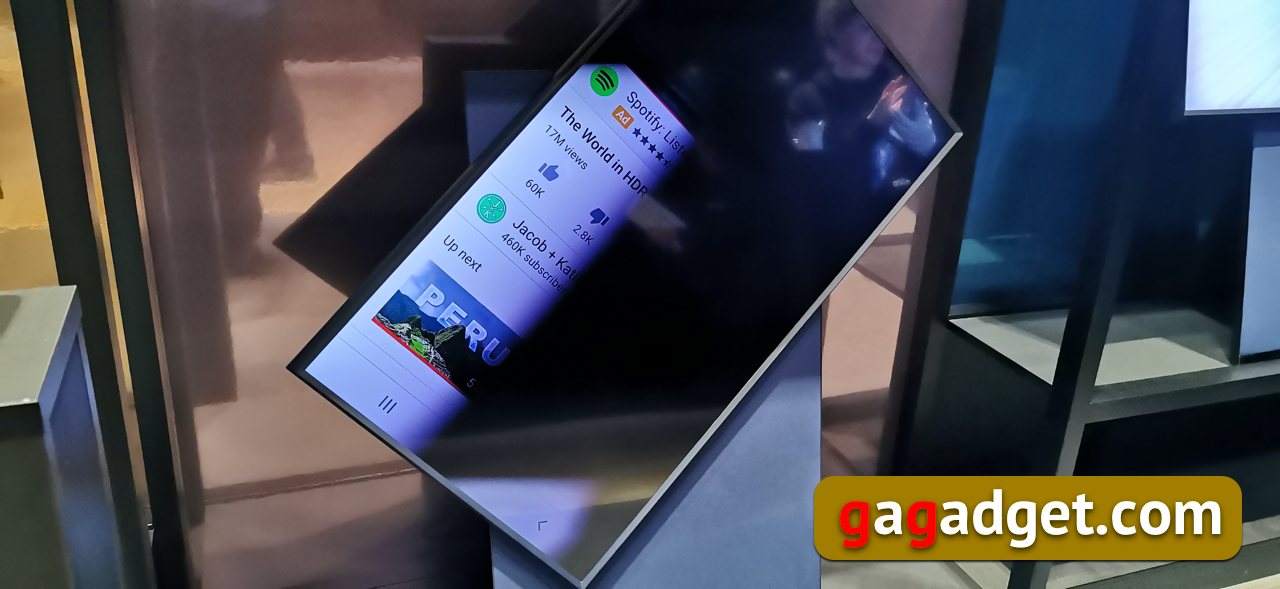
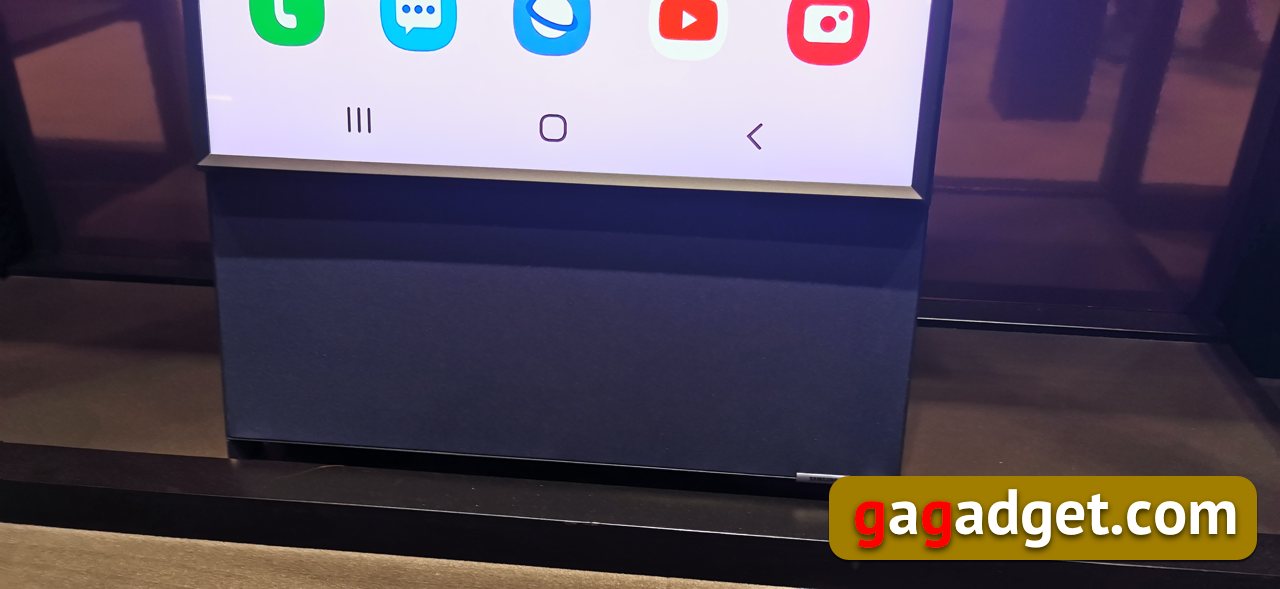
This TV only exists in one43-inch diagonal and reflects the movement of users towards vertical video consumption (thanks to Instagram stories and the growing popularity of TikTok around the world). According to statistics, 90% of smartphone users watch videos on them. And already 40% of the video watched is in the vertical format. That is, such a TV will clearly not be the first (and almost certainly not the second) in the house. And it will be appropriate for those users who often hold all sorts of parties with the opportunity to show off their video from a smartphone. Separately, we can highlight an interesting scenario for using such a TV - using it to organize parties and presentations with guests who will be able to show their video from their phones on the big screen. Such interactive formats are already used, for example, in the form of photo booths for Instagram, where you can print a photo from your phone and send it to Instagram with a special hashtag dedicated to the party.

</ img>
</ img>
</ img>



Everything is very simple in work: touch the TV screen with the phone, after which (thanks, NFC) the TV connects to the smartphone. Then it’s enough to expand the orientation of the smartphone so that the TV itself repeats this after you. Have a look:
Samsung 8K QLED TVs
Finally, the most interesting for us are the new Samsung QLED TVs of 2020, led by the flagship Q950.

</ img>

</ img>

It is interesting with a thin-frame screen, thankswhich has a record for the industry ratio of screen area to housing of 99% and a thickness of 15 millimeters. There are 8 speakers on the rear panel, the TV itself, of course, supports 8K resolution and all these newfangled AI technologies (in essence, we are talking about machine learning and the use of neural networks).

</ img>

</ img>

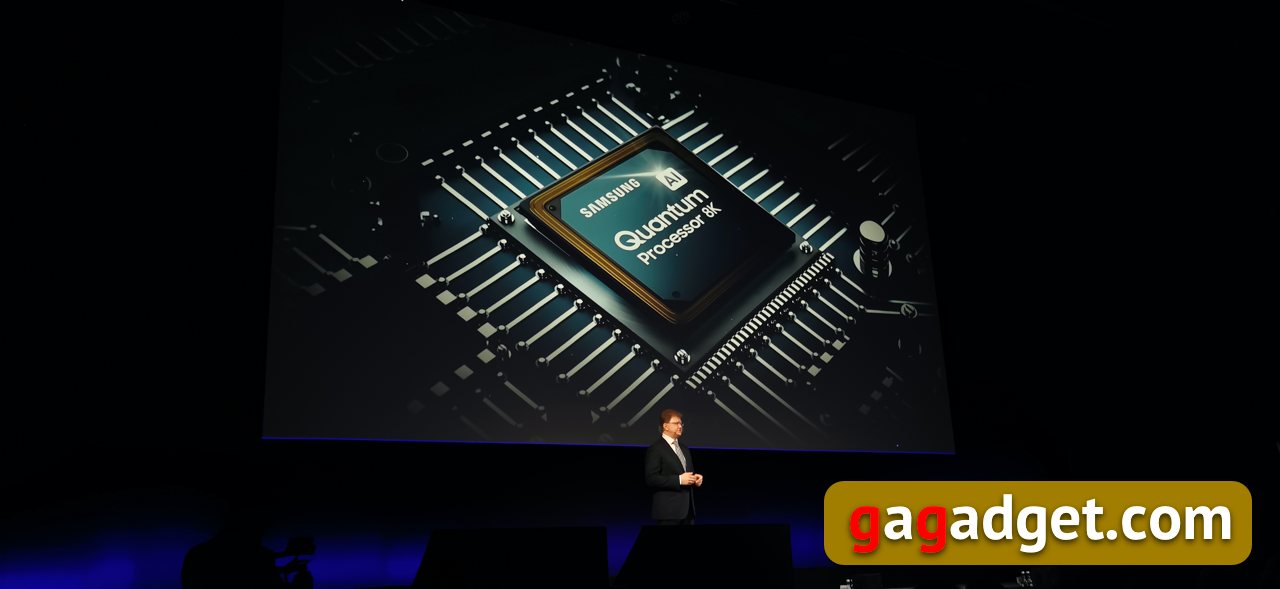
The heart of the new TVs is the Quantum AI 8K processor.
</ img>
All his computing power is used,firstly, to scale the image to a resolution of 8K. And secondly, for continuous analysis of the image and sound and their automatic correction. He determines the scene and selects the optimal sound mode and brightness. Able to increase the brightness of individual objects and control the sound, depending on its source on the screen.
In addition to the now common features for improving sound and video, several proprietary features have appeared on Samsung TVs in 2020:
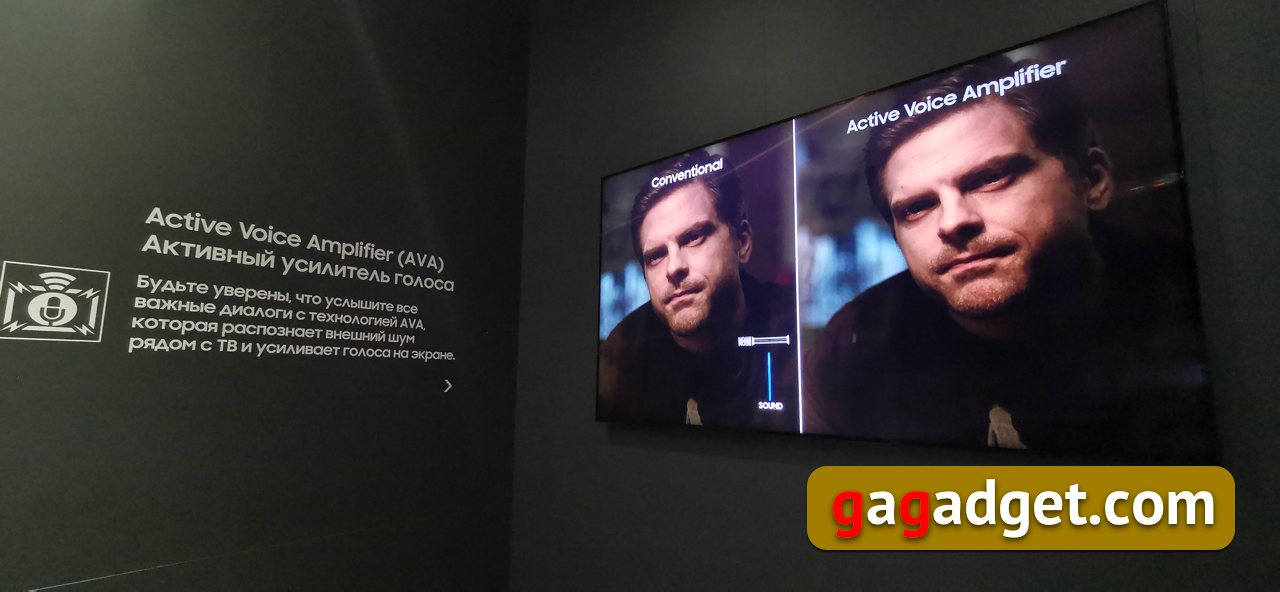
Active Voice Amplifier
The TV constantly analyzes during operation(presumably with the help of microphones used for voice commands) the surrounding sound and when noise appears (a vacuum cleaner is on or a neighbor with a hammer drill) automatically increases the volume of the sound in speech so as to compensate for external noise. It looks interesting, but in practice I wasn’t able to test the operation of this function on a stand - the power of the hand-held vacuum cleaner there was low, and I didn’t have a hammer drill at hand.
</ img>

</ img>


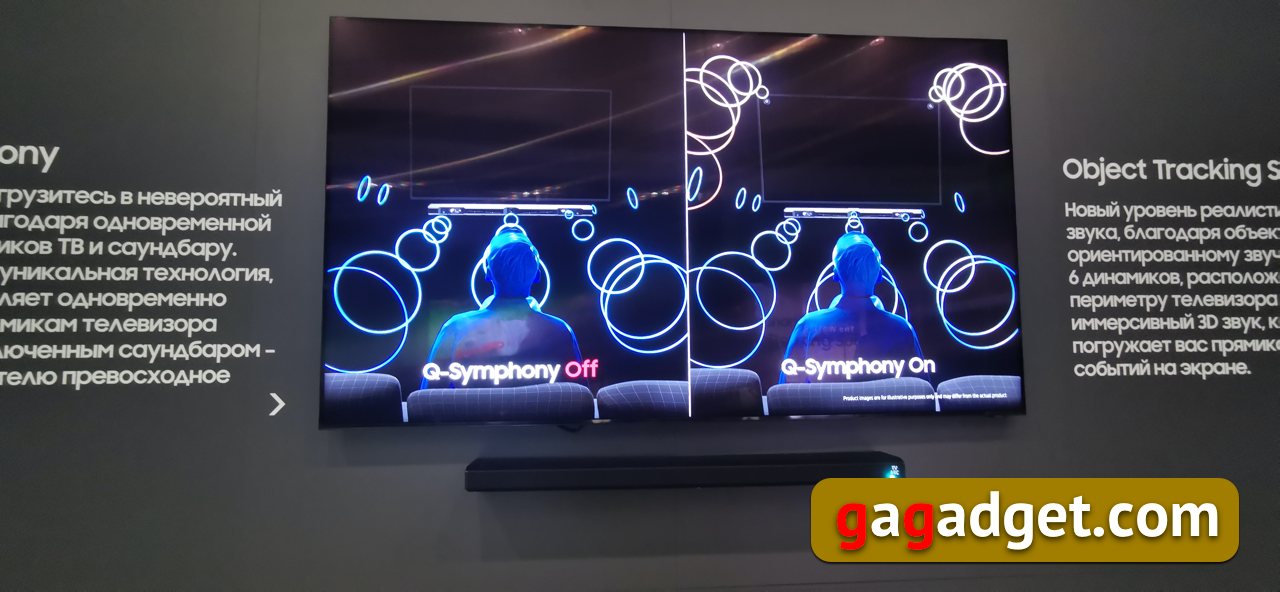
Q-Symphony
Another nice feature is the simultaneousUsing the TV speakers with a connected Q series sound bar. You can usually select one audio source or the other. But together they really create an excellent acoustic picture, complementing each other. This operating mode is called Q-Symphony.
</ img>
Object Tracking Sound +
Another nice feature is trackingsound sources in the frame and redirecting sound to the right places. It works interestingly - a similar system is found in Sony's flagship OLED TVs. To be fair, this all works great if you are directly in front of the TV. Two or three sound sources moving across the screen at the same time can actually be heard precisely from those areas of the screen where they are located. But from a distance of 3-4 meters (and this is how large TVs are viewed) the effect will not be so strong.
Multiscreen
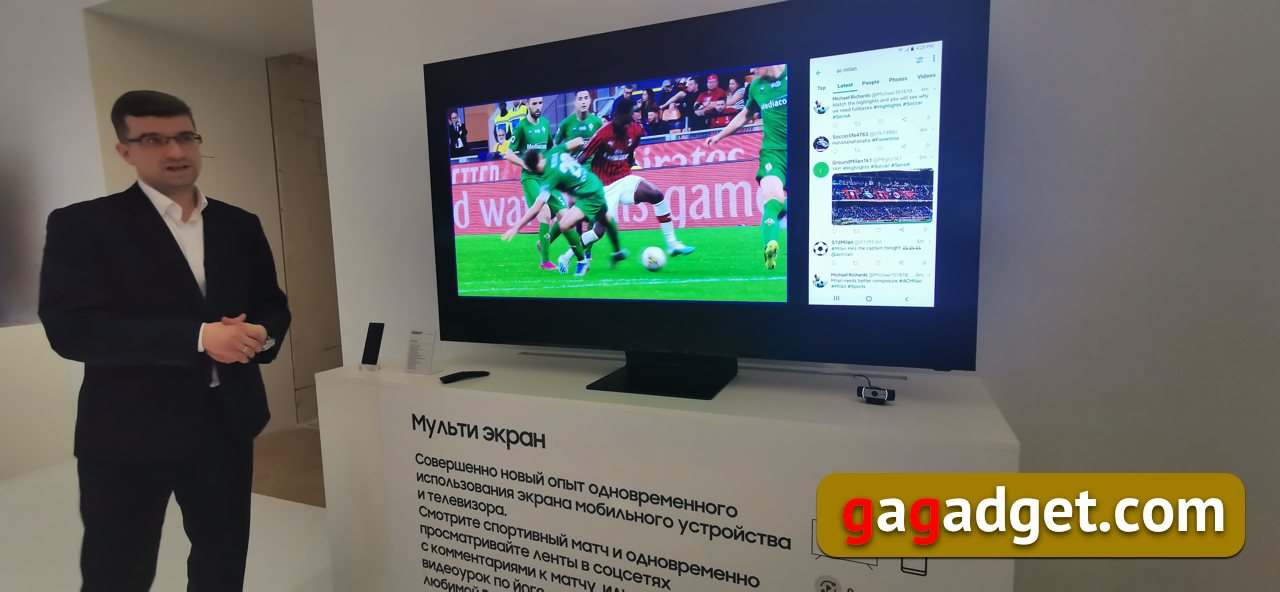
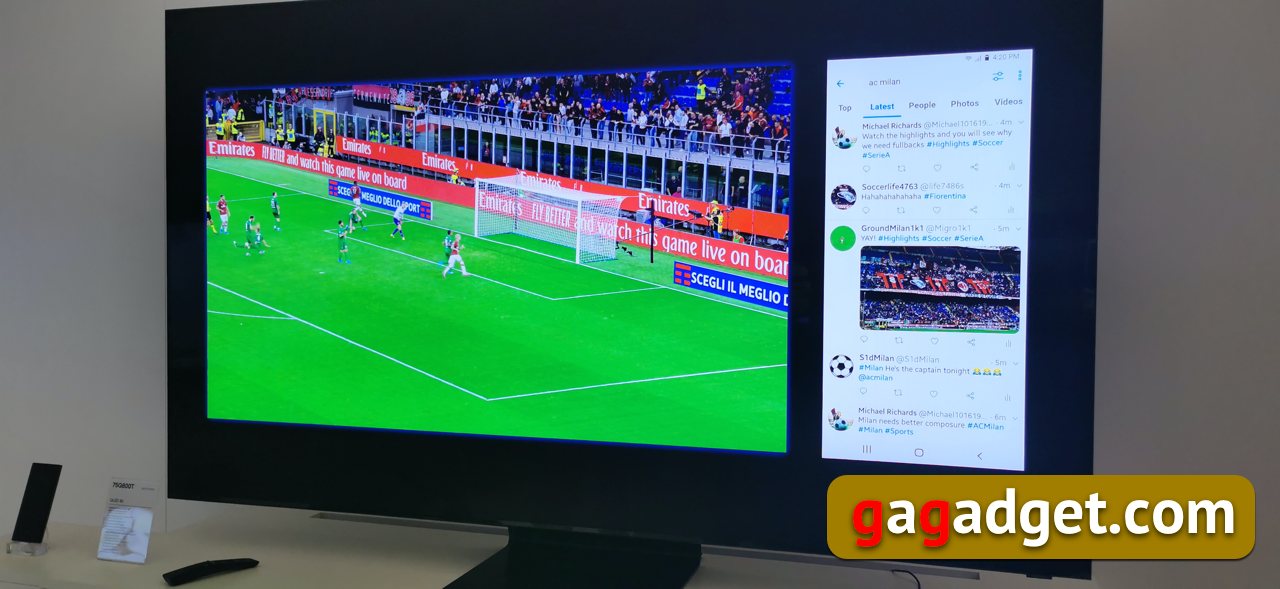
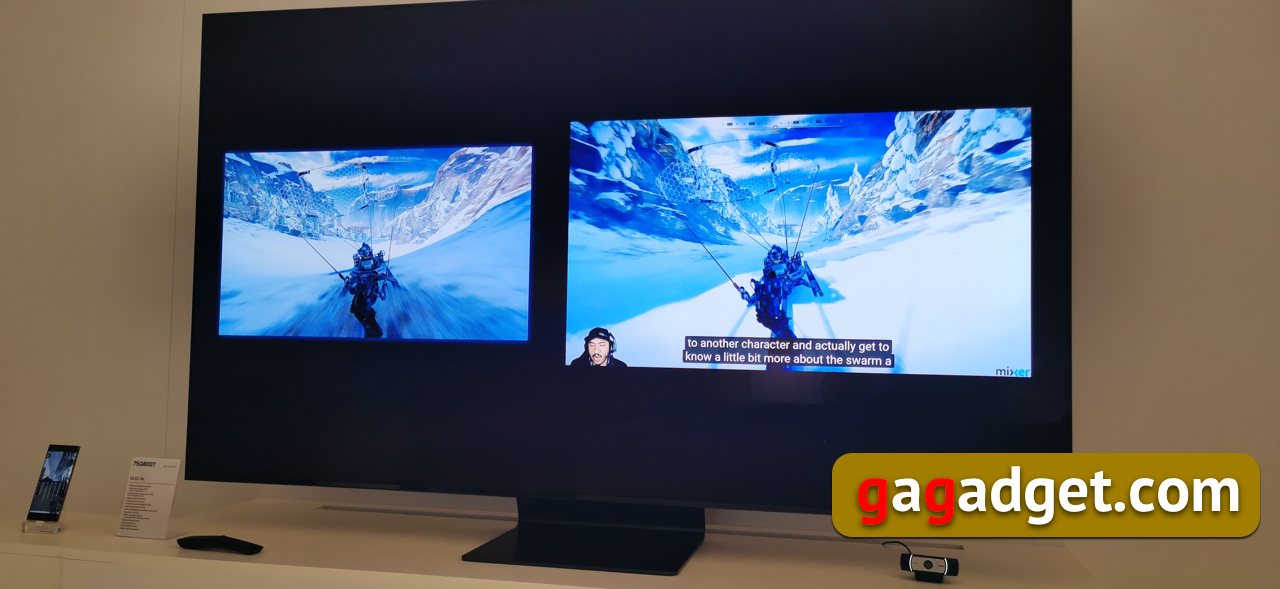
Another interesting opportunity is thoughtfuluse of two screens. The picture-in-picture function will not surprise anyone today, but Samsung went further. Firstly, you can connect its discussion to the broadcast of a sports match (although it’s not yet clear from which source it looks like comments on a broadcast on Twich or YouTube, perhaps the sources will be customizable). Another scenario for using this feature offered by Samsung is to display the game and video broadcast with its passage on the TV screen (again, Twich or YouTube?). At the same time, you can choose the sound source - your own game or broadcast with the passage.
</ img>
</ img>
</ img>



In the dry residue
Samsung TVs are ready for something new in 2020sales season like never before. TVs have a clear and tangible advantage in the form of 8K resolution (for those who prefer progress, plus scaling is becoming smarter, so the content problem is solved even better than at the start of 4K or FullHD). There is QLED technology that demonstrates excellent results in image quality. And there are new opportunities opening up thanks to the introduction of AI processors that analyze sound and image in real time. At the same time, Samsung does not forget to look into the near and yet to come future, thanks to a whole series of designer TVs, which have increased by another line this year (albeit still consisting of one model). If it weren’t for its own Tizen system, which is inferior to the same Android TV in terms of the number of applications, games and features, as well as attempts to impose its Bixby voice assistant on everyone, this would be an ideal choice for buying a TV in 2020. But, as we know, nothing is ideal in this best of worlds, so the final choice is always up to His Majesty the Consumer.