A team of researchers led by Houston Methodist Hospital has developed a thin
 Implant and a coin of 25 cents. Image: Houston Methodist
The developers called their device NICHE.This is a flat implant that is placed under the skin. It consists of a reservoir for islet cells and a reservoir for immunosuppressants. The developers note that a device ready for implantation can be printed on a 3D printer in a few minutes. At the same time, this is the first platform that is used simultaneously for cell transplantation and control of the immune response.
The device includes external "ports" forrefilling medicines as needed. In their animal experiments, the researchers replenished the drug reservoirs every 28 days. This is comparable to other long-acting medications that require periodic visits to the doctor, such as migraine prophylaxis or HIV treatment. However, the researchers plan to fine-tune the device before clinical trials to “refill” it once every 6 months.
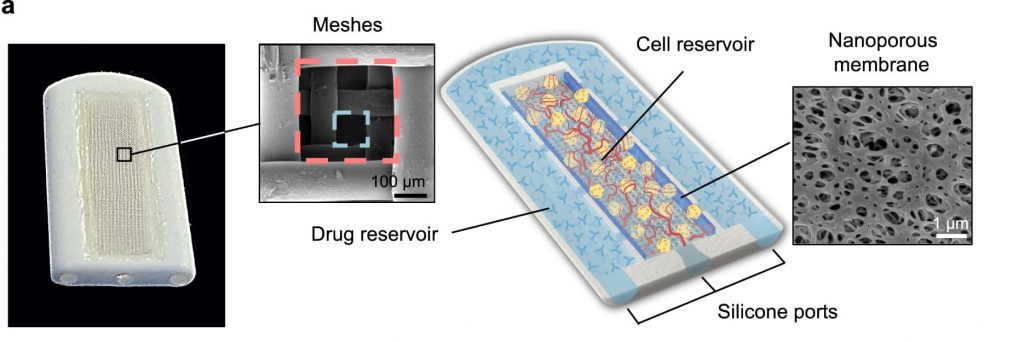 implant device. Image: Jesus Paez-Mayorga et al., Nature Communications
Type 1 diabetes is a common diseaseassociated with an autoimmune reaction that destroys pancreatic cells. With this disease, the body does not produce enough insulin. The most common treatment is continuous insulin injections. However, in more complex cases, patients require regular transplants of islet cells (endocrine cells) from the pancreas of posthumous donors.
This transplant improves the patient's condition,but, as with any organ transplant, it requires immune suppression to avoid rejection of donor cells. The use of immunosuppressants has traditionally been associated with many side effects. The researchers note that the new technology, in which both the transplanted cells and the immunosuppressant are administered locally in the same device, will reduce the number of side effects.
Read more:
The tomb of the “midwife of Jesus” was unearthed: scientists told what they found there
Einstein is wrong again and his main theory was rewritten: how it changes the world
The loss of one oxygen atom leads to the birth of girls with an XY chromosome