For 40 Earth years, or more than three full years on Jupiter, NASA planetary scientists have been collecting data on the change.
In a study publishedin the journal Nature Astronomy, researchers analyzed images of a bright infrared glow that rises from warmer regions of the atmosphere. These images, taken at regular intervals during Jupiter's three revolutions around the Sun, showed how the temperature on the planet changes.
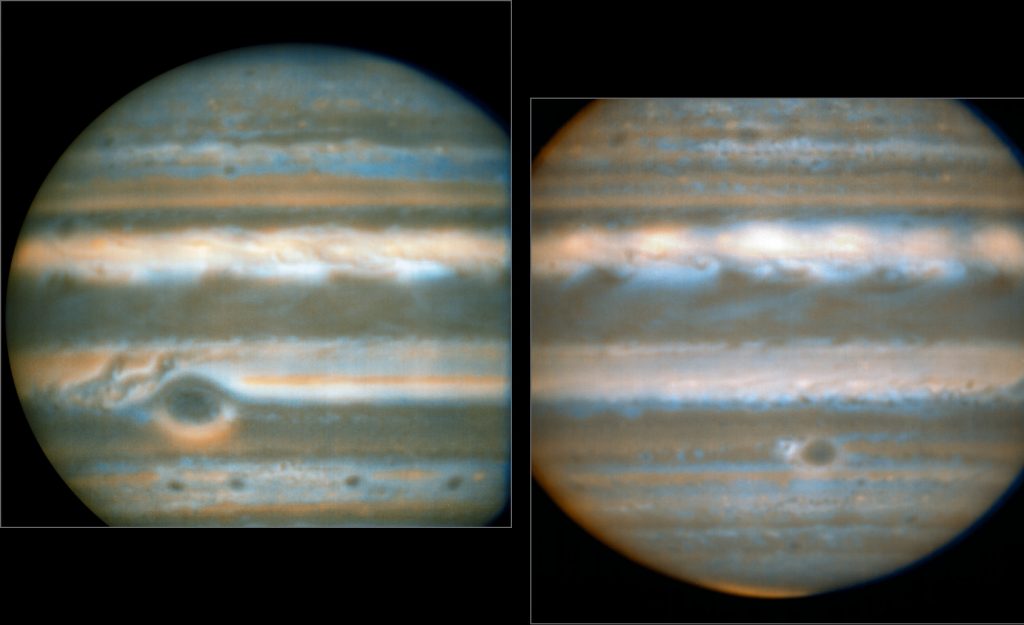 Infrared images of Jupiter taken by the Very Large Telescope (VLT) in February (left) and March (right) 2016. Image: ESO/L.N. Fletcher
Planetologists have discovered that the temperature of Jupiterrises and falls according to certain periods, which are not related to the seasons or any other known cycles. Moreover, the low inclination of the planet with respect to the plane of the ecliptic does not imply pronounced seasons on the planet at all.
In addition, the study also founda mysterious connection between temperature shifts in regions thousands of kilometers apart: as temperatures rose at certain latitudes in the northern hemisphere, they decreased at the same latitudes in the southern hemisphere - as if reflected in a mirror located at the equator.
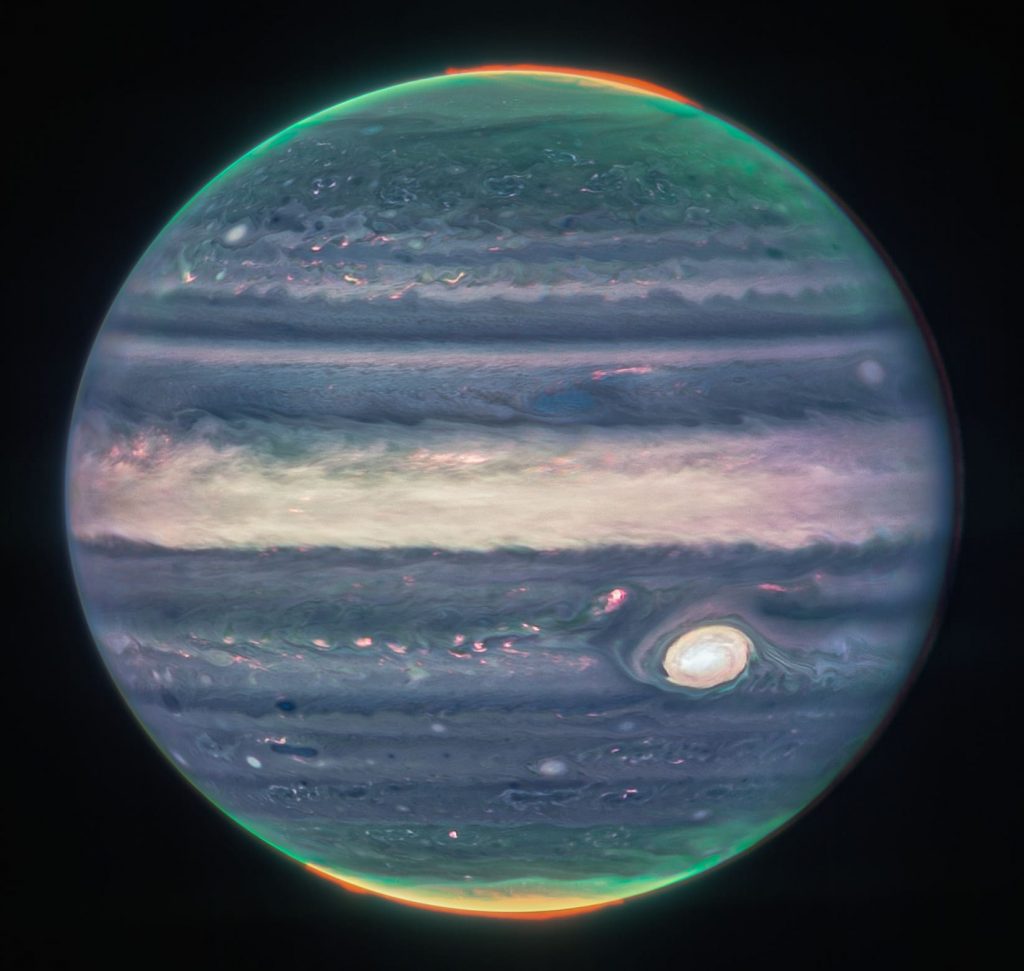 Jupiter as seen by the James Webb Space Telescope in 2022. Image: NASA, ESA, CSA, Jupiter ERS Team
Although the reason for such "reflections" is not completelystudied, the researchers noted that similar fluctuations propagate in the stratosphere - the higher layer of the atmosphere. Perhaps it is the upper layers that control the weather on Jupiter, they believe.
Jupiter's troposphere has much in common with Earth's:here clouds form and storms rage. Of greatest interest to scientists is the upper troposphere - the layer of the atmosphere in which the main weather phenomena are formed, including the characteristic colorful striped clouds.
To understand how the weather changes on a gasgiant, scientists studied wind, pressure, humidity and temperature. It has been known since the first Pioneer missions in the 1970s that light and dark areas in clouds correspond to different temperatures. But there was not enough data for a deeper analysis of climate change.
The researchers believe that this and future research will help to better predict the weather on Jupiter and understand the principles of climate formation on other planets.
Read more:
17-year-old engineer came up with a magnetless motor: it can be used in electric vehicles
Two planets have been found not far from Earth. Perhaps they are inhabited
A unique meteor rewrote the history of the solar system: where did it come from
Cover: Jupiter as seen by the James Webb Space Telescope in 2022. Image: NASA, ESA, CSA, Jupiter ERS Team