According to the United Nations, on November 15, 2022, the world population reached 8
Even though the world as a whole continues to growwith rather high rates, the contribution of various regions and countries to the increase in the number differs significantly. Countries with the highest birth rates tend to have the lowest per capita income. Thus, global population growth is increasingly concentrated over time in the world's poorest countries, most of which are in sub-Saharan Africa.
How has the world population changed?
At the dawn of agriculture, around 8000 BC.According to researchers, the world population was about 5 million people. Over the 8,000 years before the beginning of our era, it grew to approximately 200 million. This is a very rough estimate based on available data.
Different methods give estimates that differ inseveral times: you can find figures of 300 or even 600 million people. But all scientists agree that for the first time humanity reached a billionth population only in the last quarter of the second millennium of our era.
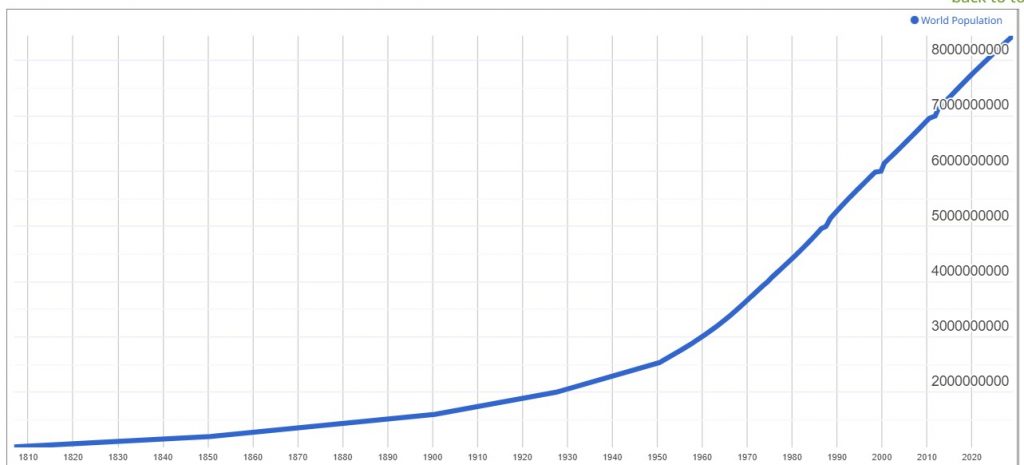 Estimated population of the Earth in 1800-2020. Data: Worldometer
Huge changes have taken place sinceindustrial revolution: while in the entire history of mankind by about 1800 the world's population crossed the threshold of one billion, the second billion was reached in just 130 years (1930), the third billion in 30 years (1960), the fourth billion in 15 years (1974) and the fifth billion in just 13 years (1987).
The largest population increase occurred at the end1960s. Then the growth rate reached a record high - 2.09%. Although the population continues to increase, the rate at which these changes occur has slowed significantly. For example, in 2022, it is estimated to be 0.84%.
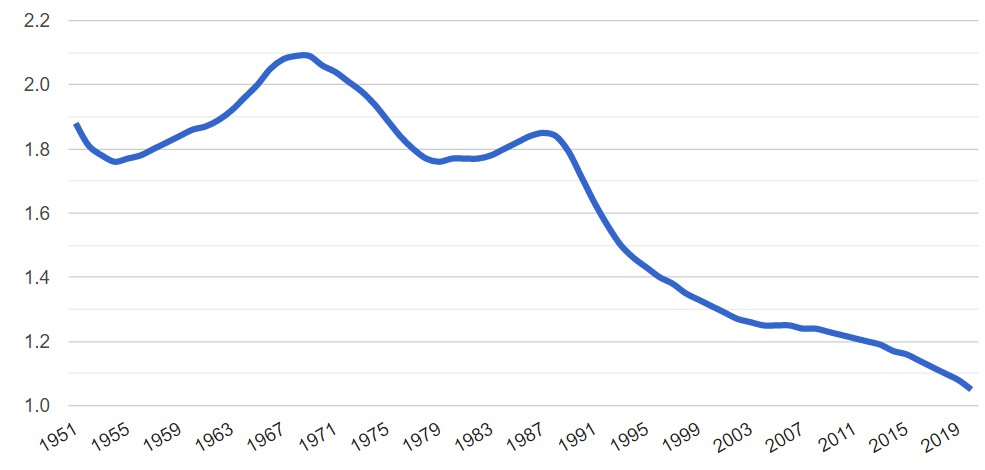 Change in the growth rate of the world's population. Data: Worldometer
Changes are associated with a decrease in the levelfertility, increasing the availability of contraceptives and the development of the economies of countries. Raising the level of education, especially among girls, and increasing employment opportunities for women have played a key role in these processes.
On average, women now give birth twice, not five.times like in 1950. However, the numbers vary by region. In sub-Saharan Africa, women give birth to more than four children, and in the Pacific or Oceania (excluding Australia and New Zealand) - three.
How are 8,000,000,000 people distributed?
As of 2020, more than half of the populationThe land was concentrated in Asia. It is in this region that two countries are located, the population of which exceeds a billion people. At the same time, according to UN forecasts, as early as 2023, India will overtake China and become the most populous country. The country's population growth is expected to continue until around 2050, while China's population will continue to decline.
Overall in East and Southeast AsiaBirth rates have been declining rapidly since the 1960s, when China introduced the One Family, One Child policy. The region's population is projected to reach 2.4 billion by 2030, after which it will gradually decline.
By contrast, in Central and South Asia, growth ratesof the population are declining more slowly and amount to 0.9% for 2022. The population of this region is expected to continue growing until it reaches 2.7 billion in 2072.
Demographic changes, including increasingliving standards in Asian countries and rising health care in Africa are expected to lead to changes in population structure. Already, the fastest growing region is sub-Saharan Africa.
Growth rates in this region peaked -3% - in the 1970s. Since then, they began to gradually decline, but even in 2022 they are 2.5% of the year, which is more than three times the global average. The UN believes that by the end of the 2060s, this region will become the most densely populated, and by 2100 the number of Africans will reach 3.44 billion people.
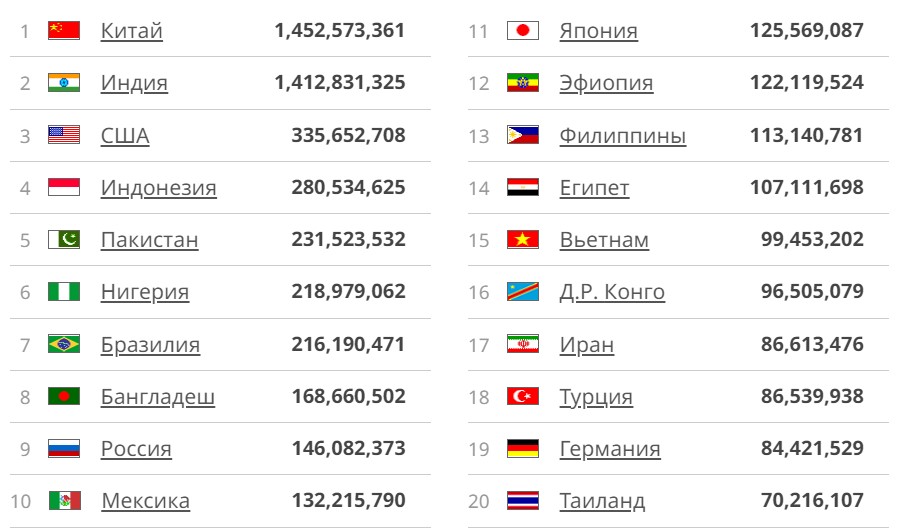 Population estimates for the 20 largest countries in the world. Data as of 11/15/2022: Worldometer
Population over half of 54 African countriesdouble, if not more, by 2050 as a result of consistently high birth rates and declining death rates. In the whole world, during this period, more than half of the population growth will occur in eight countries: the Democratic Republic of the Congo, Egypt, Ethiopia, India, Nigeria, Pakistan, the Philippines and Tanzania. At the same time, the population of the Congo and Tanzania will double over the next three decades.
Is the Earth in danger of overpopulation?
At the end of the 18th century, the English scientist ThomasRobert Malthus formulated the foundations of the theory that later became known as Malthusianism. The researcher believed that the population is growing exponentially (doubling every quarter of a century in the absence of wars and disease), and the resources of the Earth are limited. It followed from this that, if the growth of the population is not restrained, over time, resources will no longer be enough for all the inhabitants of the Earth.
Real empirical research has shown thatMalthus, relying on the historical data of that time, made two mistakes at once. First, he did not take into account the possibility of exponential growth in production, including food, associated with technological progress. And, secondly, Malthusianism could not predict the natural change in population growth rates as countries developed.
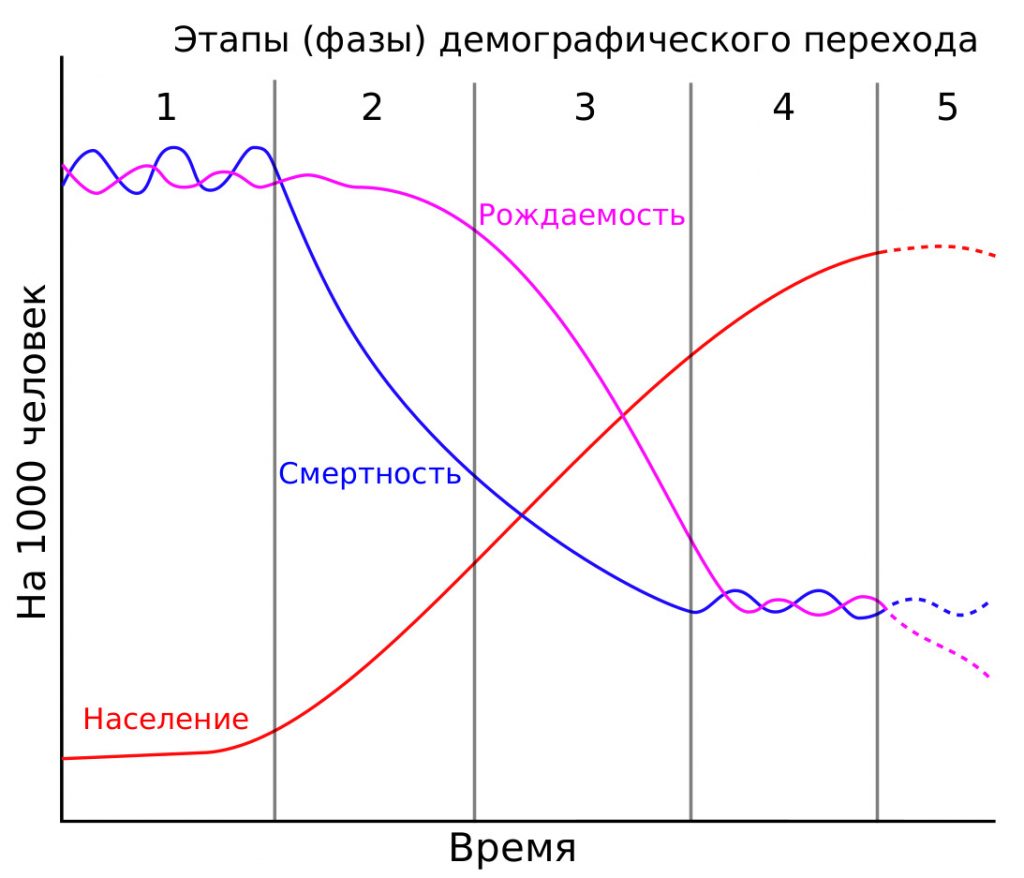 Stages of demographic transition. Image: Stage5.svg: *Stage5.jpg: en:User:Charmed88derivative work: NikNaks93 (talk)derivative work: Ain92, CC BY-SA 3.0, via Wikimedia Commons
Since the beginning of the industrial revolution and the transition fromtraditional society to industrial and later post-industrial, all countries of the world sooner or later face a demographic transition: a rapid decline in fertility and mortality.
This process begins with the improvementnutrition, medicine and living conditions led to a decrease in mortality. In addition, the spread of education, freedom to choose a profession and the growth of opportunities for professional realization, especially for girls and women, have led to a gradual decline in the birth rate. At the first stage, these two processes cause a population explosion, since the death rate decreases faster than the birth rate, but later it slows down, stops, and may even turn to depopulation.
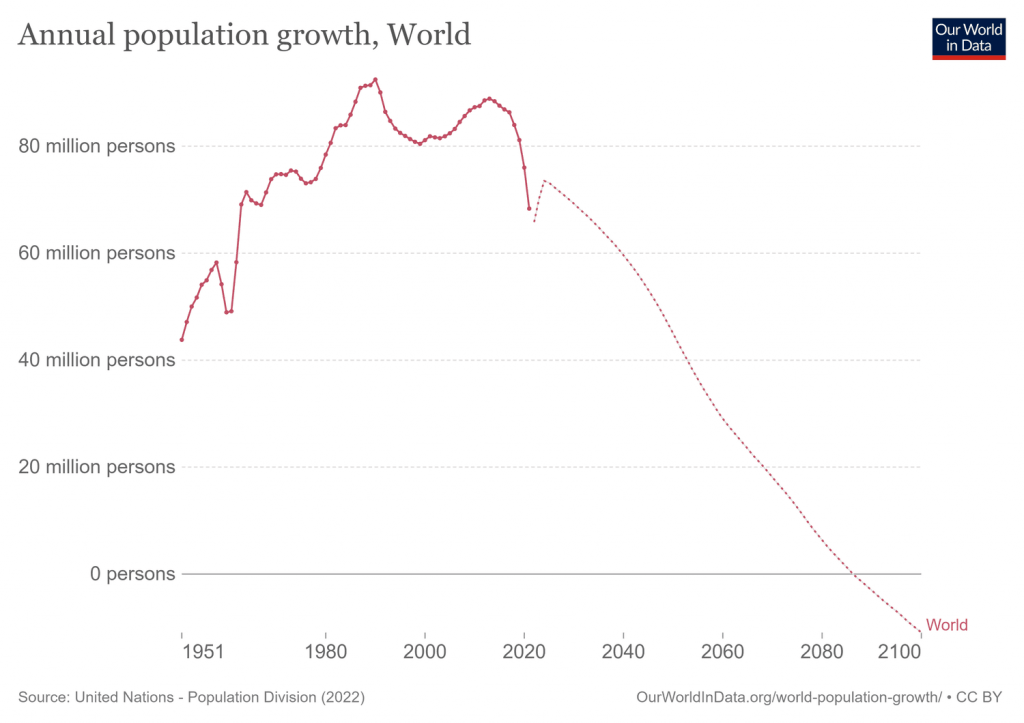 Annual increase (loss) of the world population. Historical data and forecast. Image: Our World in Data
Faced with these processes sooner or latercountries around the world, regardless of economic and social structure, religion or traditional ways. Global average growth fell below 1% in 2020 for the first time since the early 1950s. The UN believes that the world's population will peak at 10.4 billion by 2080, after which the population will stabilize at this level for the rest of the century, with possible small deviations.
Read more:
The main theory of the origin of man was refuted: where did we come from
Named the consequences of a gas leak from the "Nord Stream"
NASA's New Theory: We Haven't Encountered Extraterrestrial Civilizations Because They All Died