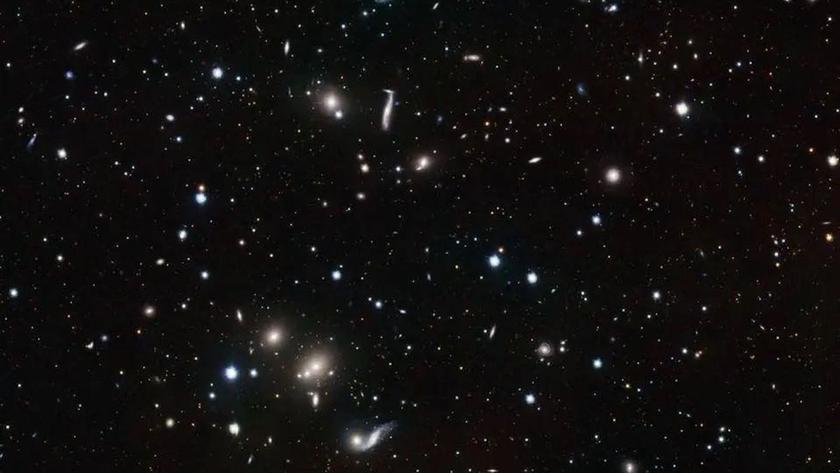
Popular web portal Bigthink has calculated that even if humanity could travel at speed
From Earth, we can observe space objects ondistance up to 46.1 billion light years. According to scientists, our visible universe contains about 2 trillion galaxies. But at distances in excess of 14.5 billion light years, galaxies are receding extremely quickly. Over time, their speed decreases, but remains relatively high.
The limit of the reachable Universe – 18 billionlight years from Earth. If humanity today began to explore space at the speed of light, it could reach galaxies up to this limit. But this is only 6% of the currently visible Universe.
There are about 160 billion stars every year,sufficient for the formation of a small galaxy, are removed from the Earth at unattainable distances. Thus, every year there are fewer and fewer space objects that humanity can theoretically reach.
Source: bigthink
Illustrations: ESO/INAF-VST/OmegaCAM
</ p>