An international team of astronomers led by the Space Research Laboratory (LSR) and
The planetary nebula itself is called IPHASX J055226.2 323724.This is the third time scientists have foundIn total, about 4,000 planetary nebulae have been discovered in the Milky Way.In addition, IPHASX J055226.2 323724 is the oldest object of this type ever found.
The authors of the study found that the kinematic age of the nebula is 70,000 years.In their assessment, the scientists relied on how fast it is expanding and also studied its emission lines.From the point of view of the life of the star from which the planetary nebula emerged, this is a moment.It has lived for hundreds of millions of years, scientists report.
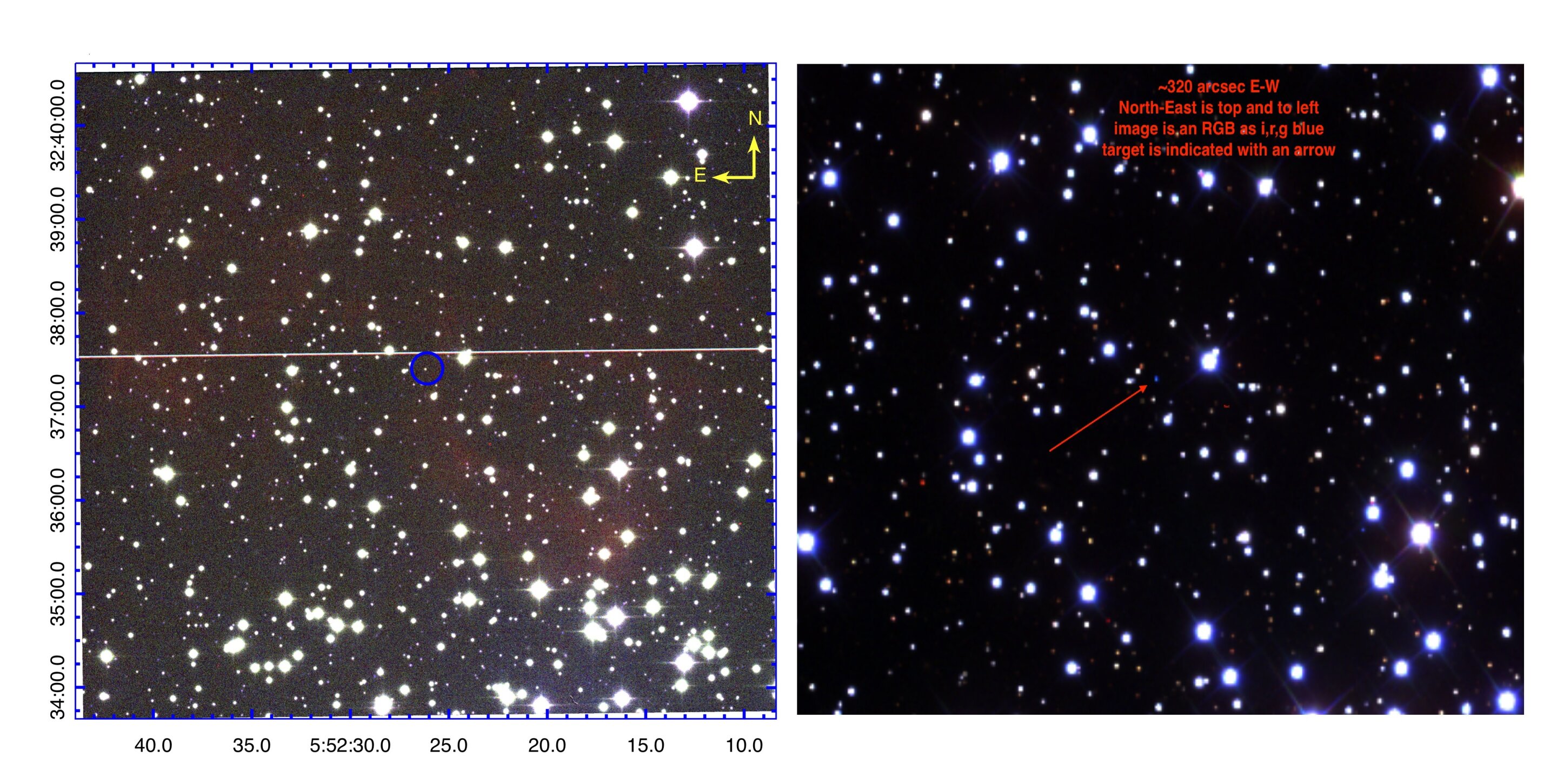 Left:enhanced color composite RGB image PN IPHASX J055226.2+323724 Right: 190×145 arcsecond RGB image generated from SDSS. The data clearly shows a weak CSPN (marked with an arrow) in the center. In both images, north is at the top and east is at the left. Credit & Copyright: Astrophysical Journal Letters, DOI: 10.3847/2041-8213/ac88c1
Also, in the course of observations and analysis, scientists found out that IPHASX J055226.2 + 323724 is located in a cluster that is almost half a billion years old.
Recall that the planetary nebulaan astronomical object, which is a shell of ionized gas around a central star, a white dwarf. It is formed during the ejection of the outer layers of a red giant or supergiant with a mass of 0.8 to 8 solar masses at the final stage of the object's evolution.
Read more:
Earth-sized sunspot grows 10 times in 2 days: it is directed at us
Scientists have found the remains of an ancient man with two X chromosomes
From the body to the mouth: scientists have understood where the teeth came from
Cover photo: Messier-57, NASA