Engineers from the University of Cambridge have developed a soft robotic hand printed on
The researchers used printedAn anthropomorphic hand implanted with tactile sensors in a 3D printer so that the hand can “feel” what it touches. The hand was only capable of passive motion based on the wrist. “The big advantage of this design is the range of motion that we can get without using any actuators,” the authors say.
Training a “passive” robotic arm. Video: University of Cambridge
Scientists conducted more than 1,200 tests with a robot arm,watching her ability to grab small objects without dropping them. Initially, the robot was trained using small 3D printed plastic balls and grasped them using predetermined actions derived from human demonstrations.
The robot used trial and error tofind out which capture will be successful. After finishing his ball practice, he tried to grab various objects, including a peach, a computer mouse, and a roll of bubble wrap. In these tests, the hand was able to successfully grasp 11 out of 14 objects.
Capturing objects of different sizes, shapes and textures- a task that is simple for a person, but difficult for a robot. Most of today's advanced robots are not capable of performing manipulative tasks that small children can easily handle. For example, people instinctively know how much force to apply to lift an egg, but for a robot this is a problem: not strong enough will cause the object to fall, too strong will break the egg.
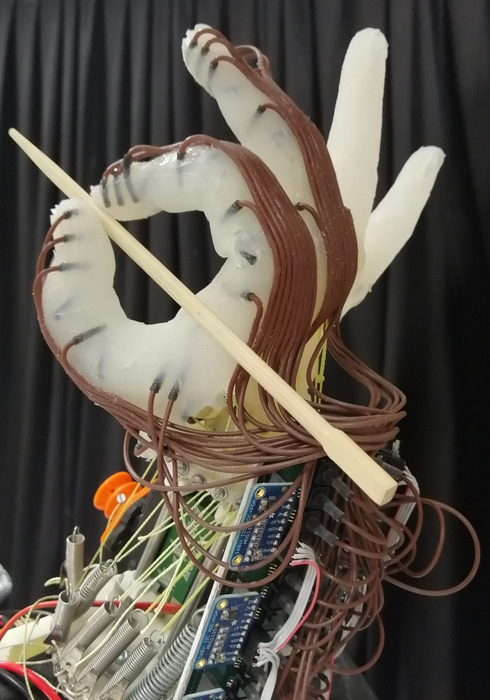 Prototype robotic gripper. Image: University of Cambridge
Sophisticated technology with motorized fingersrequires a significant amount of energy and a large number of complex and expensive actuators for each joint. The passive grip proposed by the engineers makes the robot much easier to control and much more energy efficient. The researchers believe their adaptable design could be used to develop low-cost robotics capable of more natural movements.
Read more:
Look at the highest resolution map of Mars: 110,000 frames and 5.7 trillion pixels
"Sea" of quarks inside one proton: what does an elementary particle consist of
New image of Hubble puzzled scientists
On the cover: a prototype robotic gripper. Image: University of Cambridge