An international team of researchers presented the results of the observation of the avoidance zone, an area of avoidance.
In their work, scientists combined dataprevious studies of the zone of avoidance with observations collected by the VVV project. This is an international study led by the European Organization for Astronomical Research in the Southern Hemisphere.
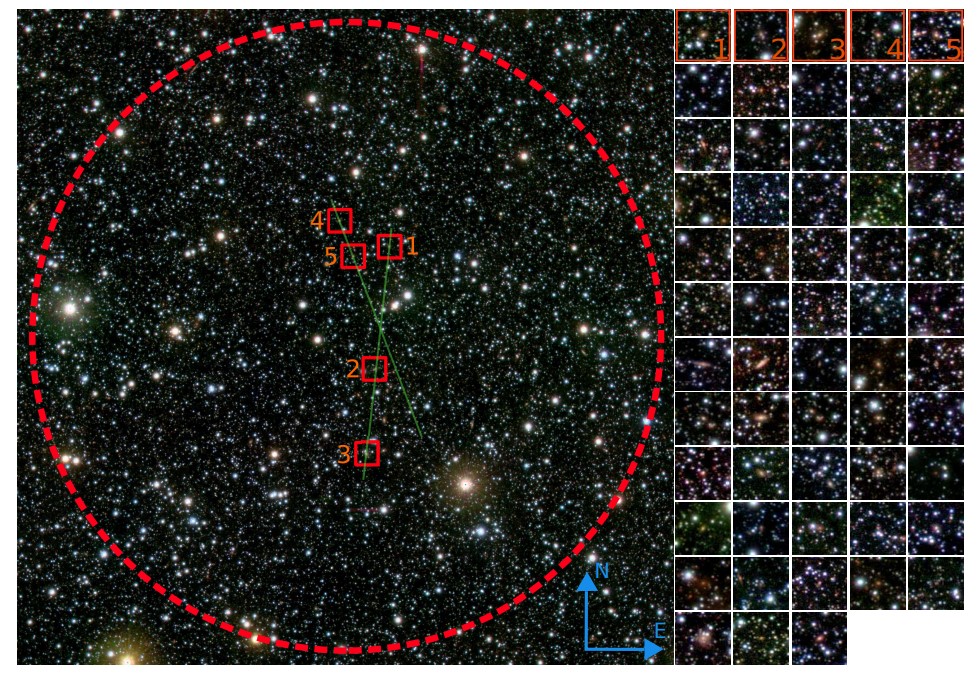 The region of the sky in which a suspected cluster of galaxies is located. Image: Daniela Galdeano et al.
In the VVV study, scientists combine datacollected in observatories and research centers located in different parts of the Earth. Instead of making optical observations, the astrophysicists of this science program study stars in the infrared. Such radiation is able to pass through gas, dust and light from stars in the galactic disk.
Analyzing infrared images, scientists foundseveral galaxies that exist far beyond the Milky Way. And because of their number and clustering, researchers believe that these galaxies are bound by gravitational forces into a common massive structure. Scientists estimate that there may be up to 58 galaxies in the structure.
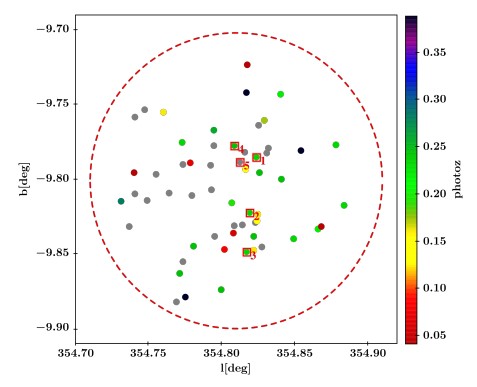
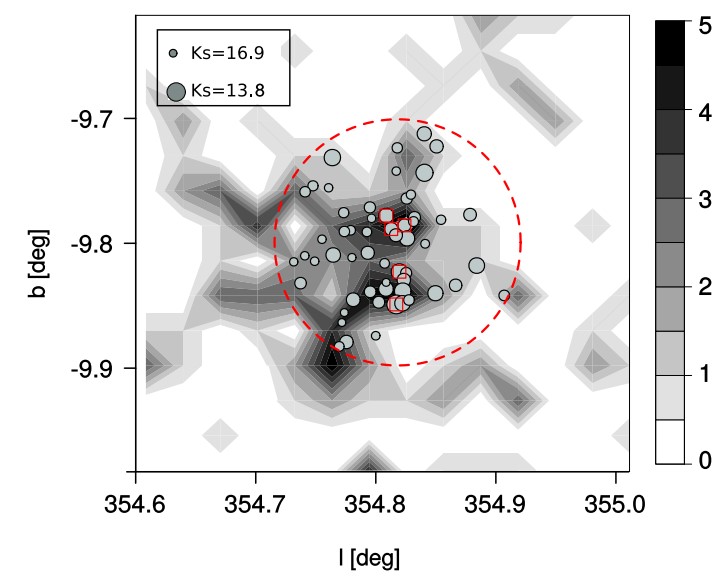
Location of 58 sources in the observation area. Image: Daniela Galdeano et al.
The zone of avoidance is an area ranging from 10up to 20% of the night sky. Observation from the Earth in these directions is carried out through the plane of the disk of our Galaxy. As a result, due to the attenuation of light, interstellar dust and stars, distant objects "hide" in the visible part of the spectrum.
Read more:
Scientists Confirm Alternative Gravity Theory: Why It Changes Physics
A massive impact from a space object triggered the Earth's magnetic field
Pig heart beats slower after transplant to human