The authors of a new study have suggested that an ancient creature that looks like an "evil minion" without an anus is more likely
Saccorhytus coronarius, which is 500 million years old,was previously associated with a group of animals known as deuterostomes. They were believed to be the ancestors of all vertebrates and humans. However, a new research team has concluded that they are ecdysozoans. The group includes insects and marine invertebrates such as penis worms (priapulids) and kinorhynchs.
According to the researchers, the latest results make an important adjustment to the evolutionary tree and our understanding of how life evolved.
Philip Donoghue, study co-author and professorpaleobiology at the University of Bristol in the UK, said that scientists have always been convinced that S. coronarius needs to be reclassified. “I’m sure people are relieved that we didn’t evolve from wrinkled, globular sacs,” he said.
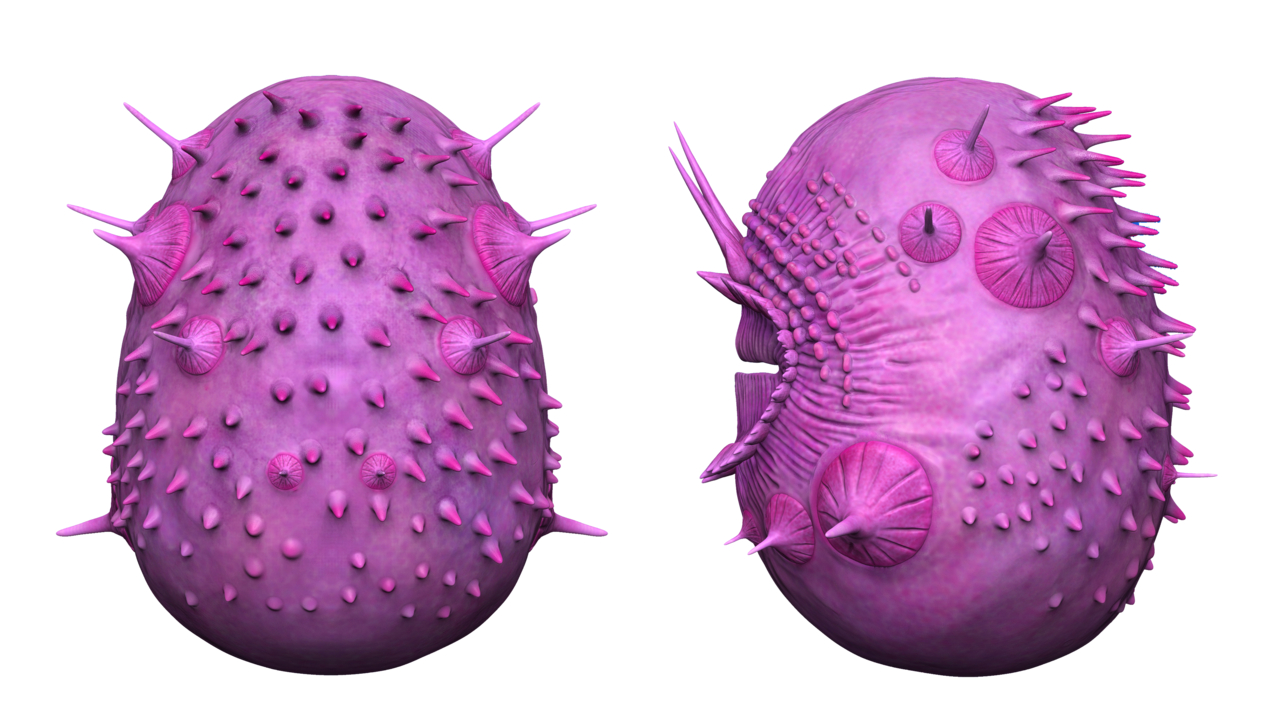 Credit: Philip Donoghue et al.
The length of the early Cambrian species is onlyabout 0.5 mm. It has been found in microfossils from the Shaanxi province in northwest China. The scientists used a synchrotron — a type of particle accelerator — to take detailed X-ray images of the fossil. They revealed microscopic details of its structure.
The original interpretation of S.coronarius, first published in 2017, was that the openings around the mouth were pores and possibly precursors to gills. A new study has concluded that the species did indeed have spines that go through holes that fell off during fossilization.
The team created a digital 3D model of the S.coronarius and compared it with various groups of animals before placing it among the early ecdysozoans. This is a big step for a small creature that could lead to a full-blown scientific debate, the authors of the study believe.
Read more:
The United States designed a fusion reactor. It can heat up to a billion degrees
Record coronal mass ejection at Betelgeuse is 400 billion times larger than the sun
In Australia, created a laboratory that will revive the marsupial wolf
</ p>