A team of researchers led by the Fraunhofer Institute for Applied Solid State Physics has developed
NV center or nitrogen-substituted vacancy is onefrom numerous point defects in diamond. It is formed when the structure of the crystal lattice of the mineral is disturbed. When a carbon atom is removed from a lattice site, the resulting vacancy in this place is associated with a nitrogen atom.
The researchers explain that the amount of lightemanating from the NV center varies depending on the strength of the magnetic field. This effect is already used by scientists, but in existing installations most of this radiation is lost.
Our breakthrough was the creation of a laser from defects.By collecting all of the light, not just a small amount of it, we can detect the magnetic field 10 times more accurately with our sensor compared to today's best practice.
Andrew Greentry, professor at the Royal Melbourne Institute of Technology and one of the authors of the study
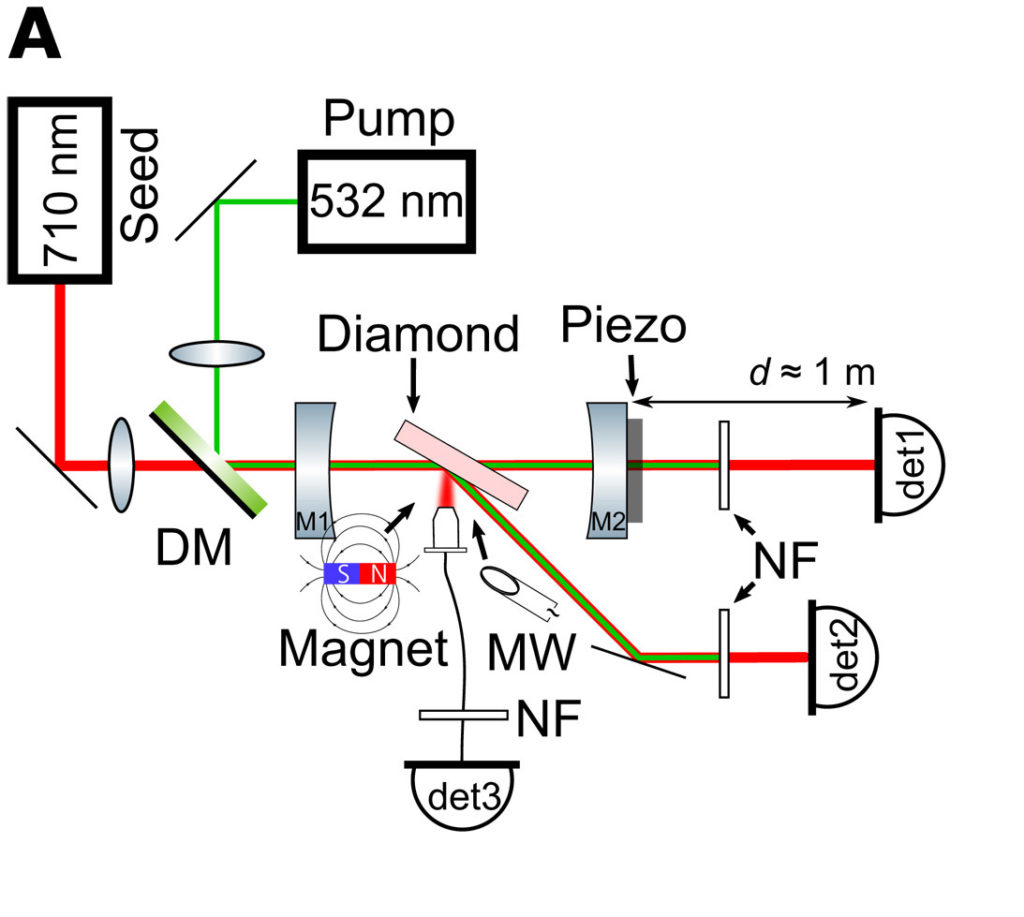 Scheme of the experimental setup.The pump laser (532 nm) and the seed laser (710 nm) are combined with a dichroic mirror (DM) and individually focused into the resonator. The green laser is blocked by 532nm notch filters (NF). The sensors capture transmitted light (det1), reflected light (det2) and photoluminescence (det3). Image: Felix A. Hahl et al, Science Advances
Researchers believe that the new technologywill help improve methods of measuring magnetic fields to map brain activity and identify abnormalities. Current magnetoencephalography devices are very sensitive, but also bulky, expensive to install, and require operation at ultra-low temperatures with liquid helium.
The authors of the new study believe thatusing a diamond laser sensor, you can create compact devices that will operate at room temperature. Affordable technology will help in the early detection of Alzheimer's disease, epilepsy and other brain disorders.
In addition, the device can be useful in the mining industry. For example, high-precision detection of magnetic fields will help to explore mineral deposits.
Cover image: RMIT University
Read more:
The main myth about dinosaurs has been refuted: scientists have understood how reptiles took over the planet
350 million years ago, something strange happened to the Earth: it affected habitability
A huge ozone hole has been found. It is dangerous for 50% of the world's population and is visible all year round.