Until recently, screen refresh rates above 60 Hz were the province of flagships and those smartphones that
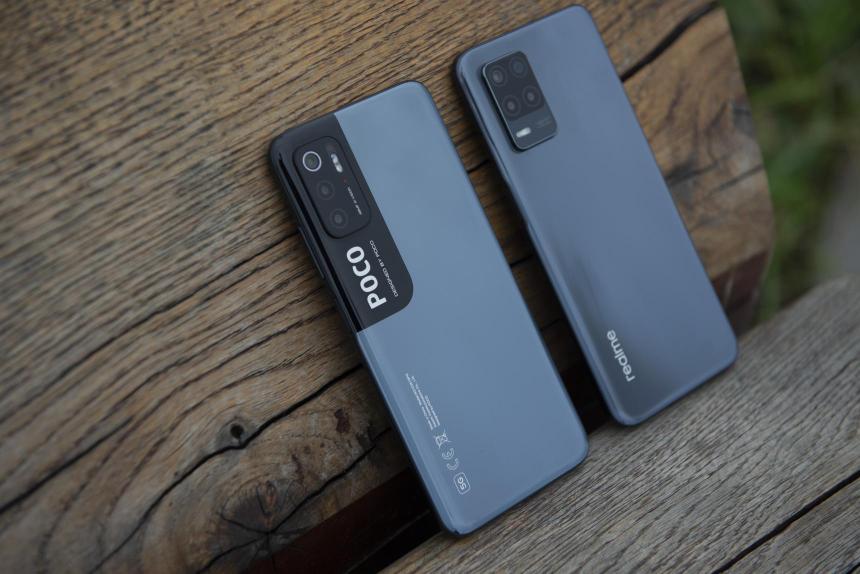
Table of contents
- Appearance
- Display
- Performance and autonomy
- Cameras
- Competitors
- Realme 8
- Xiaomi Poco X3 Pro
- Total
Appearance
I'm sure you've already noticed that inexpensivesmartphones today all look the same: glass backs with the same overflow. They are united by the similar arrangement of the camera, and the fingerprint scanner in the power button.
A couple of years ago to see quite innovativea sub-screen scanner was not that difficult by today's standards. It would seem that over time, such technologies should become cheaper and spread to the masses. Alas, now you will not find a subscreen scanner even among the “Chinese”, who cost all thirty thousand rubles. Let me remind you that the heroes of the review are devices whose price is almost half the price. Therefore, we have what we have.
Xiaomi Poco M3 Pro 5G and Realme 8 5G
If you put both smartphones face down andIf you move a couple of meters away from them, it will be difficult to distinguish the devices. In this they are helped by almost the same colors and similar shape of the body, including the radius of the rounding of its corners. However, smartphones feel completely different in your hands.
Poco has rounded edges, and the frame looks likea kind of sandwich - it consists of several parts, and such a complex structure is felt with the palms. Especially when comparing Poco to Realme, which has a flat side frame. Because of her, he looks a little more solid and prettier, but in practice this provides a more confident grip. At the same time, such facets do not bite into the skin - a definite plus.

 12
12
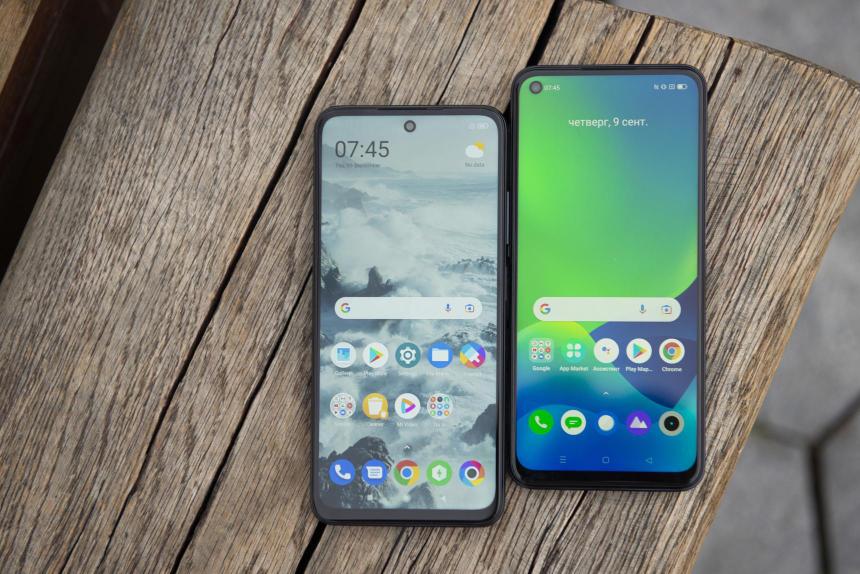
Realme 8 5G and Xiaomi Poco M3 Pro 5G
But it's easier to distinguish smartphones from the front. Thanks to the front camera and notch for that. Poco has it exactly in the center, while Realme has it in the left corner of the screen.
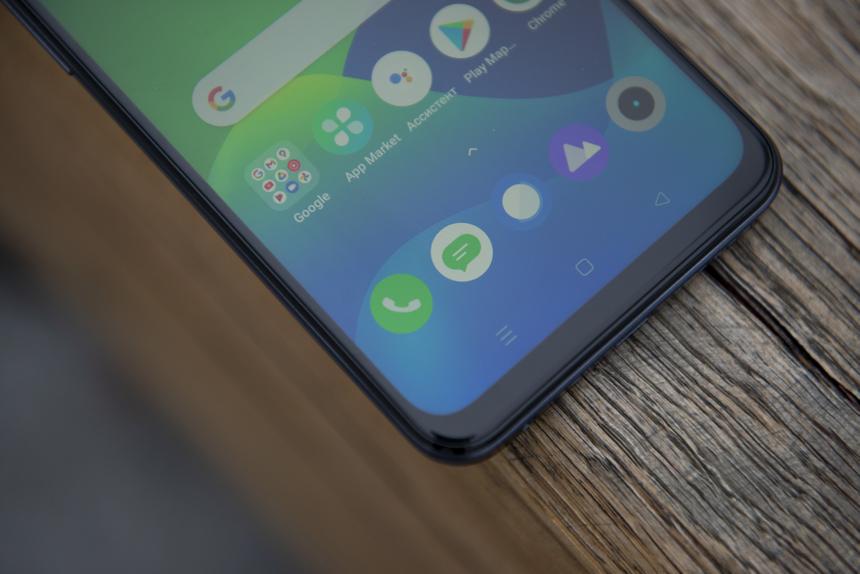
Realme 8 5G. Xiaomi has a "chin" about the same size.
Bored "chins" in this generationstate employees have not been liquidated yet, but they do not look too megalomaniac. Approximately what you expect from an inexpensive smartphone, although in 2021 I would like to do without them.
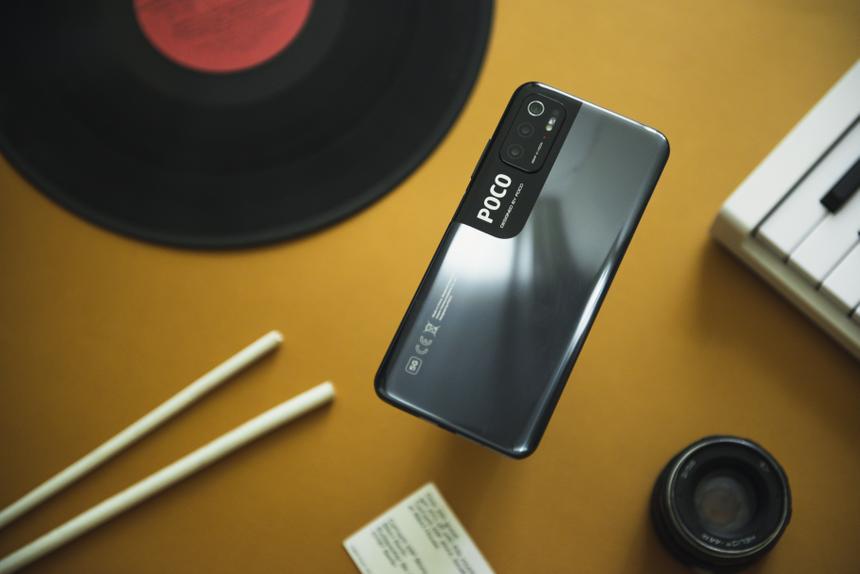
Xiaomi Poco M3 Pro 5G
Gamers and other sympathizers will benefit fromknow how the issue is with the oleophobic coating (the very thing that gives a pleasant sensation from sliding your finger on the glass). So, if you hold the phone in each hand and scroll the desktops, then it is more pleasant to do this on the Realme 8 5G. The flagships are still far away, but already better than the Poco M3 Pro 5G. At least at the level of my subjective feelings.

 12
12
Xiaomi Poco M3 Pro 5G
We came across frankly boring colorssamples that hide half of the final smartphone experience. The same Poco M3 Pro in yellow looks good, and Realme 8 5G in a blue case is my compliments.
Display
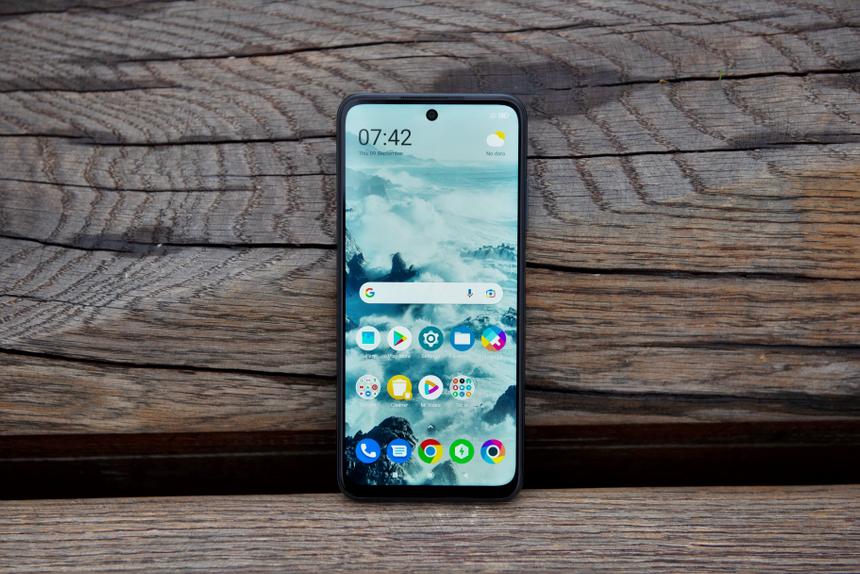
IPS displays with a separate backlight layerare gradually giving way to slightly more energy-efficient OLED matrices, which can control the backlight of individual pixels. There are still plenty of fans of both types of screens, but in our case, both smartphones received the first type.
In addition to the general type of matrix, screens andsizes. Not really, but almost - the diagonal difference is at the level of two tenths of an inch. The aspect ratio is also the same - 20: 9. By the way, the frames on the sides of the display on Realme are visually slightly, but smaller. Rather, it is more of a visual effect from flat edges than a difference in size.
Xiaomi Poco M3 Pro 5G
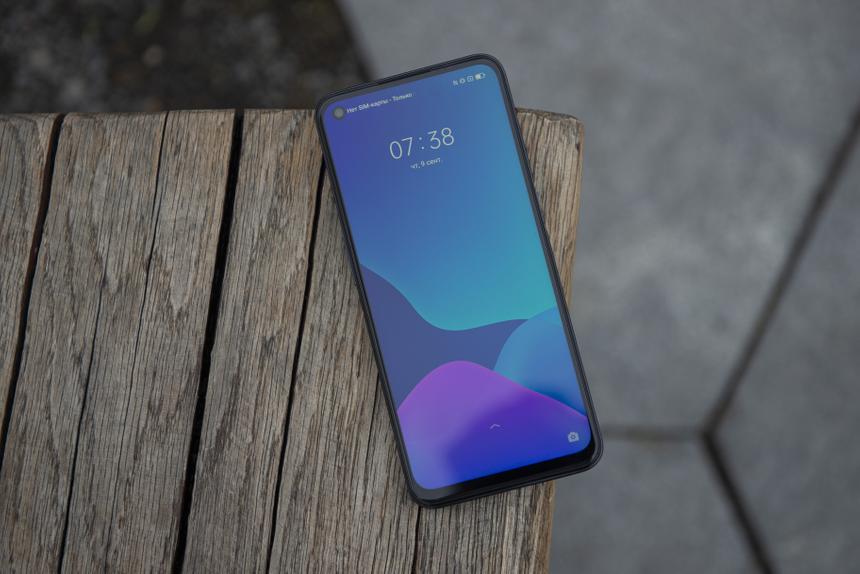
The build quality of the display module in ourthe samples were slightly different. The Poco M3 Pro 5G was more likely to show small areas with a lack of pixel backlighting. It looks like a barely noticeable shadow and is especially clearly visible against a light background near the camera cutout. The old sore of many smartphones with cutouts, there is nothing you can do about it. And, perhaps, these are the only drawbacks of the screens, if you think about the price of smartphones.
Realme 8 5G
They are doing surprisingly well with the brightness level.Realme 8 5G, even without an auto brightness mode, produces a white level in the range of 420-430 cd / m2 - a sensible result in comparison with competitors. The more expensive Xiaomi Redmi Note 10 Pro, for example, can no longer boast of such values, but in auto mode it overclocks well and produces all 500+ cd / m2. But what if you don't use the automatic setting of this parameter?
Realme 8 5GXiaomi Poco M3 Pro 5GMaximum brightness level(min./max.)1.3/427 cd/m23/404 cd/m2Contrast(more = better)1362:11473:1Color gamut(sRGB) (90-100% is ideal, more = worse)120%110%DeltaE(less = better)4,631.5Gamma(ideal - 2.2)2.12.3Colour temperature(ideal = 6500K)7700K6656K
Poco M3 Pro is slightly inferior to its brother fromRealme in brightness, but produces a deeper level of black. This is evidenced by the contrast value - 1362:1 versus 1413:1. But all this is not as interesting as the increased Hertz power of local displays.
You should immediately be prepared for the fact that the maximumsmartphones will use the frequency only for rendering the interface, watching videos and other not particularly resource-intensive activities. In games you will have to be content with the standard 60 Hz for one simple reason - the hardware does not allow rendering complex graphics at such a frequency. By the way, about the filling.
Performance and autonomy
The heart of both smartphones is the Dimensity 700 chip fromMediaTek. This is a good and rather nimble system on a chip with a built-in 5G module (yes, the fifth generation communication standard is increasingly appearing in budget devices).
The processor includes two clusters for differenttasks. The first consists of two ARM Cortex-A76 cores clocked at 2.2 GHz. It's not hard to guess that they are needed for resource-intensive tasks. The second cluster is already represented by six more energy-efficient 2 GHz Cortex-A55 cores. Compared to the similar Dimensity 800U, the local processor lacks frequencies on the two main working Cortex-A76 cores. From 2.4 GHz, their frequency was reduced to 2.2 GHz.


 13
13
Platform behavior in games clearly illustratesinexpediency of their launch in 90 Hz mode. I will say more - they will not start in it. Most of the current and heavyweight games are, of course, quite playable here, but they work either at low settings or at medium ones. The only title that behaved decently at the highest settings was World of Tanks: Blitz. Glory to the Belarusian optimization! However, the only game that works well out of many is not a reason to call Dimensity 700 along with the Mali-G57 MC2 a game filling. It is enough for everyday tasks, but no more.
By the way, the amount of RAM in smartphonesdifferent depending on the version. Realme 8 5G in the maximum configuration received as much as 8 GB with the possibility of expanding RAM using free ROM. You can choose from 2, 3 and 5 GB of additional memory. At the same time, the Poco M3 Pro does not have such features, and the amount of RAM in the upgraded version is limited to the not most impressive 6 GB.
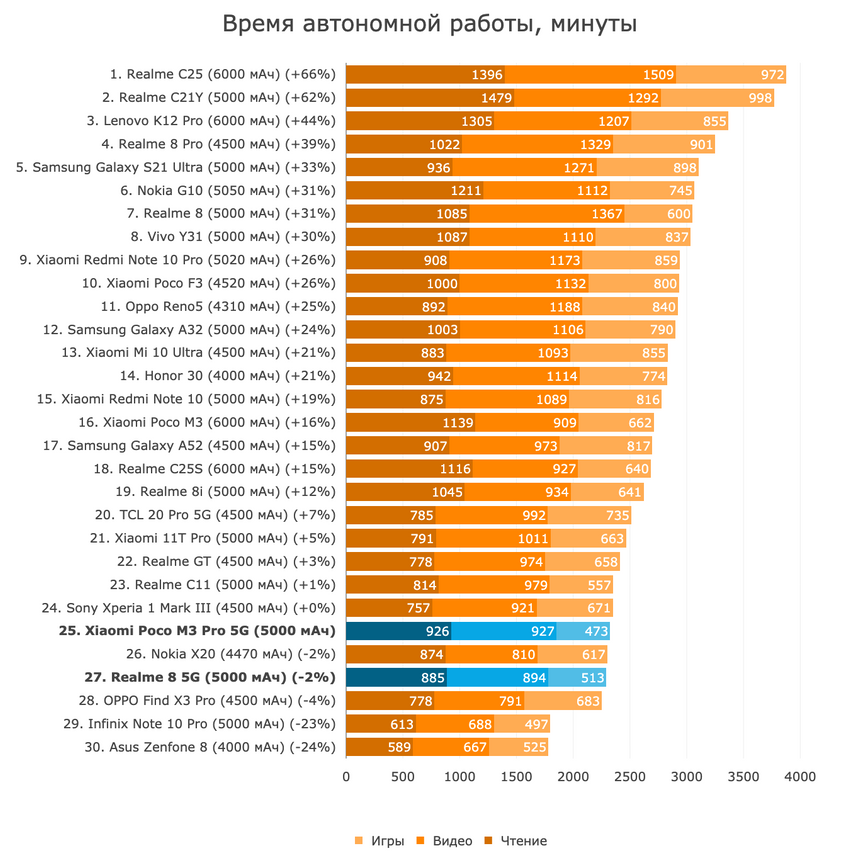
But what the heroes of this review have no problems with isautonomy. 5000 mAh is still more than a decent figure, which guarantees a day and a half of full-fledged work away from the outlet. Yes, you don’t even have to turn down the screen brightness at the end of the working day.
Smartphones would definitely benefit from fast charging,because not everyone can wait two hours for the battery to replenish the charge. The most ridiculous is the situation with the Poco M3 Pro. Its bundled PSU can deliver 22.5W, but the smartphone itself can only accept 18W. So it goes.
Cameras
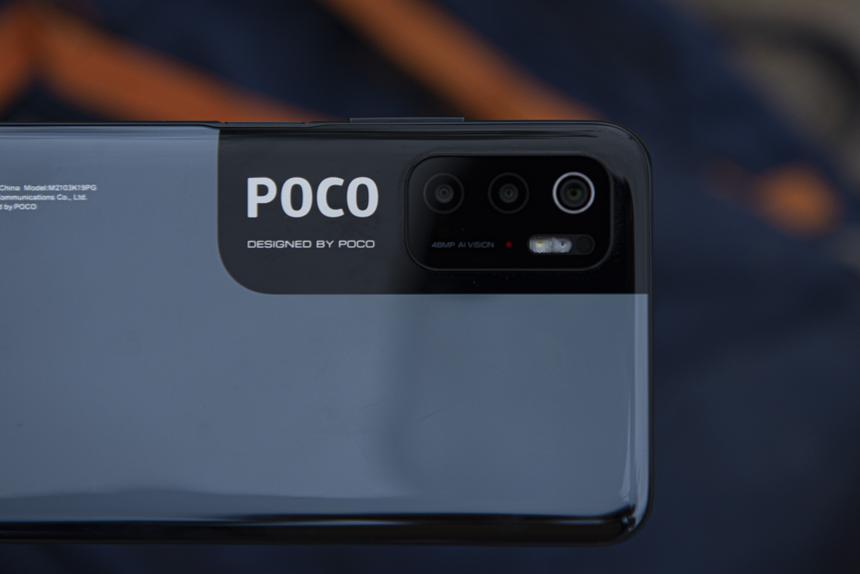
There is no significant difference between smartphones andin terms of camera equipment. Like the vast majority of budget fighters, both the Poco M3 Pro 5G and the Realme 8 5G are led by a 48 megapixel sensor with identical aperture - ƒ / 1.79 and ƒ / 1.8, respectively. The rest of the cameras, as it should be now, are pure props, which are not capable of anything.
Xiaomi Poco M3 Pro 5G
Sensor manufacturers for devices are different.Xiaomi uses the Sony IMX582 Exmor RS, while Realme opted for Samsung, equipping its brainchild with an ISOCELL S5KGM1 sensor. And, looking ahead, I will say right away that there is almost no difference between them.


 19
19
Xiaomi Poco M3 Pro 5G


 16
16
Realme 8 5G
During the day, both cameras produce quite decentresult. Photos can be viewed on a laptop screen without any problems; there is enough detail even to zoom in on a specific area of the frame. Even the colors in the photos are fine, although Realme has one specific feature - turning a gray cloudy sky into... a blue cloudy sky. Errors with white balance settings do not happen too often, but more often than with the competitor from Poco.
But the situation changes at night.In the dark, Realme 8 5G works better with lighting, eliminating stray light from street light sources in the frame. This is best seen in these two pictures.

 12
12
Xiaomi Poco M3 Pro 5G


 fourteen
Xiaomi Poco M3 Pro 5G


 15
15
Realme 8 5G
Front cameras (8 MP for Poco versus 16 MP forRealme) is simply there, you should not expect cool portrait modes from them. But they can recognize your face while unlocking. The flagships from Sony still cannot even do this, but here, please, use it. But, of course, it is better not to look at the pictures themselves. Perhaps this will be corrected by a camera from Google, but we have to admit that front-facing cameras are not the strongest side of the heroes of the review.

 12
12
Xiaomi Poco M3 Pro 5G
Dimensity 700 limits are notallow you to squeeze all the juices out of local cameras, so the video capabilities in smartphones are somewhat curtailed. And they are cut not only by the chip, but also, apparently, by the manufacturers themselves, because the Dimensity 700 supports shooting video in 2K, but not in these smartphones.
Xiaomi Poco M3 Pro 5G: Full HD, 30 fpsRealme 8 5G: Full HD, 30 fps
Both Realme 8 5G, Poco M3 Pro 5G support recordingvideo in Full HD resolution and 30 frames per second. At the same time, Poco has a higher bitrate - 20 Mb/s versus 14 Mb/s. The quality of the final image is not bad for both smartphones, but only if you do not display the footage on large screens. The detailing will be lame, and you are unlikely to enjoy watching it.
Competitors
Not everyone needs support for networks of the fifthgenerations and an official guarantee from the seller. Therefore, for the same money (well, almost) you can find smartphones more interesting, but already in gray retail. Actually, here they are.
Xiaomi Poco M3 Pro 5GRealme 8 5GRealme 8Xiaomi Poco X3 Prooperating systemAndroid 11 + MIUI 12 Android 11 + Realme UI 2.0 Android 11 + Realme UI 2.0 Android 11 + MIUI 12.5 for POCOScreenIPS, 90 Hz, 6.5", 1080 x 2400 p., 20:9, 405 ppiIPS, 90 Hz, 6.5", 1080 x 2400 pixels, 20:9, 405 ppiAMOLED, 6.4'', 1080×2400 pixels, 20:9, 411 ppiIPS, 120 Hz, HDR10, 6.67", 1080 x 2400 pixels, 20:9, 395 ppiCPUMediaTek MT6833 Dimensity 700 5G, 7 nm, 8 cores (2Cortex-A76 cores at 2.2 GHz + 6 cores Cortex-A55 at 2.0 GHz) MediaTek MT6833 Dimensity 700 5G, 7 nm, 8 cores (2 cores Cortex-A76 at 2.2 GHz + 6 cores Cortex-A55 at 2.0 GHz) Mediatek Helio G95 , 12 nm, 8 cores (2 cores Cortex-A76 @ 2.05 GHz + 6 cores Cortex-A55 @ 2.0 GHz) Qualcomm Snapdragon 860, 7 nm, 8 cores (1 core Kryo 485 Gold 2.96 GHz + 3 Kryo 485 Gold cores at 2.42 GHz + 4 Kryo 485 Silver cores at 1.78 GHz)GraphicsMali-G57 MC2Mali-G57 MC2Mali-G76 MC4Adreno 640RAM4 GB4 GB4 GB4 GBStorage device64 GB64 GB128 GB128 GBConnectionWi-Fi 802.11 a / b / g / n / ac, dual-band, Wi-Fi Direct, NFC, Bluetooth 5.1 (A2DP, LE), GPS, A-GPS, GLONASS, GALILEO, BDS Wi-Fi 802.11 a / b / g / n / ac, dual-band, Wi-Fi Direct, NFC, Bluetooth 5.1, A2DP, LE GPS, A-GPS, GLONASS, BDS, GALILEO, QZSS Wi-Fi 802.11 a / b / g / n / ac, dual-band , Wi-Fi Direct, NFC, Bluetooth 5.0, A2DP, LE GPS, A-GPS, GLONASS, GALILEO, BDSWi-Fi 802.11 a / b / g / n / ac, dual-band, Wi-Fi Direct, NFC, Bluetooth 5.0 (A2DP, LE) GPS, A-GPS, GLONASS, GALILEO, BDSCamerasMain: 48 MP, f/1.8, 26 mm, 1/2.0", PDAF Main: 48 MP, f/1.8, 26 mm, 1/2.0", PDAF Main: 64 MP, f/1.8, 26 mm, 1/1.73", PDAF Main: 48 MP, f/1.8, 26 mm , 1/2.0", PDAFMacro: 2 MP, f/2.4 Macro: 2 MP, f/2.4 Wide-angle: 8 MP, f/2.3, 119˚, 16 mm, 1/4.0" Macro: 2 MP, f/ 2.4 Depth sensor: 2 MP, f/2.4 Depth sensor: 2 MP, f/2.4 Macro: 2 MP, f/2.4 Depth sensor: 2 MP, f/2.4 Front camera: 8 MP, f/2.0 Front camera: 16 MP , f/2.1Macro: 2 MP, f/2.4Front camera: 20 MP, f/2.2Front: 16 MP, f/2.5Battery5000 mAh 5000 mAh 5000 mAh 5160 mAhDimensions161.8×75.3×8.9 mm162.5×74.8×8.5 mm160.6×73.9×8 mm165.3×76 .8×9.4 mmWeight190 g 185 g 177 g 215 gPrice15 thousand rubles 15 thousand rubles 17-18 thousand rubles 17-18 thousand rubles
Realme 8
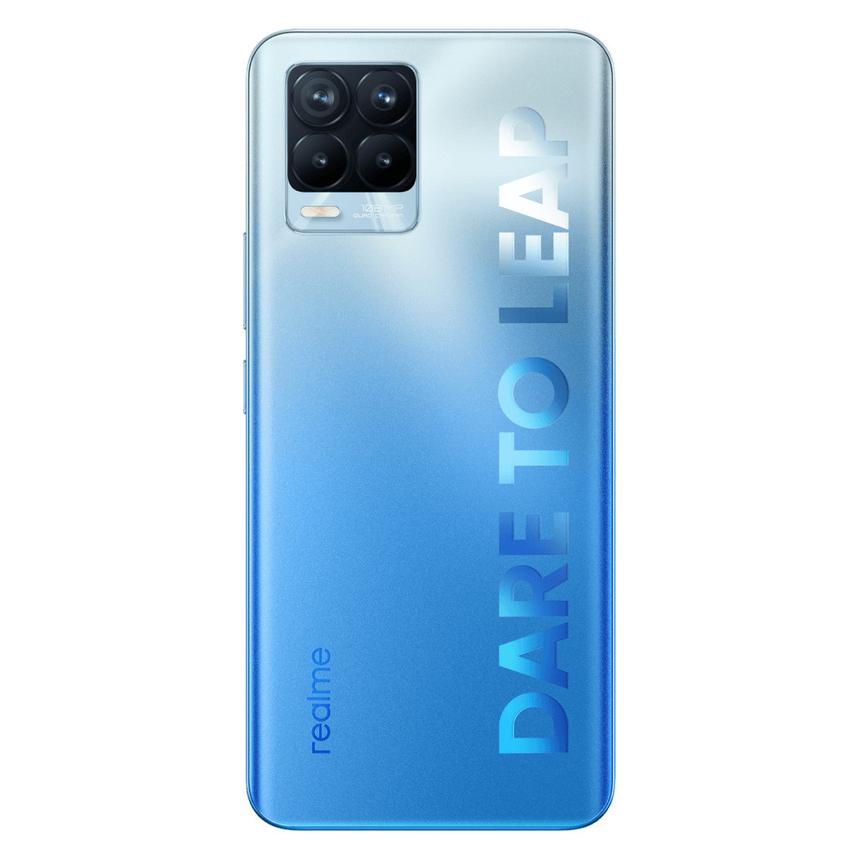
Realme 8
This smartphone is clear proof thatThe “5G” index in the name does not make a smartphone better. In the case of Realme 8 and Realme 8 5G, it's exactly the opposite. Here the buyer receives an OLED display along with an under-screen scanner, and support for 30 W fast charging, which charges the smartphone from 0 to 100% in 65 minutes. The hardware platform in Realme 8 is MediaTek Helio G95 with 4 GB of RAM.
More cameras.And they are better! The main module with a resolution of 64 megapixels is literally a cut above the sensor in the Poco M3 Pro 5G and Realme 8 5G. This is a California-based OmniVision OV64B that supports 4K video with electronic stabilization, as well as 8K video at 30fps. At Full HD resolution, the frequency can reach 240 fps, at 720p - 480 fps.
I agree, not the most productive smartphone, but there is another option.
Xiaomi Poco X3 Pro
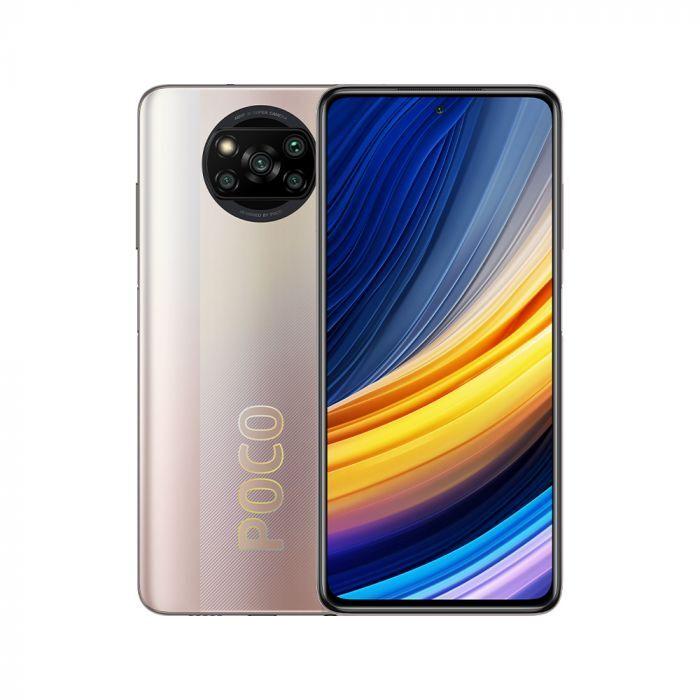
Xiaomi Poco X3 Pro
If this is not the “killer” of the entire budget segment,then what? Inside is a powerful eight-core Snapdragon 860 with a 7 nm process technology and a “leading” core with a frequency of 2.96 GHz. Add a 120 Hz screen to this and you get a full-fledged gaming smartphone with power reserves for years to come.
The camera, of course, is not the main trump card of the Poco X3 Pro(Poco M3 Pro has the same module), however, installing “gcam” will help make it something similar to a camera phone - the processor is more than enough for computational photography. There are more than a dozen available options in one thread on 4pda, so there is plenty to choose from.
Total
With most of the similar parameters, the choice between smartphones will most likely have to be based on personal preferences.
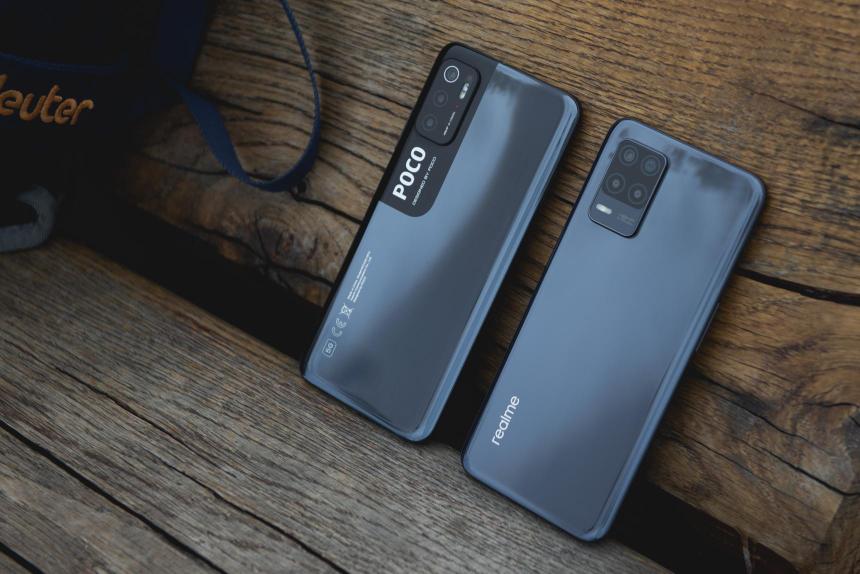
Xiaomi Poco M3 Pro 5G and Realme 8 5G
Yes, Realme has a brighter screen, bigger"parrots" in benchmarks, but there are also some things where it is much inferior to Poco - video shooting and screen calibration. The Xiaomi smartphone manages to better stabilize the image, and the DeltaE value and display color temperature are generally unusual for smartphones of this level.
If your slogan when choosing a smartphone is“AliExpress is our everything”, then you can pay attention to the Xiaomi Poco X3 Pro, which, at a slightly higher price, will give a huge performance boost due to a full-fledged flagship processor.
Here we have news, reviews, discounts… ?
Subscribe to