How the Ingenuity mission has changed during its work on Mars
JPL published on the website of the National Administration for
In fact, in it, Dave Lavery and Mimi Aung, the leaders of the Mars helicopter mission, declared its complete success.
Five test flights were originally planned.the Mars flight. At the same time, scientists said that one could not count on the first successful flight, since there are a lot of risk factors. But after everything worked out, and three flights in a row were successful at once, the project team decided to extend the life of Ingenuity.
Despite the fact that with the fourth toast there wereslight difficulties, the leaders of the mission decided that it was going well. Now the project management plans to develop a plan for aerial photography of the area, as far as, of course, this term corresponds to the realities of Mars and the capabilities of the drone.
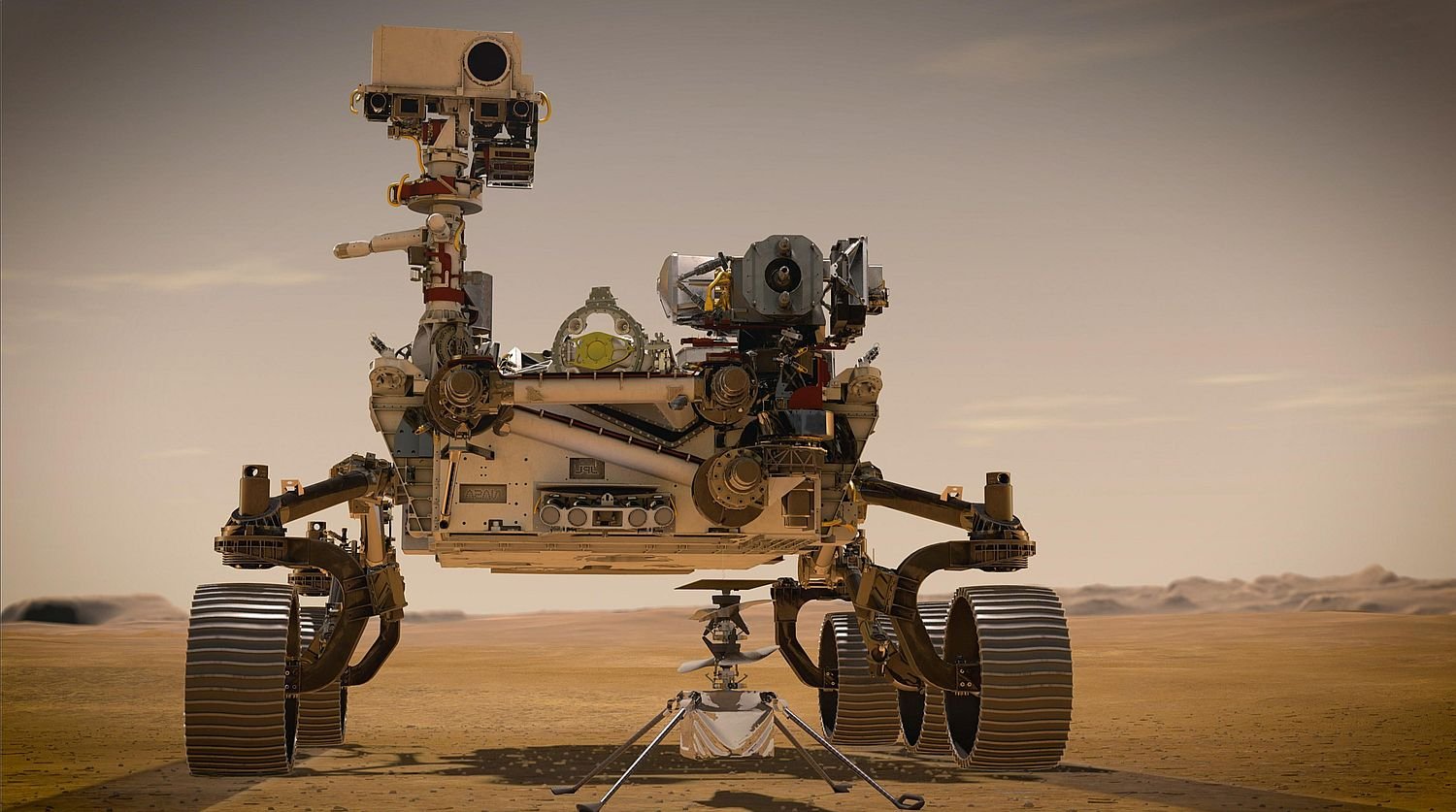 Ingenuity and Perseverance
What Ingenuity can do
The hardware provides highthe performance that a rover needs. Normal flight requires the control loop to operate at 500 cycles per second, plus image analysis at 30 frames per second.
SoC Snapdragon 801 (four cores, 2.26 GHz, 2 GB RAM, 32 GB Flash) is responsible for the basic system environment based on Linux. It is it that performs high-level operations, including:
- Visual navigation based on the analysis of camera images,
- Data management,
- Command processing,
- Formation of telemetry,
- Maintaining a wireless channel.
Using the UART interface, the processor is connected totwo microcontrollers. They are responsible for various flight control functions. In addition, they are also used for backup in case of failure, so that the information that goes to them is duplicated.
How will the flights go according to the new plan
It is planned that flights will be carried out 1-2 times a month, and without significant diversion of resources from the main program - that is, from the research program of the rover itself.
The mission of the rover is now the study of potentially interesting objects for science, the study of possible routes for the rover and the compilation of detailed photographs of the landscape.
How to choose the places where Ingenuity will fly
The choice of areas over which Ingenuity flies is not accidental, but to the least extent depends on the scientific value of the information received by the copter.
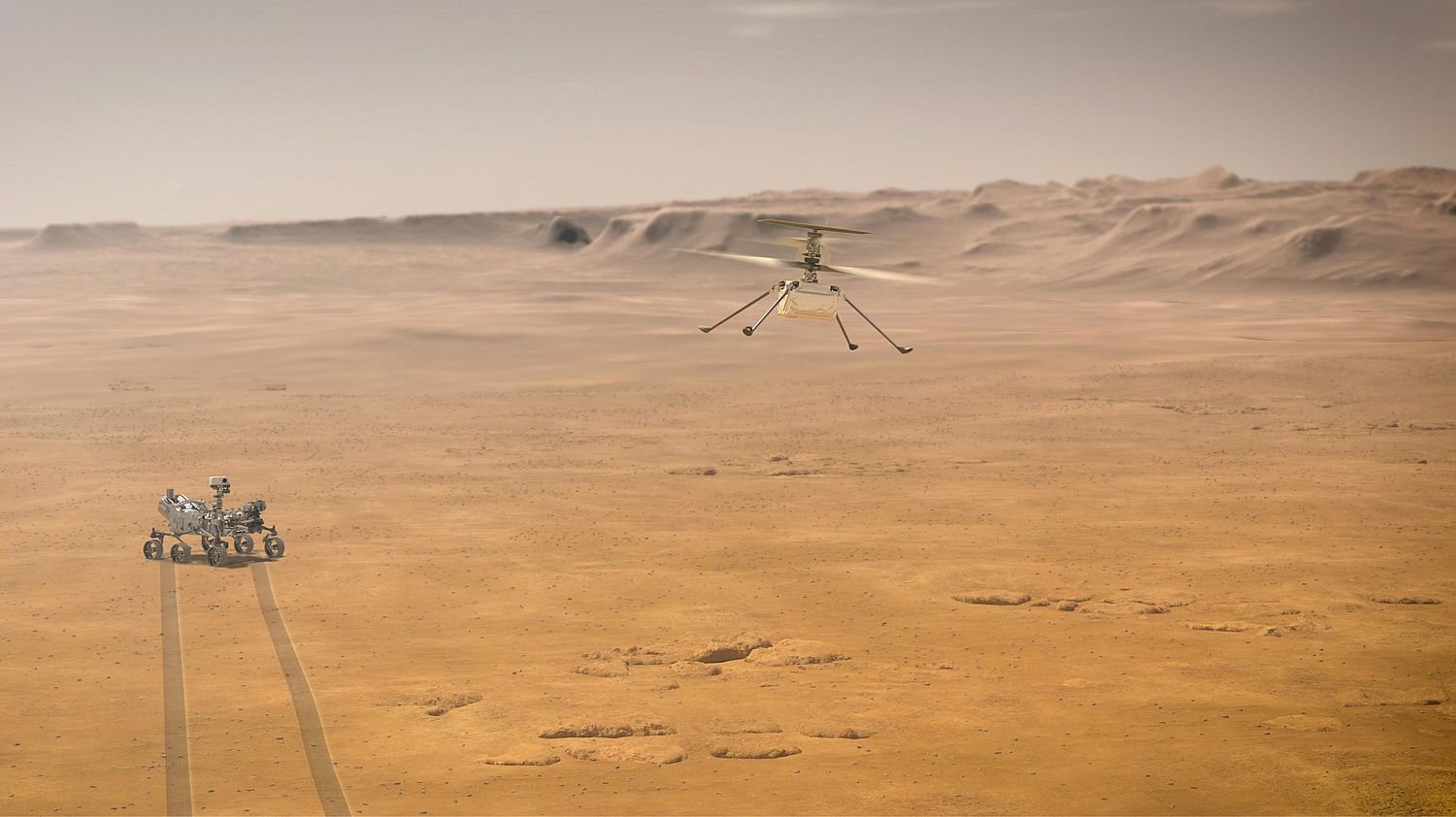
Recall that the Ingenuity helicopter on Mars is notalone, it operates in conjunction with the Perseverance rover, and where the drone will fly depends on their connection. Therefore, everything that is transmitted from Earth is processed by the rover: it builds engine operation diagrams (or selects one of a couple of dozen ready-made templates) and transmits a package of instructions for the helicopter. Ingenuity receives all commands from Perseverance.
The selection process began with the analysis of images of the areathe rover landings performed from orbit by the MRO station. Thus, it is possible, in a first approximation, to determine potential take-off and landing sites, to which Perseverance can approach and conduct a more detailed survey of the terrain.
Depending on rockiness, inclination and evenof how smooth or uneven the surface is, we will choose a place for the helicopter to operate. There are trade-offs: the safest terrain is a board-smooth surface without stones, but this is the worst option in terms of being able to track changes in the location of objects on it. Therefore, we need a balance, for example a bunch of small stones, which can be well monitored. But their size shouldn't make it difficult to fit.
Tim Canham, director of Mars helicopter operations at JPL
What will happen to Ingenuity next
Six months after deployment, the helicopter is in excellent condition, having covered a total of 2,670 m in 12 flights with a total duration of 22 minutes.
This is noticeably more than Perseverance drove.Note: for the Ingenuity team, even one successful flight meant the success of the entire mission. The maximum they were counting on was three or four flights. But the copter has mastered a dozen flights, and it seems that this is far from the limit.
Representatives of the Mars Helicopter Scout program announced plans to increase the flight duration to three minutes and the range to a kilometer.
Subsequently, Ingenuity's travels were to become more complicated and lengthened. The update, loaded into the "brain" of the copter, made it possible to exclude the anomalies that manifested themselves in the sixth flight.
Problems Ingenuity
The main disadvantage is that Ingenuity can fail at any time. Despite excellent telemetry data, the helicopter has a high chance of breaking down every second spent on Mars.
It is impossible to predict when and what part of itFinally, it will not withstand extreme temperature changes. Perseverance will begin to move faster and the drone, even taking into account good communication, will not keep up with it.
To read Further:
Scientists have been unable to catch Rambo's fox for three years. It prevents rare animals from being released into the forest.
Crypto Artists Will Explain How To Create NFT Art And Collect Crypto Art
See a heavy attack drone that carries a ton of weapons