Researchers from Brookhaven National Laboratory reported the discovery of a previously unknown species.
We measure two outgoing particles, and it is clear that theythe charges are different - they are different particles - but we see interference patterns that indicate that these particles are entangled or synchronized with each other.
Zhangbu Xu, physicist at Brookhaven National Laboratory and research participant
Quantum entanglement is a phenomenon in whichthe quantum states of several objects turn out to be interdependent. So far, this effect has only been observed for identical particles, such as two photons or electrons. In their study, published in the journal Science Advances, physicists have shown entanglement between pions with different charges that arise when photons of light interact with gluons in an atomic nucleus.
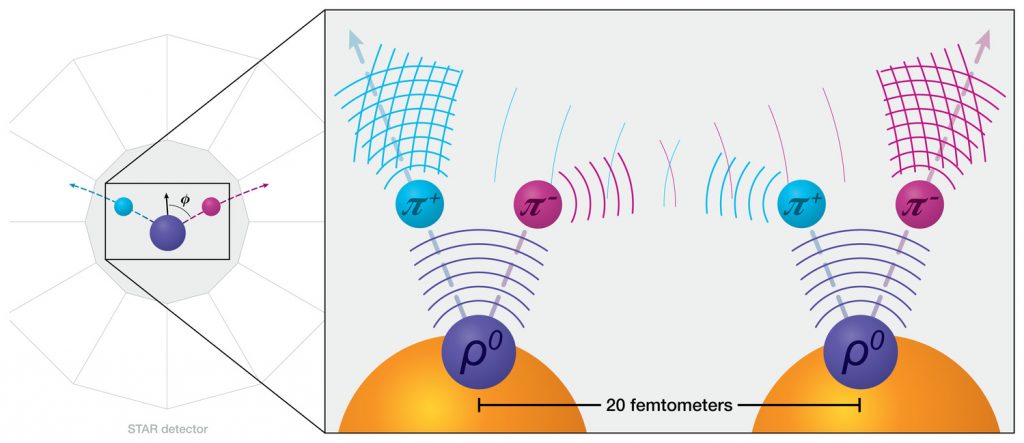 Interaction between pions during the close passage of gold ions surrounded by a "cloud" of photons inside the collider. Image: Brookhaven National Laboratory
Through a series of quantum fluctuations, photonsinteract with gluons, the glue-like particles that hold quarks together inside the protons and neutrons of nuclei, the scientists explain. As a result of these interactions, an intermediate particle is formed, which quickly decays into two pions with different charges. By measuring the speed and angles at which these new particles collide with the detector, scientists can go back to get important information about the photon and use it to pinpoint the location of gluons in the nucleus with high precision.
In the study, scientists analyzed the "clouds"photons surrounding the accelerating gold ions, which are accelerated in the collider to speeds close to the speed of light. If two metal ions pass very close together without colliding, the photons surrounding one of them "explore" the internal structure of the other.
This method is similar to how doctors usea positron emission tomography (PET) scan to see what's going on inside the brain and other parts of the body. But in this case, we are talking about mapping objects on the scale of femtometers - quadrillionths of a meter - the size of a single proton.
James Daniel Brandenburg, Ohio State University physicist and research participant
Read more:
See the most powerful volcanic eruption on Jupiter's moon
Named foods that cause cancer. They are served on the New Year's table
Chinese rover discovers traces of never-before-seen basalt on the moon