Although the mysterious object of a new type is, for now, a hypothetical mathematical construction, new simulations,
How did it all start?
There would be no new research without gravitationalwaves These are changes in the gravitational field that travel like waves. They are emitted by moving masses, but after radiation they are separated from them and exist independently of these masses. Mathematically related to a perturbation of the spacetime metric and can be described as “spacetime ripples.” In other words, these are fluctuations in space-time that move away from massive objects moving with acceleration. The higher the acceleration and mass of an object, the greater the vibration.
First time talking about gravitational wavesoutstanding physicist Albert Einstein, who a century ago predicted their existence within the framework of the general theory of relativity (GTR). However, they were discovered only in 2015 and this shocked the world of astrophysics as it confirmed the existence of black holes.
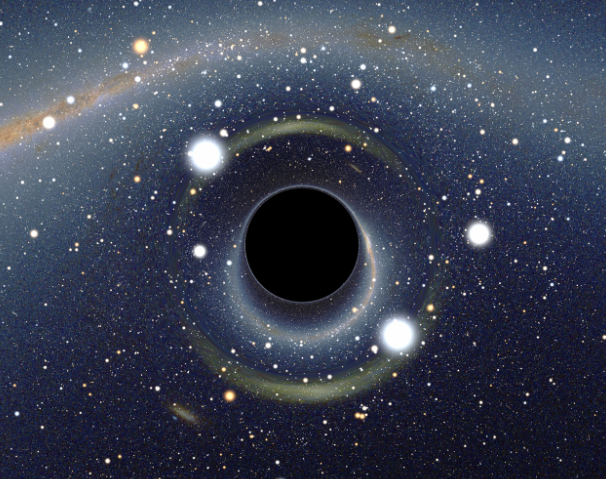 Black hole concept. Photo: Alain
A black hole is a region of space-timehaving such a strong gravitational attraction that no particles or electromagnetic radiation can leave it. The boundary of this region is called the event horizon. In the spring of 2019, media around the world showed the first photograph of a black hole (more precisely, its “silhouette”). The press conference, where the results of the scientific discovery were presented, was held in six cities at once - from Washington to Brussels and Tokyo.
What if…?
Inspired by these discoveries, a team of scientistsJohns Hopkins University decided to study the possibility of other objects that could, in theory, produce similar gravitational effects, but that sensors on Earth read them as black holes. Physicists called such objects topological solitons. New simulations realistically depict one of them. From a distance it looks like a blurry photograph of a black hole, but up close it's something completely different.
What is a soliton?
At this stage the object is hypothetical.But the fact that the team built it using mathematical equations and showed what it looks like through simulations suggests there may be other types of celestial bodies in space, hiding from even the best telescopes on Earth.
According to the data obtained, the topologicalthe soliton distorts space just like a black hole, but behaves differently. It emits weak beams of light that cannot escape the strong gravitational force of a real hole.
Video clip showing the effects of gravitational lensing caused by the absence of an object in the observer's line of sight, a black hole, and a topological soliton.
Credit: Pierre Heidmann / Johns Hopkins University
“Light is highly bent, but instead ofabsorbed, as in a black hole, it dissipates in bizarre movements, until at some point it returns to you in a chaotic manner. You don't see the dark spot. All you see is a “blur,” which means the light is spinning wildly around this strange object,” write the study authors.
The gravitational field of a black hole is sostrong that light can revolve around it at a certain distance from the center, just as the Earth revolves around the Sun. It defines the edge of the “shadow” of the black hole, so that any incident light will end up in the “event horizon” and cannot escape.
What have the scientists done?
Physicists at Hopkins have simulated severalscenarios using images of outer space as if they were captured by a camera, placing a black hole and a topological soliton in front of the lens. As a result, they received distorted images due to the gravitational influence of massive bodies.
Solitons serve as the best models of howNew objects of quantum gravity look like compared to black holes. They had previously created models of bosonic stars, grav stars and other hypothetical objects that could have similar gravitational effects to exotic forms of matter.
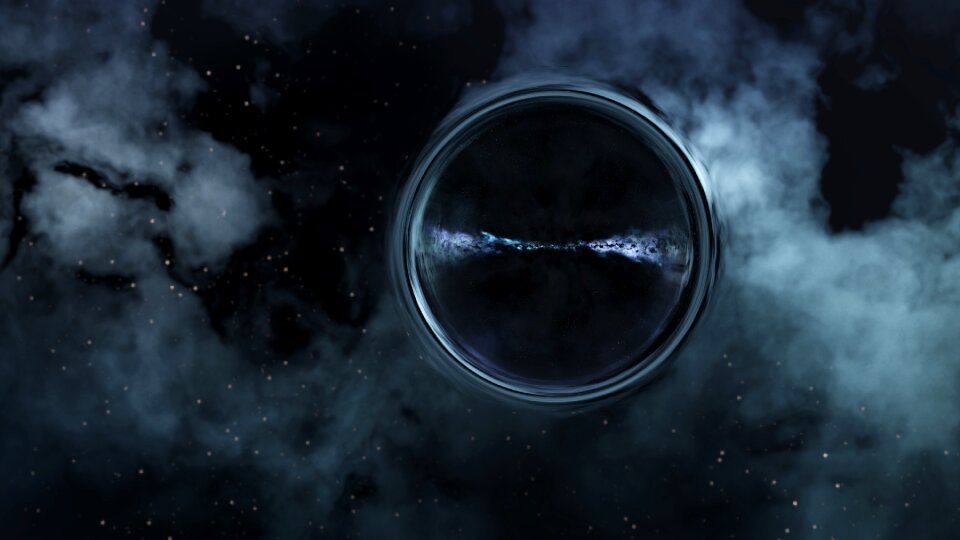 Black hole concept: Creazilla
“This is the first simulation of astrophysically significantobjects of string theory, since we can characterize the differences between a topological soliton and a black hole as if an observer were seeing them in the sky,” the study authors explain.
What does string theory have to do with it?
The authors of the new study used various results from string theory and, in 2021, discovered ways to construct topological solitons using Einstein's general theory of relativity.
String theory is a branch of theoretical physics,studying the dynamics of the interaction of objects not as point particles, but as one-dimensional extended objects, the so-called quantum strings. This theory is one of the attempts to combine the General Theory of Relativity and quantum physics.
Gravity and the quantum world are historically consideredopposite, different processes. But, according to researchers, this is not entirely true. scientists were trying to create a “theory of everything”—to unify relativity and the quantum world. In the process, physicists created many very unusual theories, one of them being string theory.
Why is the new study so important?
The peculiarity of the new study is precisely this:it explains basic theories about the inner workings of the Universe that are not found in other models. It uses string theory, which reconciles quantum mechanics and Einstein's theory of gravity.
“This is the beginning of a wonderful researchprograms. We hope that in the future we can actually propose new types of ultra-compact stars, composed of new types of matter from quantum gravity.”
Read more:
A photo appeared inside the second deepest underwater sinkhole in the world
See what happened to Mercury when it got as close as possible to the Sun
Scientists have figured out the nature of the mysterious ancient "monster"
Cover photo: Yukterez