How did you search for extraterrestrial life before?
The beginning of the SETI project dates back to 1959, when the international scientific
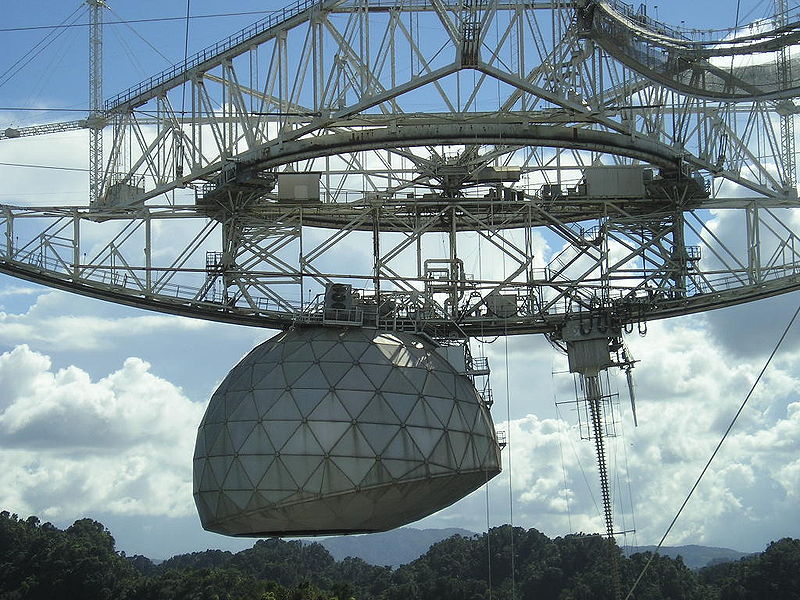 Close-up of the feeder antenna of the Arecibo radio telescope in Arecibo, Puerto Rico.
In 1995, American astronomers, due to insufficient funding from the federal government, decided to turn to private funds. The non-profit Institute was foundedSETIin Mountain View, California, and the project was launched"Phoenix"; The project involves studying thousands of nearby solar-class stars in the radio range 1200-3000 MHz. Dr. Gill Tarter was chosen as the director of the institute. This project uses extremely sensitive instruments that can detect the radiation of a conventional airfield radar from a distance of 200 light years. Since 1995 the InstituteSETIwith a budget of $5 million a year, it has already scanned more than a thousand stars. But there are still no tangible results. However, Seth Shostak, senior astronomer on the projectSETI, with unfading optimism, believes that the Allen telescope system of 350 antennas "will stumble upon the signal before 2025."
Astronomers from the University of California at Berkeley demonstrated an innovative approach to the problem: in 1999 they launched the projectSETI @ home... The idea is to attract millions of owners to workpersonal computers, whose machines are idle most of the time. Those who participate in the project download from the Internet and install on their computer a package of programs that work in screensaver mode, and therefore do not cause any inconvenience to the owner. These programs are involved in decoding the signals received by the radio telescope.
SETI @ home considered an unprecedented success indemonstrating the power of large-scale distributed computing, and its influence can be seen in everything from multiplayer video games to cryptocurrency projects such as Bitcoin and Ethereum. However, a project to use spare computing cycles to help the search for extraterrestrial intelligence was suspended a year ago after 20 years of work.
But as the computing power grows, the projectgave out more and more data. “We are on the verge of declining profitability,” the organizers explained in a statement. - In fact, we have analyzed all the data that we need at the moment. We have a lot of work to do in managing distributed data processing. We need to focus on completing the internal analysis of the results we already have and write about it in a scientific journal article. "
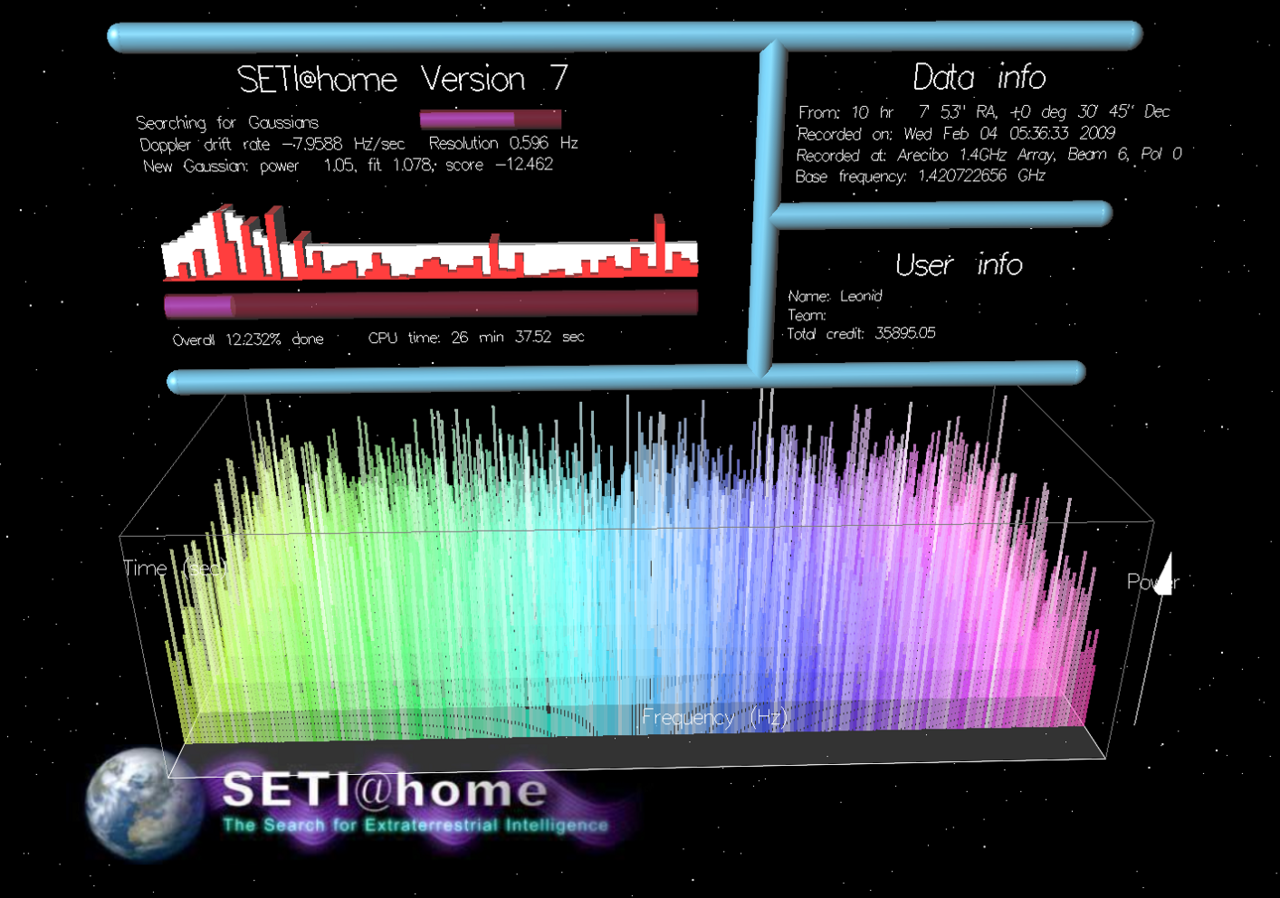 Author: Distributed Computing Project SETI @ home, LGPL
The development of machine learning that requireshuge computing power could give this area another boost in the coming years, although privacy and security concerns limit areas in which a distributed approach can be useful.
However, the SETI @ home project never fulfilled its main goal: after 20 years of searching, extraterrestrial intelligence was never found.
What's next?
A new beginning
27 years before the end of the SETI@home project,in 1993, NASA abruptly ended its original SETI program to search for intelligent extraterrestrial life before it had even begun. It included two complementary ambitious projects, one using the giant radio telescope in Arecibo, Puerto Rico, and the other with Deep Space Network antennas in California. Now, almost 30 years later, everything has changed and the Agency wants to resume search efforts.
Why?
Over the past decade, great advances have been made in the field of astronomical instruments, which have led to a revolution in the science of discovering and studying exoplanets.
- First, the TESS project appeared
April 18, 2018 aboard a SpaceX Falcon rocket9 NASA launches Transiting Exoplanet Research Satellite (TESS). The mission was the next step in the search for planets outside our solar system. Including those that can support life. During the mission, exoplanets have already been discovered, which periodically block part of the light from their host stars. This method of searching for exoplanets is called transit. TESS surveys 200,000 of the brightest stars around the Sun in search of other worlds.
 An artistic cast of a surface recentlyopen hot super-earth Gliese 486b. At around 700 Kelvin (430 ° C), CARMENES astronomers expect a Venus-like hot and dry landscape interspersed with flaming rivers of lava. Perhaps the Gliese 486b has a fuzzy vibe.
In almost three years, TESS has cataloged thousands ofcandidate planets and increased the number of known exoplanets. Several of them turned out to be the size of the Earth - on a cosmic scale, and by NASA standards, these are planets that are no more than twice the size of Earth. The more the mission finds exoplanets, the more chances we have of finding traces of life there.
- Secondly, new telescopes have been created.
Fundamentally new telescopes and future projectsSpace missions will make it possible for the first time to search for biomarkers indicating life on other planets. Many experts believe it is likely that we will discover extraterrestrial life in the coming years, although it will most likely be in a very simple form.
Considering the present and future technicalprogress, there will be new opportunities for finding technosignatures. This is why NASA has decided to re-engage in the search for extraterrestrial intelligence, taking advantage of the capabilities of current and prospective future space observatories.
Visualization of the flight path of the Nancy Grace Roman Space Telescope to the Lagrange point L2 Sun-Earth
These topics, among other things, were on the agendaTechnoClimes 2020 meetings under the auspices of NASA at the Blue Marble Space Institute of Science (Seattle, USA). His goal with scientists from all over the world was to propose new developments that drive future advances.
Finally, due to the COVID-19 pandemic, the meeting washeld virtually via videoconference, in which 53 researchers from various disciplines from 13 countries discussed a number of aspects of the search for other intelligent species.
How will they look for alien life now?
Researcher from the Institute of AstrophysicsIAC is the lead author of the study and new proposals to search for extraterrestrial "technosignatures" for future NASA missions. This is evidence of the use of technology or industrial activity in other parts of the universe. The article, published in the specialist journal Acta Astronautica, contains the initial findings of a meeting of experts in the search for intelligent extraterrestrial life, organized by the space agency to gather recommendations for resuming the search.
This article provides some ideas for searchingtechnosignatures that would indicate the existence of extraterrestrial civilizations, from the most banal - industrial pollution in the atmosphere or large clusters of satellites, to hypothetical giant space engineering structures, for example, heat shields to protect against climate change or Dyson spheres for optimal use of the light of a local star. Some of the proposed searches aim far into space, beyond our galaxy, while others scan the solar system for probes that may have been sent here in the distant past.
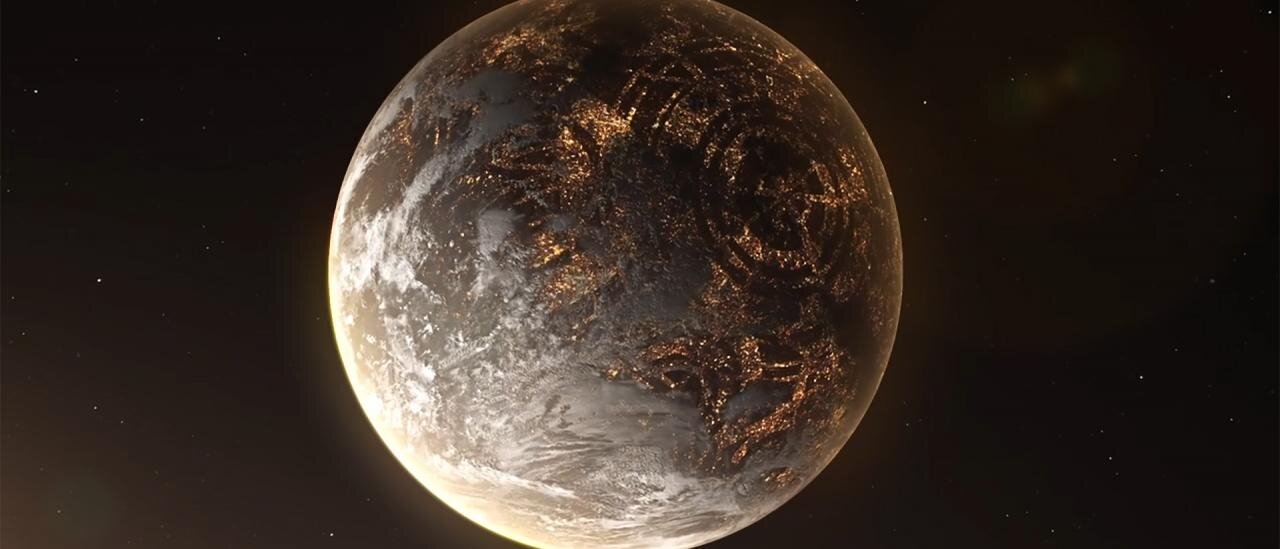 Artistic re-creation of a hypothetical exoplanet with artificial lighting on the night side. Credit: Rafael Luis Mendes Peña / Sciworthy.com.
“We don know whether is intelligence is something very common in the Universe or, on the contrary, it is extremely rare,” explains Hector Socas-Navarro, IAC researcher, director of the Science and Space Museum, the Tenerife Museum and the first author of the article. “For this reason, we cannot know whether these searches have any chance of success.” There is no choice but to try again and again.”
“The idea of searching for technosignatures is basedon the technologies we have on Earth today, and their development in the future, notes Jacob Haqq-Misra, co-author of the article and chairman of the organizing committee of TechnoClimes 2020. “This does not necessarily mean that any extraterrestrial technology should be similar to ours. However, by imagining our future, we can guess what traces of intelligent life are worth looking for.”
Read more
Uranus has received the status of the strangest planet in the solar system. Why?
Physicists have created an analogue of a black hole and confirmed Hawking's theory. Where it leads?
Abortion and science: what will happen to the children who will give birth