Nathan Gianneschi's laboratory set out to synthesize melanin that would mimic the one that was
Melanin has been found in living organisms onour skin and the back of our eyes; and as pigments in many animals and plants. It also plays a role in protecting species from environmental factors. Turtle-headed sea snake stripes darken, for example, in the presence of polluted water, and butterflies living in industrial areas turn black as their cells absorb toxins from the soot. The researchers wondered if this type of biomaterial could be made more like a sponge to optimize these properties, and if spongy melanins already exist in nature.
“The function of melanin is not always and not in allcases is fully known. It is definitely a radical scavenger in human skin and also protects against ultraviolet radiation. Now, thanks to synthesis, we have discovered this exciting material that may very well exist in nature. Fungi can create this material to give their cells mechanical strength, but it is porous, allowing nutrients to pass through.”
Nathan Gianneschi, Deputy Director of the International Nanotechnology Institute.
The ability to create this material in the laboratoryis encouraging for a number of reasons. In typical non-porous materials, particles are adsorbed only superficially. But porous materials such as allomelanin absorb and trap unwanted toxins while allowing nutrients such as air, water, and nutrients to pass through. This could allow manufacturers to create breathable protective coatings for uniforms.
Under the right conditions, melanin looksvoids or may contain what appears to be voids on electron microscopy. When the team stumbled upon a synthetic material, they began experimenting with the porosity and selectivity of the materials to adsorb molecules to these voids.
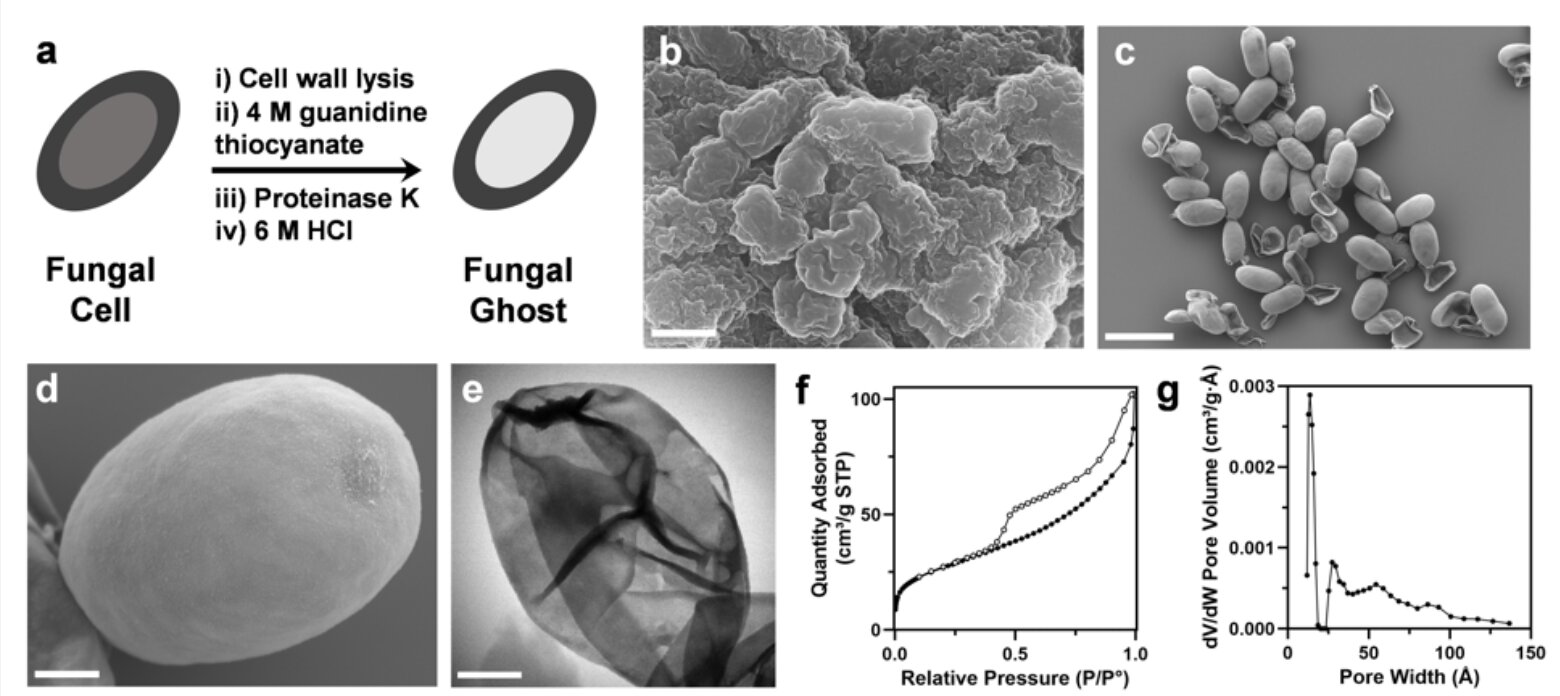
During a key demo, the team was able toshow that the new porous melanin will act as a protective coating, inhibiting the penetration of nerve gas mimics. Inspired by this result, the scientists then isolated naturally occurring melanin from fungal cells. This was done by etching the biomaterial from the inside, leaving a shell containing melanin. They then called these structures "mushroom ghosts" due to the fact that the elusive hollow shape resembles "Casper" from the cartoon of the same name. The material obtained from mushrooms can also be used as a protective layer in fabrics. It is noteworthy that the material remains breathable, water permeable and traps toxins.
Another advantage of this material isits simplicity because it is easy to manufacture and scale from simple molecular precursors. In the future, it can be used to make protective masks and face shields, and it may find application in space travel over long distances. The coating materials in space will allow astronauts to accumulate the toxins they exhale while protecting themselves from harmful radiation, which reduces waste and weight.
It is also a step towards selective membranes, verya complex area of research that aims to produce compounds such as water and allow minerals to pass through, blocking heavy metals such as mercury.
Read on:
- The first panorama of Mars has appeared. It consists of 142 photos!
- Look at the new images of Mars from the Chinese probe "Tianwen-1"
- Researchers have learned how to print bones in the human body