At night last weekend, residents of different regions of the Earth could observe the aurora borealis.
Researchers attribute this aurora tocoronal mass ejection that occurred on the Sun on April 21. The charged particles from the atmosphere of a star that cause a magnetic storm move very quickly, but even they take time to travel the distance to our planet.
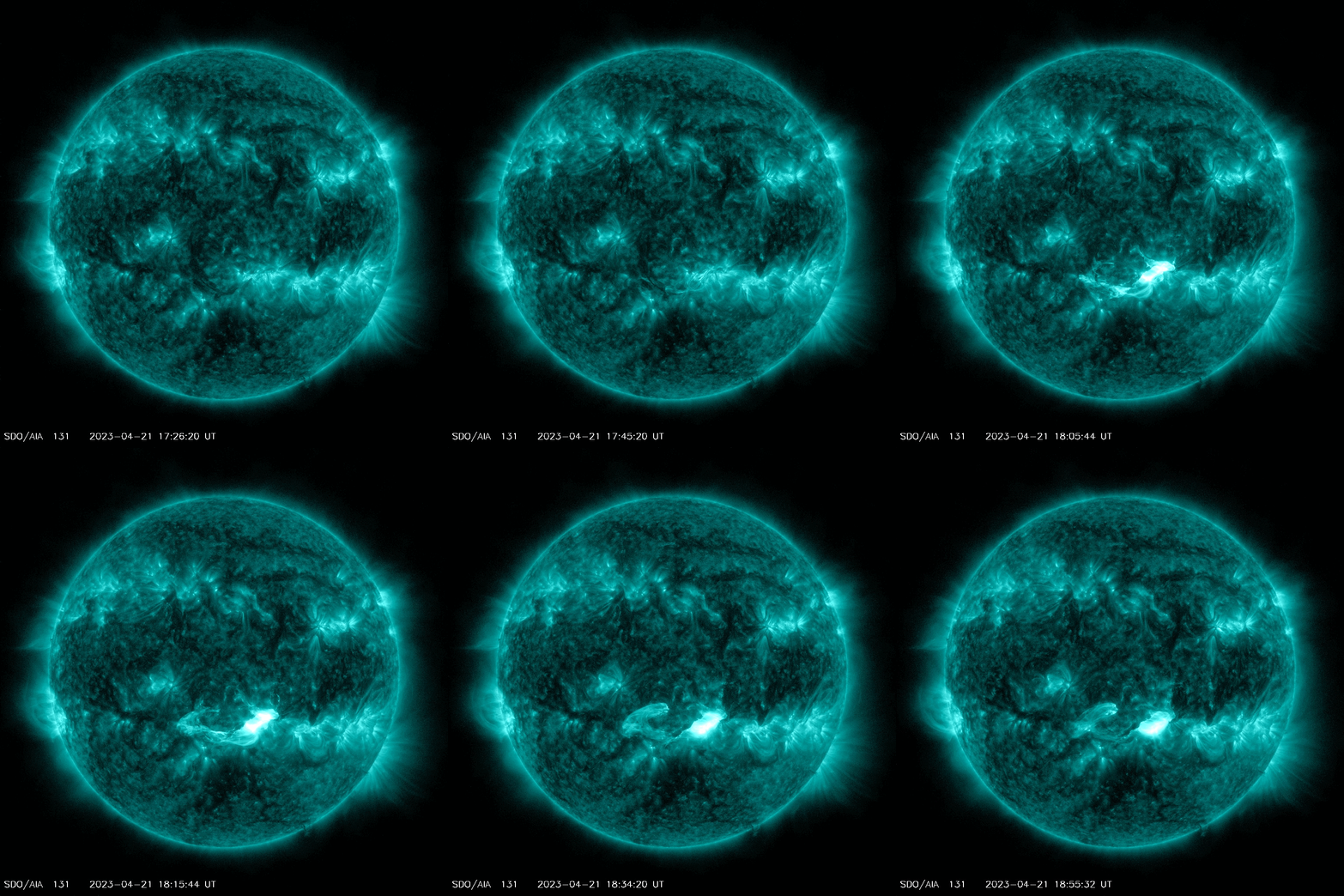 Coronal mass ejection on the Sun on April 21, which caused a magnetic storm on Earth. Video: Solar Dynamics Observatory
A geomagnetic storm occurs when a cloudcharged particles of a coronal mass ejection on the Sun collides with our planet and interacts with the Earth's magnetic field. Charged particles are deflected towards the poles of the planet and interact with the atoms of the atmosphere, leaving bright traces. When billions of collisions occur in succession, the auroras appear to be moving or "dancing" in the sky.
Depending on which atomsparticles interact, it can be of different colors. For example, the most common, green, hue occurs when charged particles collide with oxygen molecules at an altitude of 100 to 300 km, and nitrogen atoms at an altitude of about 100 km give a pink and dark red glow. As a rule, the aurora is observed only in the subpolar regions near the north or south pole of the Earth, but during strong magnetic storms, like last weekend, they can also be observed in temperate latitudes.
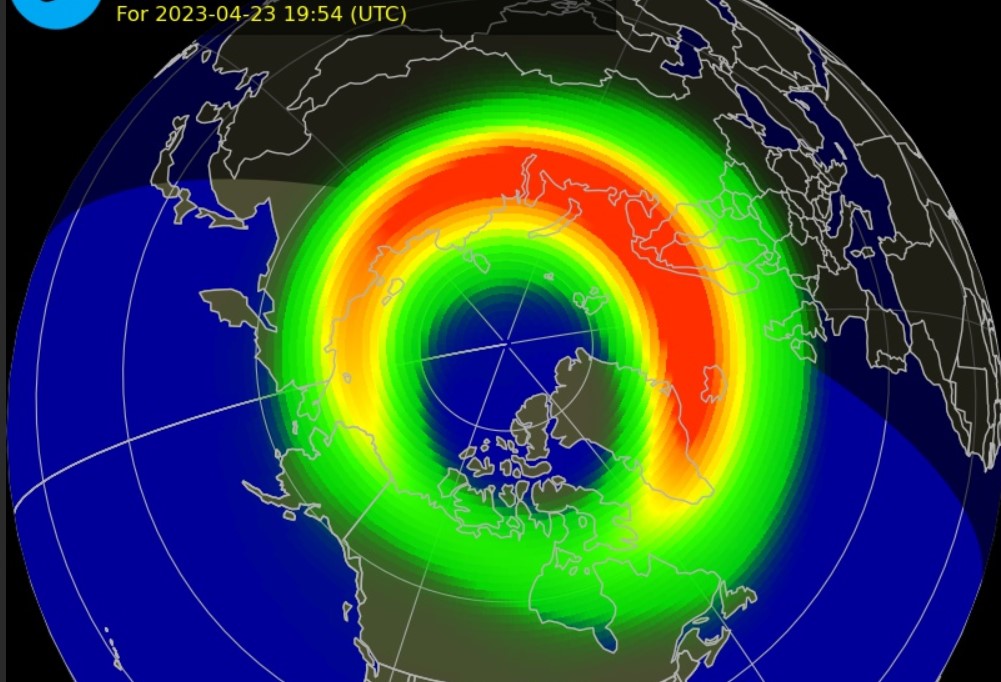 An area where there was a high probability of seeing an aurora caused by an ongoing magnetic storm. Image: NOAA
National Oceanic andAtmospheric Research estimates the level of the magnetic storm as G4 - a powerful storm. The proposed scale classifies all geomagnetic storms from G1 to G5. Level G1 corresponds to the weakest storm, and G5 to the extreme storm. The G4 storm can cause voltage control problems in power systems, degrade satellite navigation and interfere with low frequency radio transmission.
In addition to the potential negative consequencesa magnetic storm of this class causes auroras that are visible far beyond the Arctic Circle. Over the weekend, the observation of the aurora was reported in St. Petersburg, Moscow, in many cities in Europe, in the south of France and Canada.
LIVE: Aurora over Vologda, Russia pic.twitter.com/emvZXHtnNM
— Kirill Bakanov (@WeatherSarov1) April 23, 2023
Polar lights in Vologda. Photo: Kirill Bakanov
This is so far the most colorful #auroraborealis I have ever seen since I started chasing the #northernlights. What a beautiful #aurora I’ll surely remember!! This night is one for the books!
South Indian Lake, MB
This is what KP8/G4 geomagnetic storm look like. @AuroraNotify pic.twitter.com/ErWpUqjDUr— Rj Roldan ™ 🔅 (@rjayroldan) April 24, 2023
Aurora Borealis in Manitoba, Canada. Video: Rj Roldan
Another fantastic display of the Northern Lights in the early hours this morning over St Mary's Lighthouse in Whitley bay #weather #aurora @PA @StormHour pic.twitter.com/so0YghSuUU
— Owen Humphreys (@owenhumphreys1) April 24, 2023
Aurora borealis over a lighthouse off the coast of England. Photo: Owen Humphreys
Ранее «Хайтек» рассказывал о том, как формируются полярные сияния и можно ли их наблюдать на других планетах.
Read more:
There was a photo inside the second deepest underwater sinkhole in the world
See what happened to Mercury when it got as close as possible to the Sun
Scientists are ready to recognize the new tree as the oldest in the world