The discovery of the faintest radio galaxy is part of an NRAO astronomer's VLA Frontier Fields legacy study
Distant galaxy clusters have been usedby astronomers as natural lenses for careful study of the most distant objects. The clusters acted as gravitational lenses to bend and magnify light and radio waves. In this way they helped the most sensitive radio receivers in the world - radio telescopes. They are capable of detecting very weak beams of radiation from objects in the most remote corners of the Universe.
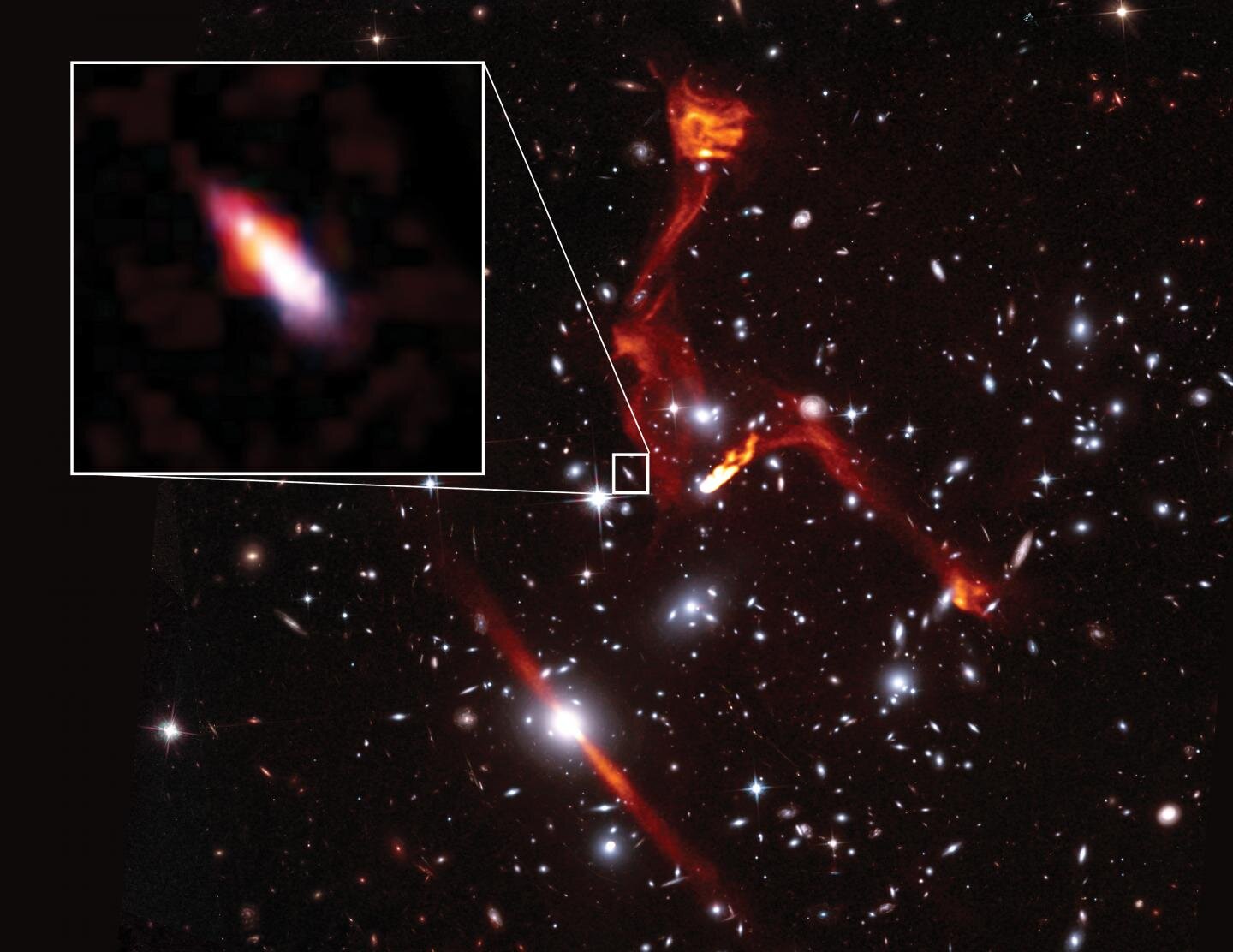
The composite photo above is a radio image of the VLAsuperimposed on a visible light image taken by the Hubble Space Telescope. The prominent red-orange objects are radio relics (large structures possibly caused by shock waves) within the galaxy cluster in the foreground. The galaxy cluster MACSJ0717.5 + 3745 is located at a distance of more than 5 billion light years from Earth.
Detailed observations of the VLA have shown that manythe galaxies in this image emit radio waves in addition to visible light. One of them is located more than 8 billion light years away. Its light and radio waves are distorted by the gravitational lensing effect of the intermediate cluster.
According to astronomers, the radio image of thisthe distant galaxy, which was named VLAHFF-J071736.66 + 374506.4, is enlarged by a gravitational lens more than 6 times. This is what allowed the VLA to find him.
"This is probably the weakest everdetected radio-emitting objects,” said Ian Heywood from the University of Oxford in the UK. “That’s why we want to use these galaxy clusters as powerful cosmic lenses to learn more about the objects behind them.”
Read more
Physicists have created an analogue of a black hole and confirmed Hawking's theory. Where it leads?
Uranus has received the status of the strangest planet in the solar system. Why?
SuperCam scientific instrument from Perseverance rover sends first results to Earth
Purpose of the VLA Frontier Fields StudySurvey—characterize the radio continuum emission of high-redshift galaxies through the use of massive clusters that magnify inherently faint, distant systems.
NRAO (National Radio Astronomy Observatory) - National Radio Astronomy Observatory, USA
The gravitational lens is a massive body that changeswith its gravitational field, the direction of propagation of electromagnetic radiation, just like an ordinary lens changes the direction of a light beam.