A volcano on the Italian island of Stromboli erupted early on Sunday morning, releasing a huge plume of smoke.
The eruption caused a partial collapse of the terracecrater, followed by large lava flows reaching out to the sea. Huge columns of smoke also appeared, rising several hundred meters above the volcano. Italian civil protection authorities have raised the alert level from yellow to orange as “the situation of increased volcanic imbalance continues.”
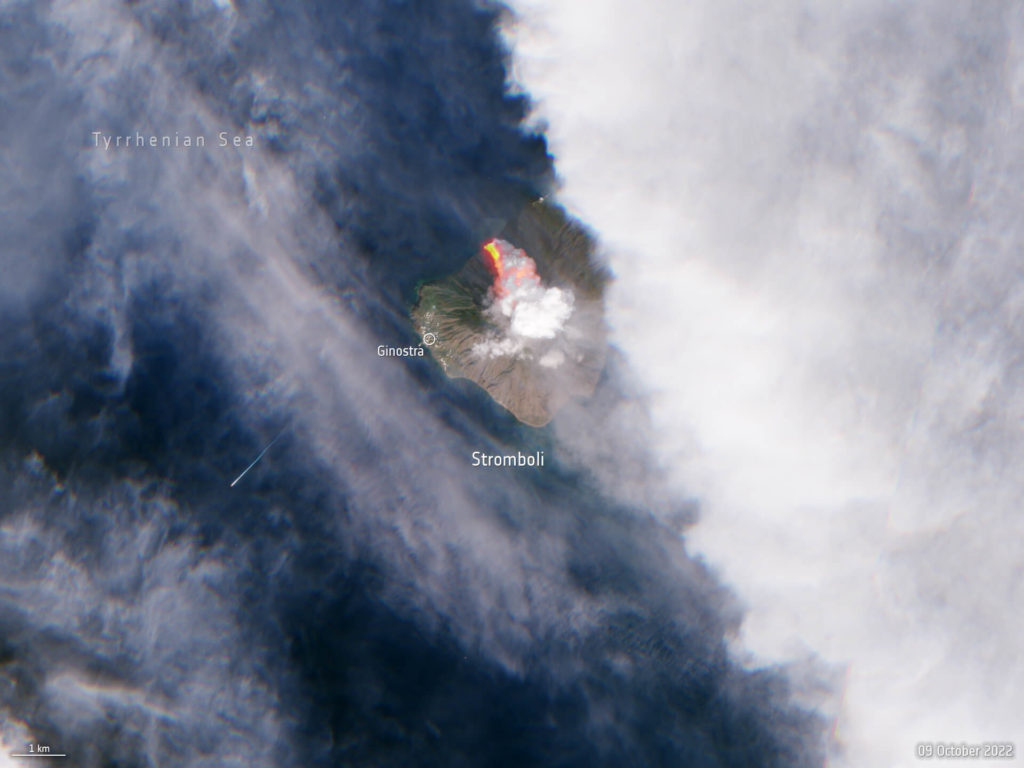 Credit: Contains modified Copernicus Sentinel (2022) data processed by ESA,
CC BY-SA 3.0 IGO
The European Space Agency showeda Sentinel-2 image that has been processed to show events in true color. Scientists used short-wave infrared to highlight the new lava flow. The Sentinel-2 mission is based on a constellation of two identical satellites. Each is equipped with an innovative high-resolution broadband multispectral imager with 13 spectral bands. The equipment allows you to observe changes in soil and vegetation.
The Stromboli volcano is on the northernmost island of the Aeolian archipelago and is close to the northern border of Sicily. It has been active for the last 90 years.
Full resolution image can be viewed here.
Read more:
An unknown species of winged insect "hidden" in amber for more than 35 million years
Gas leak from Nord Stream was shown from space
See how Jupiter and the Moon approached in the night sky