Paleontologists from Flinders University used a micro-CT scanner and 3D printing to reconstruct
“We use computed tomography tolook inside pieces of rock that contain the remains of a small dinosaur, explains lead author of the study, Associate Professor Paul Willis from the College of Science and Engineering at Flinders University. “We converted the scans into virtual 3D models, and then we will print them on a 3D printer. So we can see the bones still hidden inside the rock.”
The dinosaur that scientists are studying isa herbivorous hypsilophodont from Lightning Ridge, New South Wales. It was discovered and preserved for science back in 2019. This is a very small herbivore. Now the reconstructed dinosaur will be revived for future generations. The project involves staff from the Australian Opal Center in Lightning Ridge and Paleo Pictures, led by Associate Professor Willis.
According to him, recent scans of somefragments found by miners at Lightning Ridge showed that the bone inside was preserved in great detail. At the same time, the process of 3D printing of the most interesting samples has already begun.
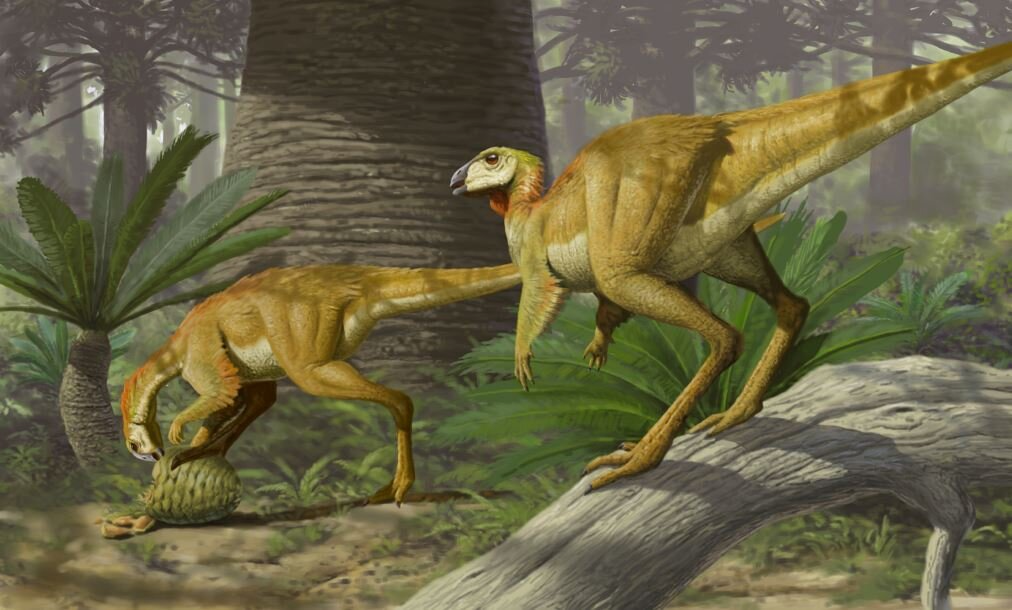 Reconstruction of what this little dinosaur might have looked like. Image: James McKinnon
So far, only about 20% have been scanned.samples. Once the process is complete, scientists will begin a detailed study of the skeleton. This way they will figure out which species the dinosaur belongs to or is it a new species. They will also understand how he lived and died.
Jewelers value, first of all, noble, or jewelry, opals - almost throughout the world, such stones are usually classified as precious.
Read more:
Earth-sized sunspot grows 10 times in 2 days: it is directed at us
Scientists have found the remains of an ancient man with two X chromosomes
From the body to the mouth: scientists have understood where the teeth came from
Cover photo: Opal from Yowa, Queensland, Australia, Noodle snacks, CC BY-SA 2.5, via Wikimedia Commons