According to recent research, on average, users unlock their phones 110 times a day.
Smartphone and person data
One way or another, this gadget is constantly with us, itcollects a lot of data about us. If you analyze them correctly, you can predict almost anything. Marketers take advantage of this to show people relevant, well-chosen ads. Now this data has been collected to predict the risk of death in the coming years.
 en.freepik.com
New research published in the journalPLOS Digital Health showed that passively tracking motion data using smartphone sensors can effectively predict a person's five-year mortality risk with about 70% accuracy.
Analysis in the past
Almost every smartphone hasFitness app. It can be called differently; the point is that it collects data from smartphone sensors about human activity. How long he walks, sits, runs—everything is recorded. Now scientists have used them to find out the relationship between walking speed and overall health.
In previous experiments, to obtainaccurate predictions of health and mortality, the researchers asked participants to either wear special fitness trackers 24/7 or perform “gait analysis tests” in a laboratory setting. Now the authors of the new study wanted to test whether motion data collected using sensors in regular smartphones was enough to make accurate predictions.
What have the scientists done?
Scientists analyzed a large data set -100 000 people provided their scores to the UK Biobank. Participants wore wrist-based activity monitors for one week and were then monitored for at least five years.
This is the largest sensor data set yetmovement available today. According to the researchers, short bursts of motion data collected by fitness trackers are similar to data that can be obtained from a smartphone in a person's pocket.
 en.freepik.com
“Although this data was collected from monitorsactivity, our sensor models use only those input data that could be collected using inexpensive, currently available smartphones, the scientists explained in the study. “This was made possible by extensive clinical experiments with low-cost phones, which developed highly accurate predictive models for the health of patients with cardiopulmonary diseases.”
How does the algorithm work?
Using just six minutes of data per day,tracking walking intensity, the predictive algorithm offers five-year mortality risk estimates. As the study authors note, they are as accurate as data obtained from 24/7 wearable devices or more complex clinical gait tests.
The findings add to a growing numberstudies devoted to various methods of assessing the risk of human mortality. Simple eye scans, blood screenings or short balance tests have been proposed as ways to screen people at risk of early death.
What's next?
Scientists are now planning larger scaletrials that will focus on data directly collected from smartphones. Experts are also working to make the cohorts studied as diverse as possible to make predictive models accurate for different populations.
 en.freepik.com
Even though a smartphone can predictthe death of a person in five years, the finished algorithm does not look like a simple link where you can enter your data or a convenient application. It is a complex circuit that analyzes the collected data. Detailed graphs compiled by scientists can be found at the link. An example flowchart is below.
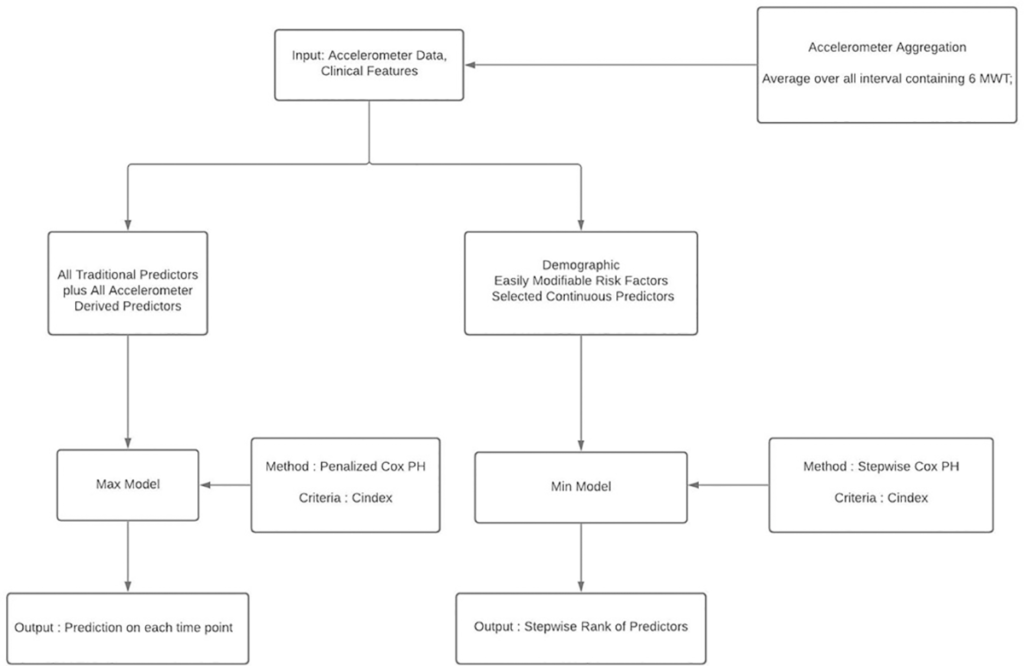 Block diagram of the algorithm. Credit & Copyright: PLOS Digital Health
However, in the future, phone apps will be able torecord six minutes of continuous walking in daily life and then compute predictive models for risk stratification using population analysis.
However, the secret to longevity is quite simple - an active lifestyle. And now data from a smartphone can be used to track daily activity.
Read more:
Starlink signal hacked to be used as an alternative to GPS
NASA revealed the origin of Haumea - the most mysterious planet in the solar system
Physicists Break Standard Quantum Limit With 'Quantum Horror'