One of the central predictions of general relativity (GR) is that a massive object—
Under the right conditions, gravityLensing acts as a kind of natural telescope out of nothing. It can increase the brightness and light of distant objects. Astronomers have already used this technique to observe some of the most distant galaxies in the Universe. Now they want to use this effect to study objects “closer to home.”
How can the sun help?
As a lens for studying nearbyexoplanets can use gravitational lensing of the Sun. Thus, the light coming from the alien world will be gravitationally focused by our star with a focus in the region from 550 to 850 AU, depending on how close the exoplanet's light passes from the Sun.
Astronomical unit (AU)) is a unit of distance measurement in astronomy, approximately equal to the average distance from the Earth to the Sun. Currently accepted to be exactly 149,597,870,700 meters.
In in principle, theoretically on thisOne or more telescopes can be placed at a distance, thus creating a telescope the size of the Sun. This would give a resolution of about 10 km² for objects at a distance of 100 light years.
What to do?
Farthest spacecraft launchedhumanity, this is Voyager 1, which is only 160 AU from the Sun. Obviously, scientists still have a lot to do before such a solar telescope becomes a reality. For now, this is only a project that can be implemented in the future. This does not require magical technologies or new physics, but it does require many extraordinary engineering solutions.
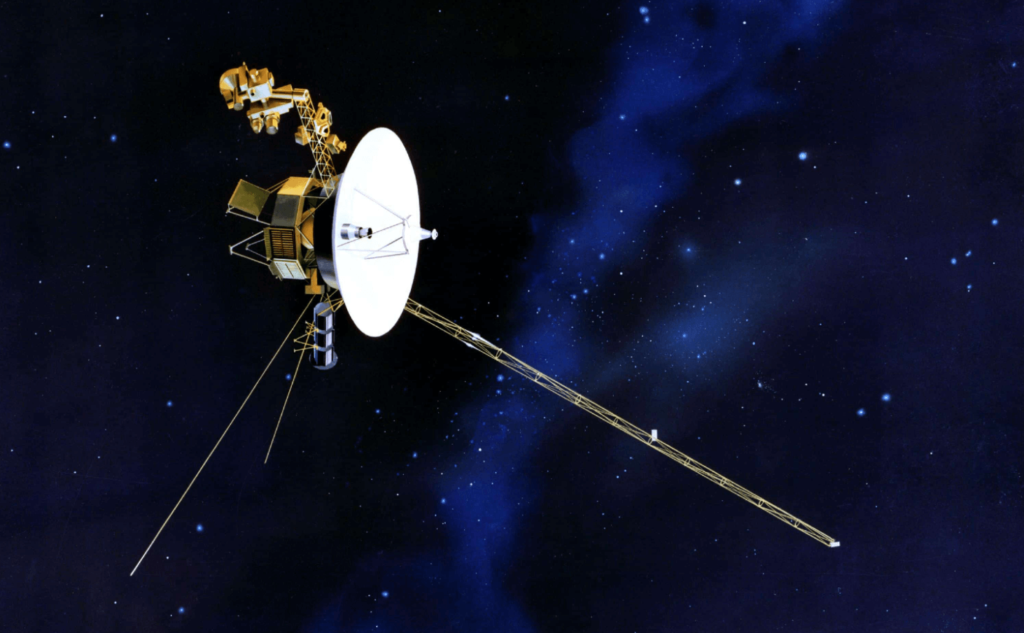 Photo: NASA
But even in this case, scientists will facewith another problem. It's about using all the data collected to create an accurate image. As is the case with radio telescopes, a “solar lens” will not be able to obtain one image at a time. A detailed understanding of how our star focuses light to image exoplanets will be required. And this is exactly the problem that scientists are ready to solve.
The problem of telescopes and the solution of scientists
No telescope is perfect.One of the limitations of their optical variations is related to diffraction. When light waves pass through a telescopic lens, the focusing effect can cause the waves to slightly interfere with each other. This is defraction, which can blur and distort the original image.
As a result, for any telescope there isThe limit of image sharpness is the diffraction limit. Although a telescope with a gravitational lens is different in its structure and properties, it also has a diffraction effect and a diffraction limit.
In a study recently publishedIn the Monthly Notices of the Royal Astronomical Society, scientists simulated gravitational lensing of the Sun. The goal is to observe its diffraction effects, which will affect how astronomers observe distant objects such as exoplanets.
What's the bottom line?
It turned out that a telescope with a solar lenswill be able to detect a 1 W laser that could come from Proxima Centauri b. This is a planet that is only four light years from Earth. Scientists have found that, in general, the diffraction limit is much smaller than the overall resolution of the telescope. In the future, using a “solar telescope”, scientists will be able to distinguish details from 10 to 100 km, depending on the observed wavelength.
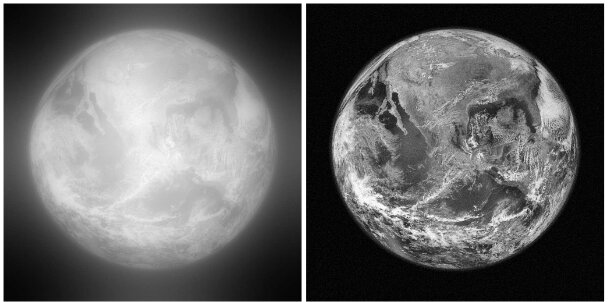 Credit: Toth V. T. & Turyshev, S.G.
To show how a solar telescope would work, the scientists simulated an image of the Earth (above) at a resolution of 1024×1024 pixels at a distance of Proxima Centauri (1.3 parsecs).
Physicists also found that, even at scalesниже дифракционного предела, с помощью Солнца астрономы смогли бы исследовать и другие объекты. Например, нейтронные звезды. Они, правило, слишком малы, чтобы можно наблюдать их особенности. Но такой гравитационный телескоп поможет изучать даже изменение температуры поверхности этих объектов.
Basically, the new study confirmed thatObjects such as exoplanets and neutron stars can be successfully observed using a telescope with a solar lens. If all goes well, astronomers will have a truly revolutionary tool in the future.
Read more:
NASA revealed the origin of Haumea - the most mysterious planet in the solar system
Living organisms have made Mars uninhabitable
The liver can work for more than 100 years: scientists told how this is possible