Russian researchers have created a stable source of spin-polarized electrons. Development
In a paper published in the journal PhysicalReview Letters, scientists have shown that a multi-alkali source of polarized electrons is more efficient than the classical gallium arsenide devices currently in use.
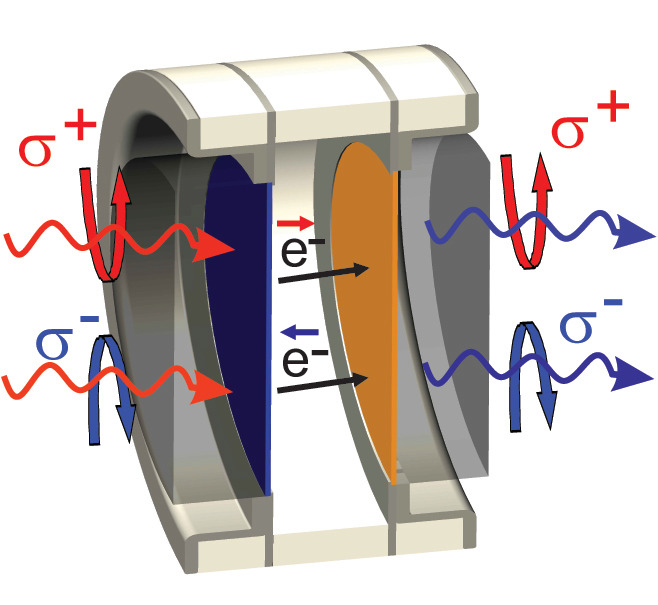 Schematic representation of a vacuum spin photodiode (it contains a multi-alkali source of spin-polarized electrons and their detector). Image: Vadim Rusetsky, Oleg Tereshchenko
The source created by scientists is a multi-alkalinephotocathode. This is a thin semiconductor layer that "produces" electrons with the same spin (polarized) when irradiated with a laser. Currently, scientists have managed to achieve a degree of polarization of 50%, they expect to increase this value to 100%.
The researchers note that multi-alkali cathodeseasier to use than classic devices. They are less demanding on the presence of unwanted impurities in the residual gas. In addition, scientists say that the sources they have created provide an order of magnitude higher quantum yield - up to 15%. This is a quantity that indicates the ratio of the emitted electrons to the incident photons that initiated the photocurrent.
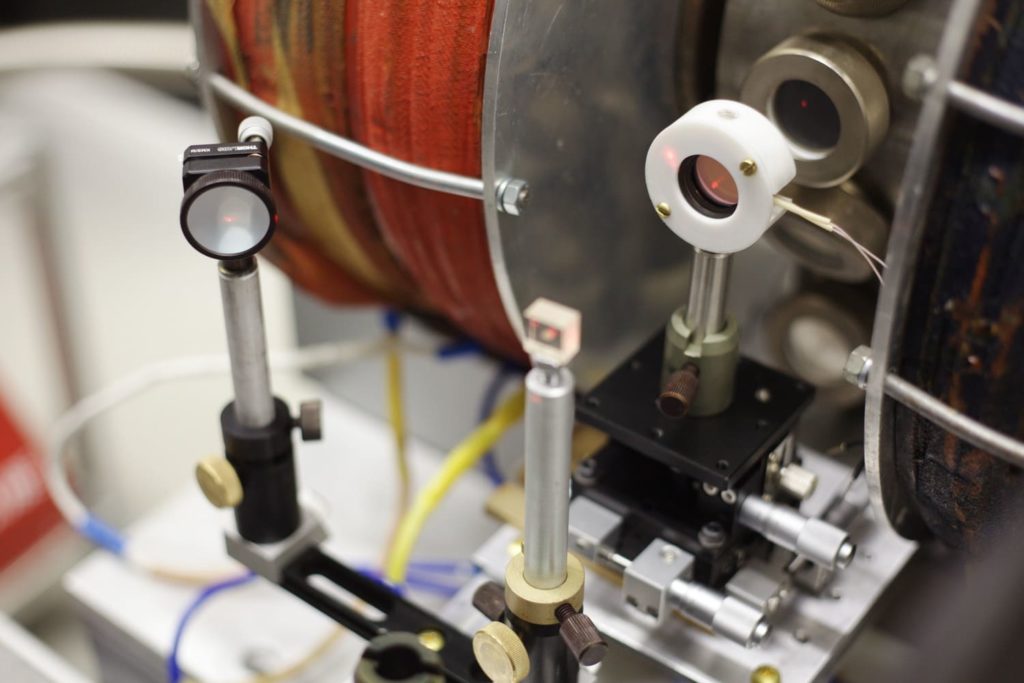 Source of spin-polarized electrons in an optical scheme. Image: Vadim Rusetsky, Oleg Tereshchenko
The authors of the work say that an increase in the degreepolarization - a key characteristic of the device - is not just a desire. Preliminary experiments have shown that by controlling the structure of the semiconductor, it will be possible to achieve 100% of the value.
Read more:
Living organisms have made Mars uninhabitable
The most powerful black hole collision in the universe proved Einstein's theory
The bones in the Midnight Terror Cave were carefully examined and found inexplicable footprints.
On the cover: a source of spin-polarized electrons. Image: Vadim Rusetsky, Oleg Tereshchenko