Agriculture on the ISS
Astronauts spend months on the ISS and their usual diet is low in fruits, vegetables and
In April 2014, the Dragon SpaceX cargo shipdelivered the Veggie green plant to the International Space Station, and in March astronauts began testing the orbital plantation. The installation controls light and nutrient intake. In August 2015, the astronauts' menu included fresh herbs grown in microgravity.
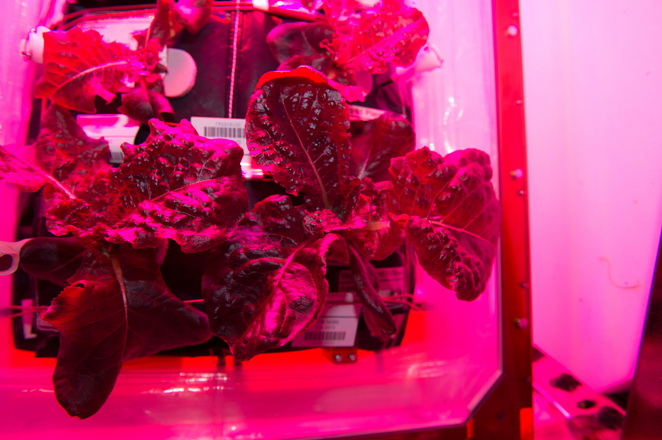 Greens from ISS
In the Russian segment of the International Spacethe station operates a greenhouse "Lada" for the experiment "Plants-2". In late 2016 or early 2017, the Lada-2 version will appear on board. The Institute of Medical and Biological Problems of the Russian Academy of Sciences is working on these projects.
But all these experiments were not without difficulties that we on Earth do not encounter during gardening:
- Microgravity. In low-Earth orbit and in potentialOn colony planets, gravity is less than what we are used to. Weak gravity affects many features of the development of organisms, and plants are no exception. In experiments where the same crops were planted on Earth and on the ISS, some species in orbit noticeably lost taste and nutritional value.
- Violation of temperature exchange... This problem occurs if the enclosed space is poorly ventilated. At the same time, volatile organic substances accumulate around the plant, which can slow down its growth.
- Radiation. Observations show that constant radiation can cause DNA damage and mutations, and also affects the level of gene expression
Atypical methods of growing vegetables and greens in space
- Hydroponics
Beds, soil and clay weigh a lot, so scientistsThey were looking for ways to exclude it from the growing process. Therefore, researchers are increasingly looking towards methods in which greens and vegetables grow in water - hydroponics and aeroponics.
You can keep the roots in water all the time or use the ebb and flow technique, as well as use a variety of substrates that hold the right amount of liquid.
- Aeroponics
Here the roots of the plants are not in the water, but in the air. Sprayers are installed nearby, which from time to time envelop the roots with a light haze of tiny drops of a nutrient solution.
This is how the plants receive both nutrition and sufficientthe amount of oxygen - the risk of suffocating the crop with a layer of water is much lower than in the case of classic hydroponics. The risk of plant disease is also reduced, as dangerous microorganisms often settle in water or wet substrates.
- Anthroponics
In this case, water and fertilizers for hydroponic installations are taken from the waste of the crew.
For example, the urine of astronauts can become the basisnitrogen fertilizers, such an experiment has already been carried out on Earth by Italian scientists. But in reality, it is not so easy to switch to this technology. The excrement of astronauts may contain, for example, an excess of certain metals.
Cosmic bones: a skeleton fragment was grown on the ISS
In November 2019, Russian scientists for the first timegrew fragments of bone structure in zero gravity conditions. During experiments on the ISS, tissue samples were made from calcium phosphate ceramics, which were populated with living cells.
At present, they are being comprehensively studied on Earth. In the future, the technology will make it possible to create bone implants for transplantation to astronauts on long-distance interplanetary expeditions.
- Why you might need skeletal fragments in space
The idea sounds logical, but so farfuturistic —to provide specialized medical care. According to experts, it is necessary to create new means of space medicine, including for the formation of body tissues in conditions of weightlessness. In the future, they could be transplanted into astronauts if they get sick or injured.
- What skeleton fragments were grown from
The study used biocompatible materials based on calcium phosphate ceramics: its composition is almost identical to the inorganic component of real bone.
The unique properties of the development are achieved inthe account of self-organization of the material at physiological temperatures, noted the director of the Institute of Metallurgy and Materials Science. A.A. Baikov Russian Academy of Sciences Vladimir Komlev.
- What technology is used to grow bones
The device operates using the technology of magnetic levitation in zero gravity, in which the object is not created in layers, as in conventional 3D printers, but from all sides at once - according to the principle of molding a snowball.
With this production method, astronautsit was possible to form a spheroidal fragment of bone tissue from ceramic particles. After which the fragments began to interact with each other, forming stable chemical bonds
- What stage are the researchers in?
Currently, scientists have managed to solve the complex problem of processing material using biofabrication technologies, which involve the artificial creation of biological objects.
However, in comparison with plastic and metal analogs, ceramics is a more fragile base, the use of which in some cases may require additional strengthening of the implant.
How will the organ growing experiment on the ISS go
Researchers from the Zurich Space CenterThe university, together with Airbus, as part of a resupply flight, sent human stem cells to the ISS to grow organoids - mini-copies of human organs.
The project was named “3D organelles in space”.It was developed by University of Zurich researchers Oliver Ulrich and Cora Thiel, who studied how gravity affects human cells. The Airbus Innovations team, in turn, has developed the necessary equipment and provides access to the ISS.
- Why grow organelles
Organoids are permanent parts of a cell that performcertain functions. On artificial three-dimensional organelles, toxicological studies can be carried out, this will exclude experiments on animals. Also organelles can replace tissue fragments in the treatment of damaged organs.
- Why did organelles decide to grow in zero gravity?
The researchers note that it is impossible to grow three-dimensional organelles on Earth due to the force of gravity.
Three-dimensional organoids cannot be grown on Earth without some kind of supporting scaffold. In space, where there is no gravity, this problem solves itself.
Cora Thiel, scientist and biologist
- How will the organ growing experiment on the ISS go
During the next mission, they will sendtissue stem cells of two women and two men of different ages. The researchers will test how reliable their method is when using cells with different biological variability.
- Prospects for growing organelles in space
Scientists also plan that in the future the ISS will have a workshop for the production of human tissues that can be used on Earth for scientific purposes and in medicine.
Successful implementation of this experiment will becomea real breakthrough for medicine. On the one hand, pharmaceutical companies will be able to conduct toxicological studies directly on human tissue, without the need for animal experiments. In addition, in the future, organelles grown from stem cells of patients can be used for transplantation - perhaps this will help meet the global demand for donor organs.
To read Further:
New electric car drives 800 km without recharging: this is Tesla's main competitor
Scientists have been unable to catch Rambo's fox for three years. It prevents rare animals from being released into the forest.
A spaceship several kilometers away: everything that is known about China's new project