Back in 1930, after the discovery of Pluto, astronomer Frederick Leonard wrote that the most distant planet of the solar
This concept unites all objects locatedbeyond Neptune (from 35 AU) within 50 AU from the sun. Recall that one astronomical unit is the distance from Earth to our star. It is noteworthy that this region was named after the Dutch and American astronomer Gerard Kuiper, although it was he who insisted in the 50s of the last century that the region from the orbit of Neptune to the Oort Cloud should be absolutely empty. The scientist believed that Pluto was comparable in size to the Earth, and therefore its gravitational influence should have cleared the space along the orbit from all asteroids.
The Kuiper belt resembles the asteroid beltlocated between the orbits of the Earth and Mars, but it is much larger, wider and more massive objects are observed in it. Including at least four dwarf planets - Pluto, Haumea, Makemake and Eris. Also, unlike the rocky belt objects near Earth, Kuiper belt asteroids are mostly solidified gas.
 Asteroid belt, Kuiper belt and Oort cloud. Image: Mark Garlick, Science Source
How did you manage to open the first object?
Although various assumptions about the existencetrans-Neptunian objects, that is, cosmic bodies located outside the orbit of Neptune, were put forward throughout the 20th century, especially after the discovery of Pluto (the first such object). The first confirmation of the existence of distant objects was obtained only 30 years ago.
Planetary scientist David Jewitt and astronomer Jane Luu fromMassachusetts Institute of Technology since the late 80s engaged in unusual searches. They used telescopes in Arizona to take random photographs of patches of the sky. A series of shots taken with short breaks could show some kind of moving object.
The experiments were successful after three yearsafter the start of the study. On the night of August 30, 1992, scientists used the University of Hawaii telescope on the Big Island. They used their usual technique for finding distant objects. Separate pictures were taken once an hour, after which the scientists compared whether something in the image had changed.
Around 21:14 scientists took the first two images. Comparing them on the screen, they saw that a small speck of light, which in the second image has shifted slightly to the west. To make sure that this is not a mistake and not a random image of distant cosmic rays, the scientists waited until 23:00 and took another photo. In the third image, the new object is preserved and shifted further to the west. Similar data was shown by the fourth picture taken just after midnight.
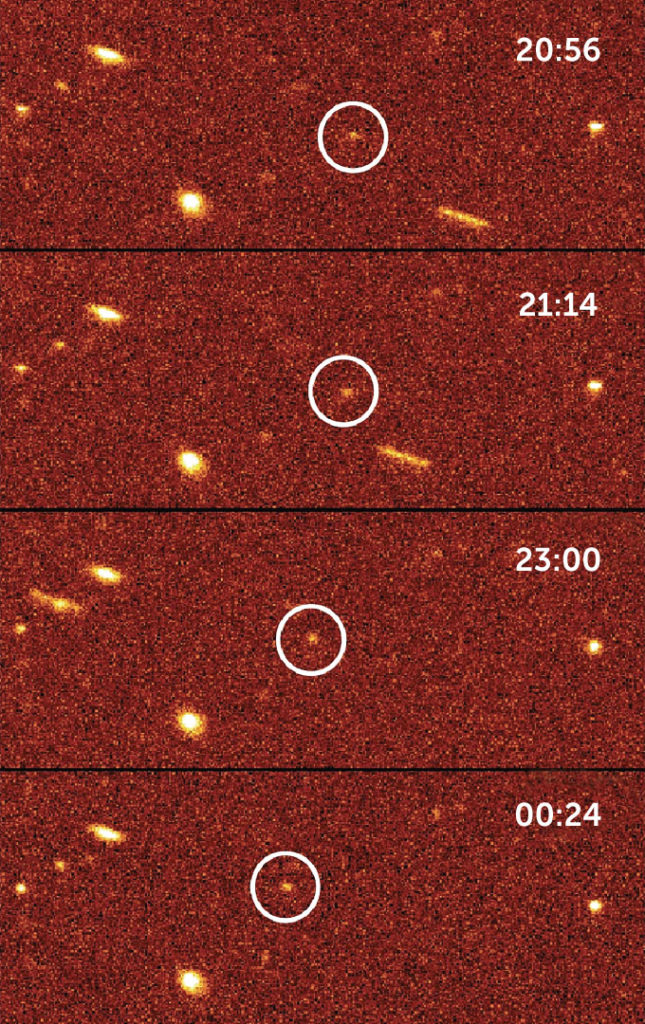 A moving object at different times of observation. Image: David Jewitt, UCLA
Further research showed that farThe object, which scientists named QB1, took nearly a month to pass through a patch of sky the width of the full Moon. Based on the object's brightness and slow speed, scientists concluded that QB1 is an object of ice and rock about 250 km in diameter and traveling beyond Neptune's orbit.
It was the first trans-Neptunian after Pluto.an object. The first success was followed by new ones: after a few months, scientists managed to open another object. And as the sensitivity of digital sensors improved, the discoveries went one after another. To date, several thousand objects are known to orbit the Kuiper belt.
"New Horizons" and the secrets of Arrokoth
A new breakthrough in the study of the Kuiper belt and the solarThe system is associated with the New Horizons research mission. The interplanetary space station was launched by NASA in 2006, and already in 2015 it sent back the first images of the Pluto and Charon system (the planet's moon) and many amazingly detailed images of the Kuiper belt objects.
But the most amazing discovery was made"New Horizons" in 2019. The ship, which at that moment was at a distance of about 1.5 billion km from the orbit of Pluto, discovered an asteroid of an unusual shape - Arrokoth. This is a contact-double object that consists of two parts. The larger part - Ultima - resembles a flat pancake, the edge of which is attached to a smaller object - the spherical Thule.
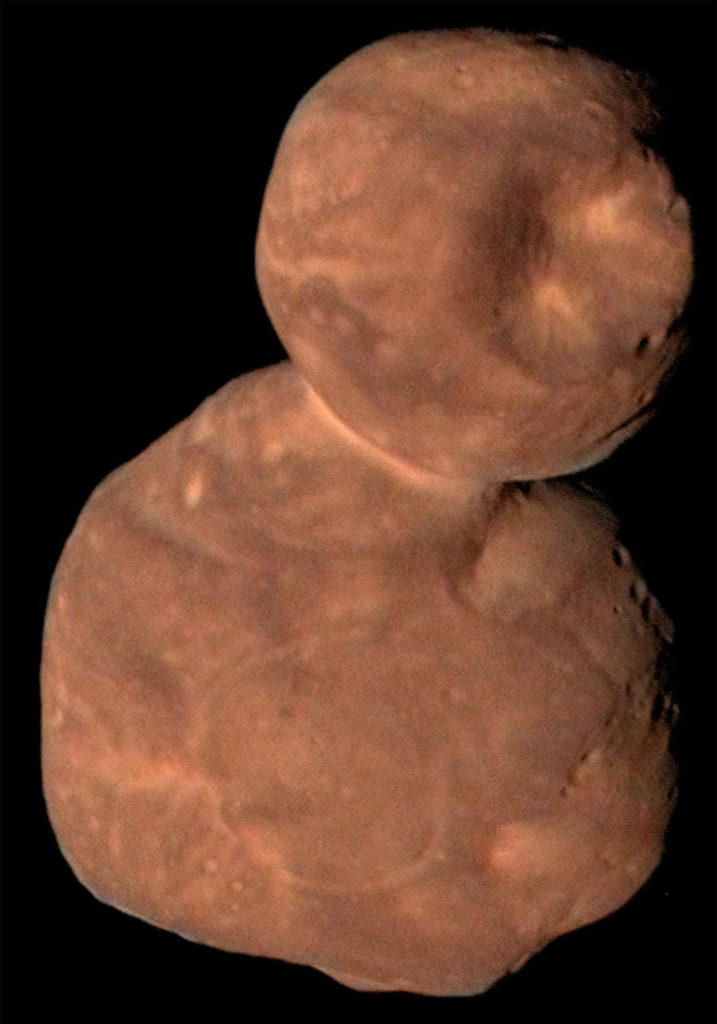 Arrokoth. Image: NASA, Johns Hopkins University Applied Physics Laboratory, Southwest Research Institute, Roman Tkachenko
Planetary accretion is one of the hypothesesSolar System Object Formation - suggests that the formation of planets occurs as a result of a series of collisions in which objects collide and stick together, becoming larger and larger. This hypothesis has only one drawback: as the mass grows, such objects acquire their own gravity. As a result, the two parts accelerate too actively before the collision and cannot simply connect, but are broken into parts.
In particular, modeling the collision of twoparts of Arrokoth shows that their collision could not have produced such an unusual object. Scientists suggest that another hypothesis better explains the unusual structure of the asteroid.
It is more likely that Arrokoth was born as a resulta process known as gravitational instability, the researchers say. In this scenario, under certain conditions, the gas cloud, part of which is more dense, quickly collapses under the influence of gravitational forces.
The researchers note that since this is the case throughoutappearances, some Kuiper belt objects formed, perhaps similar processes occurred in the early protoplanetary disk, from which all objects of the solar system were formed. It is noteworthy that the formation of planets in this theory takes thousands, not millions of years, and therefore the entire process of system formation could proceed much faster.
New Horizons still keep movingthrough the Kuiper belt, perhaps scientists will be able to identify another object with which the device can approach. This discovery, perhaps, will once again turn the ideas about the structure and evolution of the solar system.
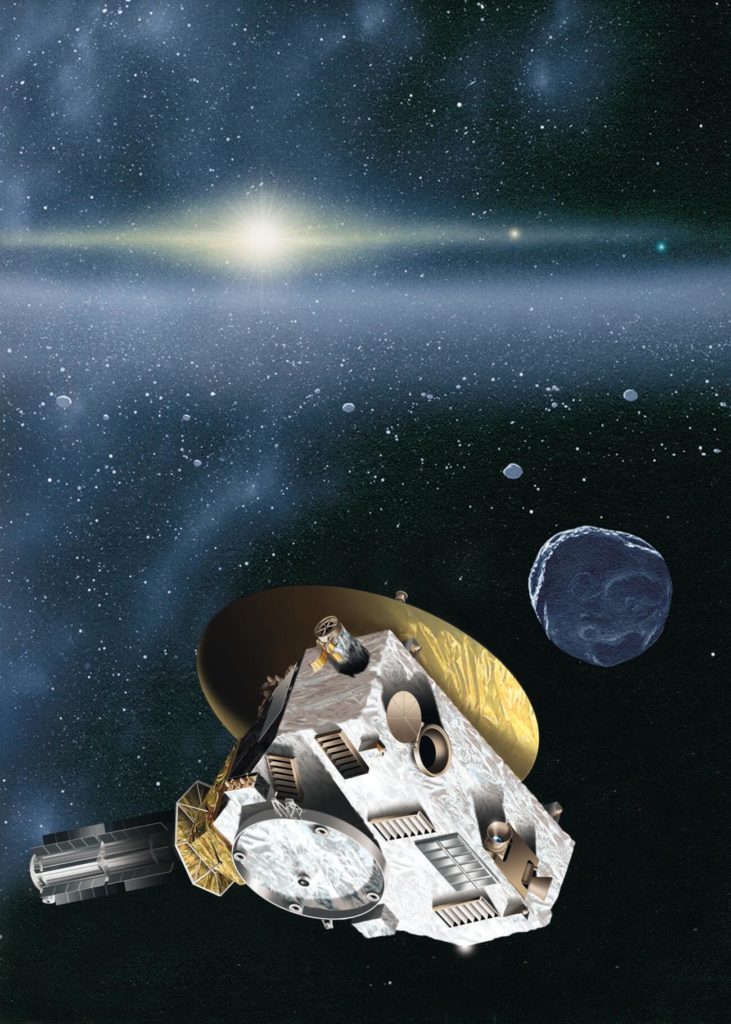 Artistic illustration of the New Horizons exploration of the Kuiper belt. Image: Johns Hopkins University Applied Physics Laboratory, Southwest Research Institute (JHUAPL/SwRI)
Moving gas giants
New Horizons provided a glimpse ofindividual Kuiper belt objects up close, and the development of ground-based observatory instruments to consider them en masse. For example, planetary scientists have recently completed a study of the origin of the solar system using the Canada-France-Hawaii telescope located on Mauna Kea. This is the same peak from which the first Kuiper belt object was discovered. During the review, planetary scientists identified 800 previously unknown objects, as a result of which their total number exceeded 3 thousand.
Large-scale observation revealed thatKuiper belt objects are not evenly distributed, but are concentrated in small groups. Such an effect is possible as a result of a powerful gravitational effect.
Researchers believe that the responsibility forsuch distortion lies on two gas giants - Neptune and Saturn. The simulations showed that if in the past these planets moved erratically, approaching and receding from the Sun from time to time, powerful gravitational waves associated with a change in the location of massive objects could affect the location of objects in the Kuiper belt.
Numerous studies of the Kuiper Belt have alreadyallowed us to learn more about the past of our solar system. Planetologists were able to confirm one of the hypotheses of the formation of planets and discovered the instability of the orbit of gas giants in the early stages of the existence of the solar system.
Despite this, there may be many more to come.amazing discoveries. For example, New Horizons may encounter another unusual asteroid. And besides, a large-scale study should begin next year with the help of the Vera Rubina observatory under construction in Chile. For 10 years, the observatory's telescopes will continuously scan the southern hemisphere to find the smallest details. This research is expected to increase the number of known Kuiper belt objects to 40,000 and is sure to bring many new discoveries.
Cover: Kuiper belt. Image: NASA
Read more:
Earth-sized sunspot grows 10 times in 2 days: it is directed at us
Scientists have found the remains of an ancient man with two X chromosomes
From the body to the mouth: scientists have understood where the teeth came from