Scientists believe that the half-exploded star did not have enough material for a full explosion.
A classic thermonuclear supernova explosion (such asla) is a massive event that completely destroys the progenitor star. SN 2012Z is a strange type of thermonuclear explosion, sometimes called a Type Iax supernova. These supernovae are dimmer and fainter. Researchers have previously assumed that these are failed Type Ia supernova explosions. New observations published in the Astrophysical Journal support this theory.
SN 2012Z is the only supernova for whichthe progenitor star is precisely defined and there are recorded observations showing what happened before the explosion. The researchers are using new observations from the Hubble Telescope taken about 1,400 days (about 4 years) after the explosion. The pictures show that the new star is almost twice as bright as the progenitor.
When we received the latest data from Hubble,we expected to see one of two things: either the star would disappear completely, or perhaps it would still be there if the star we saw in the images before the explosion was not the one that exploded. No one expected to see a surviving star that was brighter.
Curtis McCali, head of research at Las Cumbres Observatory
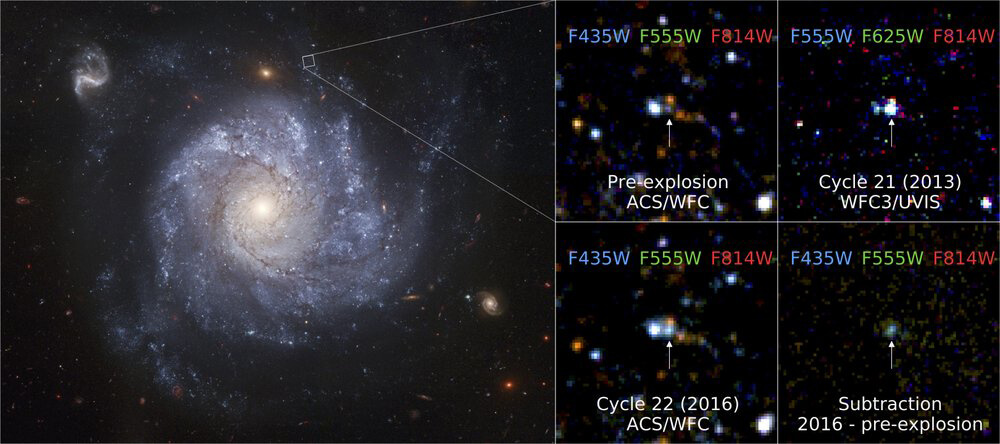 Supernova before and after the explosion in Hubble images.In the top row, images before and immediately after the explosion, in the bottom row, four years after the explosion (left) and a highlighted increase in volume compared to the image before the explosion (right). Source: McCully et al., Astrophysical Journal
Researchers believe that since the powerthe explosion was not enough to form a full-fledged type la supernova. Some of the stellar matter remained in the system, and as its mass decreased, the diameter of the white dwarf increased.
Astrophysicists believe that the new studywill help to better understand the evolution of stars and supernova explosions. Classic theory suggests that supernovae explode when a white dwarf reaches a certain limit in size, called the Chandrasekhar limit, about 1.4 times the mass of the Sun.
In recent years, this model has lostpopularity, as many supernovae have been found to have lower mass, the researchers note. In addition, theoretical studies have shown that there are other ways to make stars explode. Survivor research will help answer these questions.
Read more:
The space probe flew 200 km from Mercury. Look what he saw
The satellite of Jupiter was looked at in a new light: what scientists saw there
Scientists uncover how vitamins affect the incidence of cancer