An international group of astrophysicists led by scientists from the Niels Bohr Institute of Copenhagen
With the Very Large Telescope (VLT) andAt the ALMA radio telescope in Chile, scientists studied W0410-0913, the light from which went to the Earth for about 12 billion years. It is one of the brightest, heaviest, and gassiest galaxies known in the early Universe, and is undergoing active star formation.
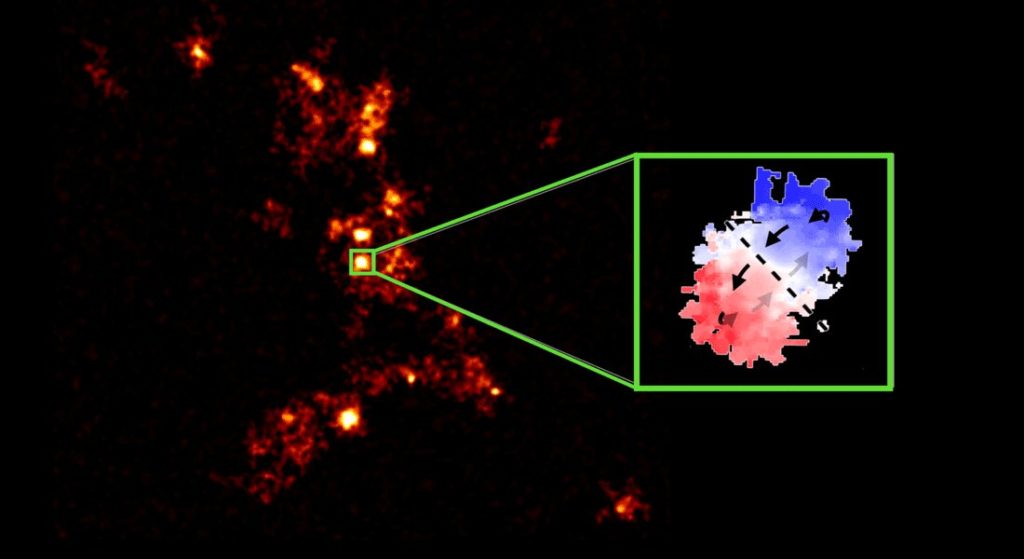 Galaxy W0410-0913 and a close-up image of gas rotation (gas approaching observers is highlighted in blue, gas moving away is highlighted in red). M. Ginolfi & G. Jones/VLT/ESO.
Stardust is heated by the energy of starlight andcentral black hole, causing it to glow and reveal the galaxy with its infrared thermal radiation. Since the evolution of a galaxy is largely dependent on its environment, astrophysicists used wide-angle instruments to study a region of the sky that is 40 times the size of the galaxy itself.
Observations have shown that W0410-0913 is surrounded by a swarm of at least 24 smaller galaxies. Based on the collected data, the researchers built a map of the three-dimensional movement of all galaxies.
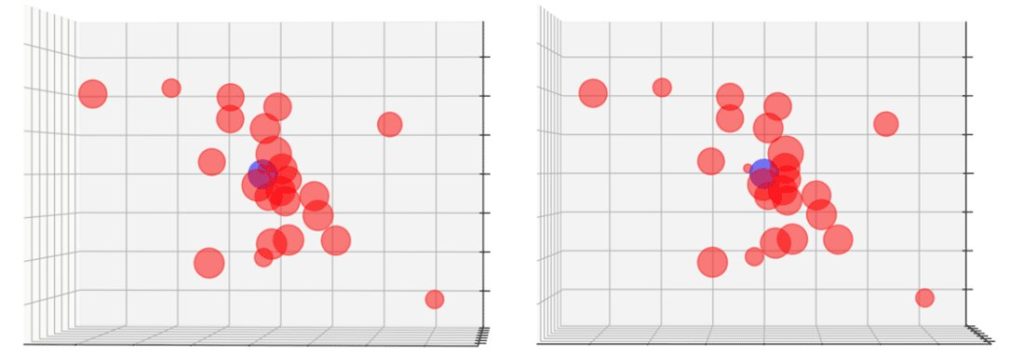 A 3D model of the satellite galaxies surrounding W0410-0913. Image: Peter Laursen, Niels Bohr Institutet, KU
Although W0410-0913 is visible in the early era of the universe,this galaxy is already 10 times heavier than the Milky Way. The traditional model suggests that to create a massive galaxy in such a short time, it needs to be fueled by the accretion of gas and satellite galaxies. This agrees well with observations of a swarm of smaller galaxies.
Surprisingly, ALMA observations givea picture of beautifully spiraling gas moving near the center of the galaxy at a speed of about 500 km / s. This means that even such powerful gravitational collisions can preserve the shape of the galaxy, and massive replenishment does not break, but only partially perturbs the spirals.
Read more:
The space plane will deliver cargo to the ISS and land at a regular "airport"
The star approached the black hole and it was torn apart: scientists observed this from three telescopes
Scientists have found traces of genetic mutations in the blood of every person who has been in space
On the cover:deep image of the early Universe taken by the Hubble telescope. Source: NASA, ESA, H. Teplitz and M. Rafelski (IPAC/Caltech), A. Koekemoer (STScI), R. Windhorst (Arizona State University), and Z. Levay (STScI)