On Monday, February 22, 2021, a large meteorite fell in the Canadian province of Alberta.This is
How did the solar system come about?
The solar system formed about 4.5 billion years ago from a dense cloud of interstellar gas and dust.At some point, it collapsed, possibly due to the shock wave of a nearby exploding star.When this happened, the solar nebula appeared.
Eventually, the pressure in the core became so great that hydrogen atoms began to combine to form helium, releasing enormous amounts of energy.This is how the Sun came to be, and in the end it collected more than 99% of the available matter.
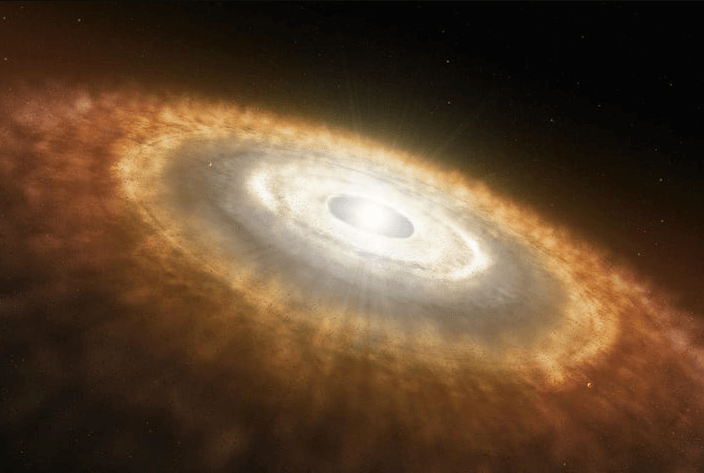 Artistic representation of a young star surrounded by a protoplanetary disk. Photo: ESO
From the remaining material, "lumps of matter" began to stick together, writes NASA.They crashed into each other, forming larger and larger objects.Some of them grew so large that gravity turned them into spheres, and so they became planets and large moons.
The order and location of the planet's other bodies in our solar system is determined by how the solar system was formed.The closest material to the star contains rocky material : only it could withstand the heat at the dawn of its birth.For this reason, the first four planets – Mercury, Venus, Earth and Mars – are small, with a solid rocky surface.
Meanwhile, ice, liquid or gas, has settled in the outer regions of the young solar system.Gravity pulled these materials together, giving rise to the gas giants Jupiterand Saturn, as well as the icy ones Uranus and Neptune.
The remaining rocky material became not planets, butasteroid belt near Jupiter. Other, smaller pieces of ice have become a cluster of icy objects that lies right at the edge of the solar system and halfway to the nearest stars. We are talking about the Oort Cloud. Scientists have yet to observe any objects there directly, but all the data that astronomers have received so far suggests that they are all made of ice.
What is the problem?
Theoretically, the very basis of understanding the origin of our solar system is built on the fact that in these remote areas there are only icy objects and, of course, nothing made of stone.
The situation changed last year whenAn international group of scientists, professional astronomers and amateur astronomers, led by Western meteorological physicists, took pictures and videos of a rocky meteoroid that flew across the sky over Alberta in the form of a dazzling fireball. After analyzing data about the object, scientists came to the conclusion - it originated from the middle of the Oort Cloud.
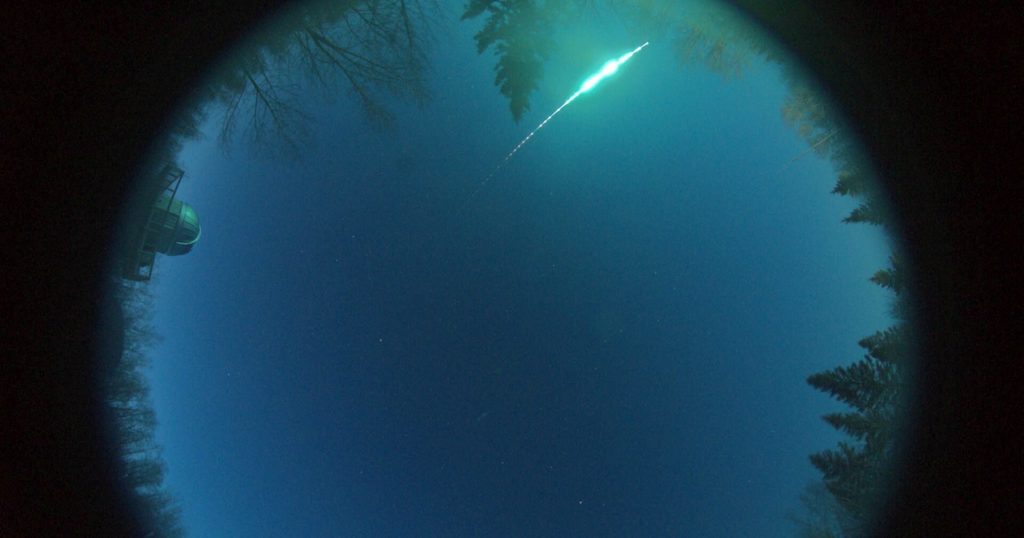 A fireball captured by the Global Fireball Observatory in Lake Miquelon Provincial Park, Alberta.
Credit: University of Alberta.
“The discovery supports a completely different modelformation of the Solar System, which suggests that significant amounts of rocky material coexist with icy objects in the Oort Cloud, scientists say. — The results of the study cannot be explained by the currently preferred models of the formation of the Solar system. They are a complete game changer."
Why do scientists think so?
All previous meteoroids came fromareas located much closer to the Earth. Therefore, an object that flew over Canada and covered enormous distances before meeting the planet’s atmosphere is truly unusual. Modern cameras of the Global Fireball Observatory (GFO) observed a rocky meteoroid the size of a grapefruit and weighing about 2 kg. Having carried out calculations, scientists have established that it is moving in an orbit in which only icy long-period comets from the Oort Cloud usually move.
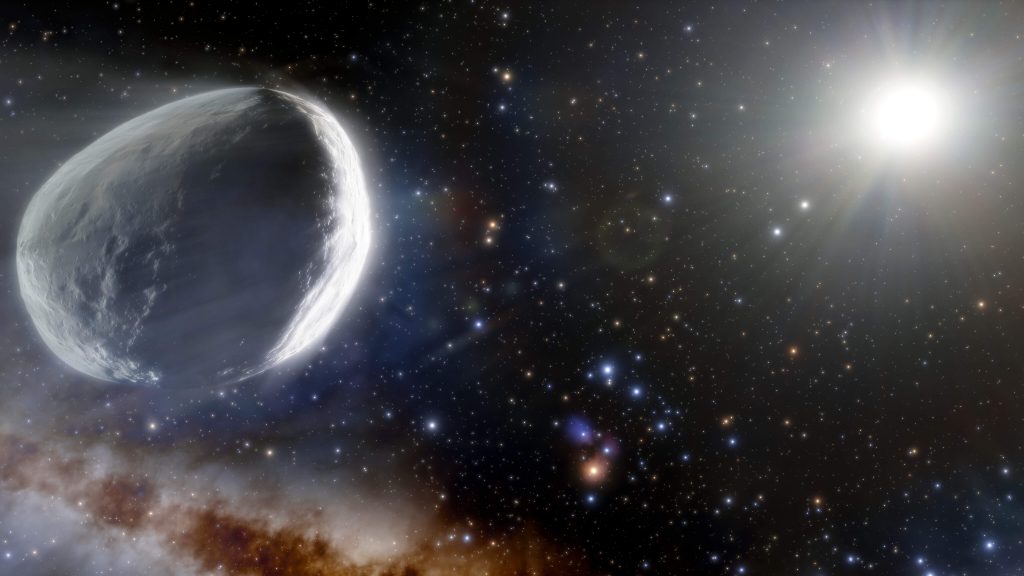 Comet C/2014 UN271 Bernardinelli — Bernstein, a long-period large comet from the Oort Cloud with an elliptical orbit,
“Over 70 years of regular observationsThe fireballs are one of the most unusual ever recorded,” explains Hadrien Devilpois, GFO principal investigator. Also during its flight, the Alberta Fireball plunged into the atmosphere much deeper than icy objects in similar orbits. In addition, it broke apart in the same way as stone meteorites.
What's the bottom line?
The meteoroid forced scientists to reconsidergenerally accepted models of the formation of the Solar System. Now scientists want to understand how the rocky object ended up so far from the Oort Cloud in order to “understand our origin,” experts explain. The more scientists learn about the conditions under which the solar system formed, the more data they will gain about what is necessary for the emergence of life.
Read more:
Does science exist in extreme conditions? We answer in numbers
Scientists have found out who benefited from the death of dinosaurs
Look at the photo of the Earth from space: it was made by the first private module