Paleontologists have discovered a third skull at the same site near Yunyang in Hubei Province in China.
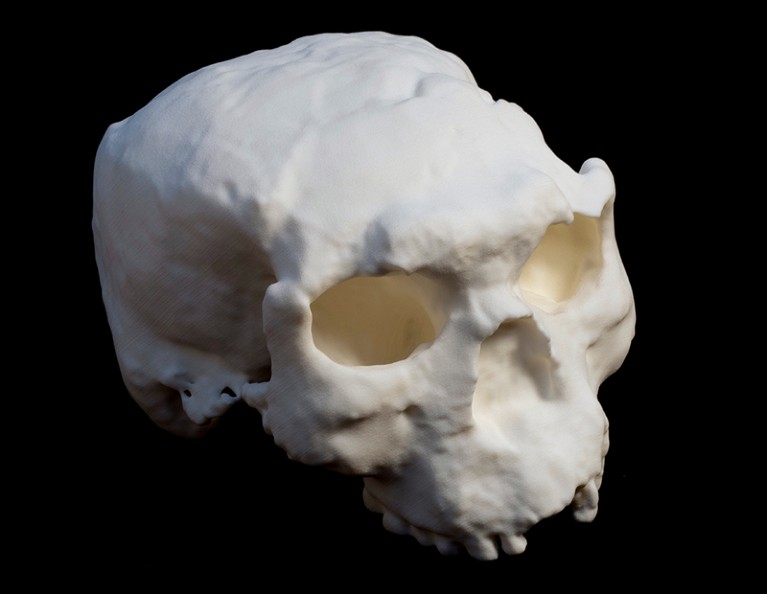 3D reconstruction of the skull of Homo erectus. Image: Pascal Goetgheluck/SPL
The new skull was discovered just 35 m from twoother similar finds discovered in 1989 and 1990, and are believed to belong to the same species of ancient people. It is still half buried in an upright position. Despite this, the researchers found a forehead, including the brow ridges and eye sockets, as well as the upper, back, and left cheekbones of the skull. It is not yet known whether teeth or the lower jaw are attached to the skull, scientists say.
The remains of Homo erectus, an ancient species that lived from800 thousand to 1.1 million years ago, have been found in various parts of Eurasia and Africa, but most of them are fragments of bones or deformed skulls, scientists say. This makes analysis difficult.
 Deformed skull of Homo erectus found at an earlier excavation site. Image: Alamy
Not surprisingly, evolution and distributionof this ancient species is still a mystery. Despite the fact that they all belong to the same species, the shapes of the skulls are different. Even the three skulls found in Yunnan have significant differences - some features make them related to more ancient representatives of the species from Africa, others to the "young" inhabitants of Asia.
Researchers are considering different theories:perhaps several populations developed independently in Asia, or they may have been the result of numerous waves of expansion from Africa. Scientists believe that preserved samples, like the new find, will help to better understand the history of the development of ancient people.
Read more:
The egg was dropped from space: look what happened to it
Brain-eating amoeba is spreading in the US: is there a danger to Russia
See what a woman Thora looks like. She lived 800 years ago
On the cover: illustration of a human skull in the Earth